I first learned about Noah Purifoy’s wondrous Outdoor Desert Museum while planning a trip to Joshua Tree National Park during the COVID pandemic. Museums, and most cultural outlets, were closed in Southern California where I live, and pretty much everywhere else, too. When I learned about an outdoor museum close to the town of Joshua Tree, I knew we had to go!
Welcome to Noah Purifoy’s Outdoor Desert Museum of Assemblage Sculpture.
After spending most of the day hiking in the strange but beautiful Joshua Tree National Park, we headed out for a look at another high desert gem—Noah Purifoy’s Outdoor Desert Museum of Assemblage Art. We drove through the small town of Joshua Tree, into the scrubby desert landscape, past large lots and small houses–more than a few surrounded by chain link fences. In this part of Southern California, pick-up trucks are far more popular than Porsches.
The high desert landscape is the perfect setting for Mr. Purifoy’s assemblage art. Shipwrecked is in the foreground with White House to the left.
Up and down the lonely roads we drove until our turn- off onto an unpaved road that ended in a dirt lot. A triumphal arch of tires spelling out W-E-L-C-O-M-E in a non- conformist way, let us know we had arrived.
Please don’t jump on the Band Wagon, 1995. Tempting as it is, visitors are asked to refrain from touching or climbing on the sculptures.
Bowling balls play a starring role in a number of Mr. Purifoy’s sculptures. Found materials of all kinds make up the monumental sculpture in the Outdoor Desert Museum, as in this work called Aurora Borealis.
I have been fascinated by assemblage art for a long time. Created from found materials, assemblage art personifies the old saying, “One man’s trash is another’s treasure,” and shows how a creative mind can make something provocative, beautiful, and meaningful from goods that might otherwise have been tossed on the trash heap. Noah Purifoy’s Outdoor Desert Museum of Assemblage Sculpture is the embodiment of that.
1996 Toilet Bowl Sculpture is just one of the 30 inventive and monumental assemblage sculptures on the 10-acre art site.
Too often, we find ourselves exploring these out-of-the-way places alone. We were happy to see others here experiencing these amazing art installations.
Purifoy’s work can be poignant and provocative. This piece is called White/Colored. Homelessness and shelter are among the social themes Purifoy explores in his work.
A renowned assemblage artist, Noah Purifoy first came to national attention with sculpture he created using burnt debris from the 1965 Watts Riots in Los Angeles. His work was part of 66 Signs of Neon, a landmark group exhibition that traveled across America and abroad from 1966- 1971.
Prominently positioned, The White House includes plumbing ware and bowling balls. It took Purifoy three years to create.
Free brochures lead visitors on a self-guided tour of the 10-acre site. Docent-led visits for groups can be arranged through the Noah Purifoy Foundation.
Purifoy was the founder and first director of the Watts Tower Art Center and was later appointed to the California Arts Council, a position he held for more than a decade. His work there included bringing art into California’s State Prison system under the Artists in SocialInstitutions program he initiated.
This piece, called Kirby Express, was created from old Kirby vacuum cleaners and bicycle parts among other things. Here’s Kirby Express from a different vantage point with Shipwrecked and Carousel to the left.
No Contest (Bicycles) is dwarfed by a Joshua Tree, the area’s namesake desert plant.
Long a fixture on LA’s art scene, Purifoy, who was born in Alabama in 1917, moved to Joshua Tree in California’s high desert in 1989. He began populating his 10-acre sculpture park with works of all shapes and sizes using materials ranging from discarded toilets to tires and just about everything in between. Industrial materials, clothing, wood, metal, rubber, concrete and old appliances all found their way into Purifoy’s art.
From the Point of View of the Little People, 1994.
Abstract, whimsical, inventive and thought provoking, Purifoy’s works are best experienced by a visit to his amazing desert museum.
Piles of old chairs became art in Purifoy’s wildly creative hands.
From 1989 until his death in 2004, Purifoy worked to create a public art space that continues to attract visitors from across the country and around the world. Admission to the sculpture park is free but donations are welcome. The Outdoor Desert Museum is open daily.
The Gas Station conveys a certain attitude. The White House is to the left.
Admission is free but donations are welcome.
Purifoy’s work can be seen at the Whitney Museum of American Art in New York, Los Angeles County Museum of Art, National Gallery of Art in Washington, DC, as well as other prestigious art institutions here and abroad. These eminent museums have long since reopened their doors, but visitors to Southern California may well want to head to the high desert to experience Purifoy’s final and very impressive body of work. Visit the Noah Purifoy Foundation for more information.
As a regular visitor to the Palm Desert area, I often wondered what was behind the big pink walls where Bob Hope and Frank Sinatra Drives intersect in Rancho Mirage. During Modernism Week I found out. Among the more than 350 events and activities offered during the 10-day tribute to Midcentury Modernism were tours of Sunnylands, the marvelous estate built by media mogul and philanthropist Walter Annenberg and his second wife, Lee.
The glass and Mexican lava rock midcentury marvel built by Walter and Lee Annenberg was conceived as a family home and high-level retreat for world leaders and luminaries from the arts, media and industry. Photo courtesy Annenberg Foundation Trust at Sunnylands.
Conceived as both a family home to escape winters in Wynnewood, PA, where the couple maintained their permanent residence, and an intimate, high-level retreat where leaders of government and industry could meet privately to address national and global concerns, Sunnylands has successfully filled both roles since it was completed in 1966.
The centerpiece of the 200-acre estate is a fabulous glass and Mexican lava rock 25,000- square-foot midcentury home designed by architect A. Quincy Jones. It’s hard not to “ooh and aah” when the front door of the historic main house opens onto the spectacular great room with its pink marble floors, prolific planting, outstanding art collection (Rodin’s Eve surrounded by 300 pink bromeliads will be one of the first things you’ll see in the central atrium), exquisite furnishings, and panoramic desert views.
Art Price’s Birds of Welcome, a favorite of the Annenbergs, greets visitors to Sunnylands.
Visitors on the 90-minute Historic House Tour, which is the only way to visit the home, learn all about the property and the people who designed, built, lived in and stayed at this wonderful estate. You’ll visit all of the rooms in the house including my personal favorite–the Room of Memories. It’s chock full of memorabilia marking momentous occasions, Christmas cards and thank you letters—some from British royalty, photos, portraits, and family mementos.
The Room of Memories has photos, portraits, letters, memorabilia, mementos and more documenting decades of visits to Sunnylands from famous guests and the historic role the house has played in U.S. history. Photo courtesy Annenberg Foundation Trust at Sunnylands.
The color-themed guest rooms (hint-Mrs. Annenberg’s favorite colors were yellow, pink and green), stunning dining room, cozy game room, and the kitchen, where visitors will get a peek at the incredible china collection the Annenbergs used to host dinners large and small, are all on the tour. Visitors also have access to the Annenberg’s private quarters, which were modified somewhat by Mrs. Annenberg after her husband’s death in 2002 at the age of 94.
Comfortable guest rooms were color-themed and included Mrs. Annenberg’s favorites– yellow, green and pink. Photo courtesy Annenberg Foundation Trust at Sunnylands.
You’ll also see the Inwood Room, redesigned from its original purpose as a patio, to hold many of the antiques Mrs. Annenberg brought to Sunnylands after closing their Pennsylvania home, Inwood. She wanted a place that reminded her of her home in the East.
The Annenbergs, known for their support of the arts, filled Sunnylands with masterpieces by artists including Picasso, Degas, Van Gogh, Cezanne, Monet, Renoir, Matisse, Rodin, Giacometti and Braque. Some of the paintings now on the walls are high-quality reproductions. Mr. Annenberg donated many of the original works to the Metropolitan Museum of Art in New York, where he was a trustee for many years.
This Kwakiutl totem pole was commissioned by the Annenbergs and is located on the estate’s private nine-hole golf course.
The grounds include a tennis court, private nine- hole golf course and no less than 11 lakes. Now operated by the Annenberg Foundation Trust, the estate has expanded to include 15 additional acres for the Sunnylands Center and Gardens, which opened in 2012. That’s the same year the property became accessible to the public.
Visitors to Sunnylands enjoy spectacular desert and mountain views. The private nine-hole golf course enjoyed by celebrities and world leaders is in the distance.
While Sunnylands served as the winter home of the Annenbergs, it was also designed to function as a private and intimate retreat for luminaries and world leaders. The guest list is as impressive as the property. Eight U.S. Presidents were among the notable visitors the Annenbergs welcomed to Sunnylands. Dwight Eisenhower, an avid golfer, was the first U.S. President to enjoy a round on the estate’s private course with Walter Annenberg.
President and Mrs. Reagan were good friends of the Annenbergs and frequent visitors to Sunnylands. Mr. Reagan was one of eight U.S. Presidents to have enjoyed their hospitality. Photo courtesy Annenberg Foundation Trust at Sunnylands.
Ronald Reagan, a good friend of the Annenbergs, was a frequent guest as President, and earlier, when he served as Governor of California. Along with his wife Nancy, a dear friend of Leonore “Lee” Annenberg, the Reagans were a fixture at the Sunnylands New Year’s Eve party for many years. Mr. Reagan held cabinet meetings and invited his top advisors to the estate. President Reagan’s treat of choice– Jelly Belly® jellybeans are still available in his favorite guest room. No detail that could add to a guest’s pleasure was too small to include at Sunnylands. Fun fact—the jellybeans are color-coordinated to match the bedding and upholstery!
The Yellow Room was President Reagan’s favorite. Jellybeans were always on hand–color coordinated to match the room, of course. Photo courtesy Annenberg Foundation Trust at Sunnylands.
Richard Nixon, who was also a long-time friend of the couple and another frequent guest before, during and after his presidency, spent a number of months in seclusion at the estate after his resignation. His poignant thank you note is on display in the house.
George H.W. Bush held the only State dinner ever hosted outside the White House at Sunnylands for Prime Minister Kaifu of Japan in 1990. They were able to negotiate some difficult trade issues in the relaxed setting Sunnylands provided. President Bush also enjoyed fishing at the estate and preferred the Green Room for its proximity to the lake for early morning angling.
President George H.W. Bush enjoyed early morning fishing in some of the 11 lakes on property at Sunnylands.
Presidents Gerald Ford, George W. Bush and Bill Clinton all enjoyed the Annenberg’s hospitality at Sunnylands. President Obama was a three-time visitor, meeting with Chinese President Xi Jinping on one occasion and Jordan’s King Abdullah II on another. He also held a summit with 10 Association of Southeast Asian Nations leaders at the estate, which resulted in the “Sunnylands Declaration.”
President Obama and Chinese President Xi Jinping were photographed strolling near the reflection pool shown here.
Appointed by President Reagan, Walter Annenberg served as U.S. Ambassador to the Court of St. James and was awarded an Honorary Knightship (KBE) so it’s no surprise that Queen Elizabeth II and Prince Philip, Prince Charles, and other members of the British Royal Family were visitors to Sunnylands.
Queen Elizabeth II and Prince Philip, shown here with Ambassador and Mrs. Annenberg, were guests at Sunnylands, along with other members of the Royal Family. Photo courtesy Annenberg Foundation Trust at Sunnylands.
U.S. Supreme Court Justices Sandra Day O’Connor and Anthony Kennedy, Secretary of State George Shultz, British Prime Minister Margaret Thatcher, Henry Kissinger, Barbara Walters, Colin Powell, Steve Forbes and other highly influential people from government, industry, media and the arts have all been feted at Sunnylands.
It hasn’t been all problem solving and high- level meetings at the estate though. Frank Sinatra wed his wife Barbara at Sunnylands and the couple were frequent guests at festivities there, including the social event of the year—the Annenberg’s annual New Year’s Eve party. Hollywood icons like Bob Hope, Bing Crosby, Kirk Douglas, Gregory Peck and Ginger Rogers have all been on the guest list. Photos capturing the Annenbergs and their famous friends at play are on display throughout the home.
All tours except the Open Air Experience must be booked in advance, online.
The historic main house can be visited only by guided tour, which must be booked online, typically one month in advance. Because access is limited, the Historic House Tour slots fill quickly. Plan ahead! This is the only tour that provides access to the home. Groups of seven are shuttled from the Visitor Center to the house for the 90-minute tour, which includes standing and walking—there is no sitting down and children under 10 are not permitted. Knowledgeable guides, many from local colleges, accompany visitors through the home and around the lushly landscaped exterior areas adjacent to the house.
Channel your inner Hollywood icon and imagine yourself preparing for a dip in the pool with some of the Annenbergs’ famous friends like Frank Sinatra, who was married at the estate.
There is a separate tour available for the grounds without prior reservations. The Open Air Experience is a 45-minute trip aboard an electric shuttle around the exquisite estate with visits to various outdoor locations such as the private golf course where visitors can see a Kwakiutl totem pole built especially for the Annenbergs, the Chinese Pavilion where Mrs. Annenberg entertained lunch guests, the Annenbergs’ final resting place, sculpture including Birds of Welcome by Art Price, and much more. The Foundation’s commitment to sustainability and the steps being taken to preserve and protect plant and wildlife species on the grounds are also discussed during the visit. The Open Air Experience can be booked on a first come-first served basis during a visit to the Sunnylands Center and Gardens and unlike the other tours, does not require prior reservations.
Birding tours on the Estate are also available and must be booked online, in advance. An experienced birder leads the 90-minute excursion and all levels are welcome to participate.
The Sunnylands Center and Gardens are open to the public free of charge.
There is no admission fee for the Sunnylands Center and Gardens, which opened in 2012 and is family-friendly. Inside the glass-walled building guests can enjoy a short film that tells the history of the estate and the Annenbergs. This is well worth viewing before visiting the house or in lieu of, if you haven’t been fortunate enough to reserve space on a tour. There are art and photo exhibitions, historic photos, and memorabilia on display.
Enjoy the gardens while having a snack or light meal at the cafe.
Sunnylands Center and Gardens are family-friendly, though the tours do have age limits.
There’s also a gift shop and a small café for a casual lunch or snack, which can be enjoyed indoors or outside at the tables overlooking the garden. On a recent visit, families were playing games and picnicking on the garden’s central grassy grounds.
Meandering paths take visitors through the Sunnylands Gardens featuring more than 70 native and drought-tolerant species.
The expansive gardens include a labyrinth for peaceful mediation, meandering paths, reflection pools and more than 70 species of native plant life. The native and drought-resistant plants used in the landscape are clearly marked for the enjoyment of amateur botanists.
Visitors can walk the labyrinth and enjoy quiet meditation at Sunnylands Gardens.
Tours are not conducted while retreats and meetings are taking place on the property. No photos are allowed inside the house due to security concerns. The Annenberg Foundation graciously provided the interior photos I’ve included here. Sunnylands is not open during summer months. Please visit their website for current tour dates and ticket information.
The Belem district is a fascinating and historic area of Lisbon that ought to be on every traveler’s itinerary—and it appeared that it was on the Sunday we spent there! Packed with monuments, museums and many of Lisbon’s “must see” spots, it’s just about five miles from the downtown area. It’s easy to reach via bus, tram or cab. We took a 10 Euro taxi ride for the 20-minute trip from Lisbon’s city center. The tram costs less but takes nearly an hour and with so much to see, we opted to save time.
There’s plenty to see and do in Lisbon’s busy Belem area.
Belem was the launching point for many sea voyages during Portugal’s Age of Discovery. The Tower of Belemwas the last thing sailors would see as they left port and the first site to welcome them home.
The Church of St. Jeronimos and its monastery are beautiful examples of the decorative Manueline architectural style.
Before setting off, many sailors would stop at the stunning Church of St. Jeronimosand its spectacular monastery to pray for a successful journey and a safe return. These gorgeous buildings are wonderful examples of the decorative Manueline architecture popular in Portugal in the late 1400s through 1500s.
St. Jeronimos and it’s spectacular monastery are among Lisbon’s most popular sites.
The entry fee for the monastery is 10 Euro and worth it. It’s stunning and surprisingly peaceful in spite of the crowds. Admission is free for the church. If you plan to attend mass, be punctual. We arrived late and no amount of pleading would make the guards open the church doors for us until services were over.
Visitors to the church can see the tomb of famed Portuguese explorer Vasco da Gama and the memorial to writer Luis de Camoes.
Entry to the Church of St. Jeronimos is free but there is a fee for the monastery.
We were directed to the end of a very, very long line. After standing around for quite some time, we realized there were no lines at the other end of the building and decided to go check it out. That’s when we found the National Archeology Museum.
Avoid the long lines at St. Jeronimos by buying a combo ticket for the Archeology Museum next door for an extra two Euro.
Here’s a tip we wished we’d known–walk right past those long lines in front of the monastery and church and make your first stop in Belem the National Archeology Museum.
The museum is full of ancient treasures and antiquities, some dating back to the Iron Age.
Buy a combo ticket for the museum and the monastery (the monastery is actually in the same building as the museum). For an extra two Euro, or 12 Euro total, you can enjoy the museum’s terrific exhibitions and avoid the crowds. The museum is a treasure trove of Egyptian, Roman, Greek, and Moorish artifacts. After touring the galleries, you’ll go directly into the monastery from the museum without waiting on the ever-present line.
This was the first megalith we saw and it inspired us to seek out the Almendres Cromeleque, home to 95 of these fascinating stones near Evora in the Alentejo area.
The museum has a rich collection of Egyptian, Greek, Roman and Moorish art and antiquities. Be sure to visit the Room of Treasures in the museum. No photography is allowed in that area but the display of coins and jewelry from 1800 to 500 BC is impressive.
After touring the galleries in the National Archeology Museum, you’ll enter the Monastery directly without waiting on any additional lines.
This fascinating time line inside the monastery captures 500 years of world history in words and images.
In spite of the crowds, there are numerous serene spaces within the monastery perfect for quiet contemplation.
You may notice long lines around the bakery just up the street from the monastery. If you’ve been to Portland, Oregon, this may remind you of the lines around Voodoo Doughnuts. I’m always amazed by the patience people seem to have in their quest for particular baked goods, but back to Belem…
Lines for Casa Pasteis de Belem snake around the corner. Worth the wait? You decide.
This is the place that claims to have the original and the best Pasteis de Belem. These are little custard pastries in a flaky filo- like crust. Locals say these are good, but you’ll have to decide if they’re worth waiting for. We didn’t, but we haven’t ever waited for doughnuts either. They sell Pasteis de Belem in the Starbuck’s next door without the wait, though buying them there doesn’t quite have the same cachet. You can find these delicious pastries all over the country though they’re called Pasteis de Nata (nata is cream) or Pastel de Nata, if you’re only having one, everywhere else except Belem. Try one or two and remember to add a healthy shake of cinnamon and powdered sugar on top!
Time for lunch or dinner? Turn down this little street to find Enoteca de Belem.
If you’re hungry for a meal, we highly recommend the Enoteca de Belem (+351) 213 631 511 Travessa do Marta Pinto, 12. Located on a little alley off the main street in Belem, this is a terrific choice for lunch or dinner. It’s very small so book a table or prepare to be disappointed.
We were delighted with our lunch at Enoteca de Belem. Here’s a peak at the menu.
Sitting at the bar gave us a chance to learn about and taste delicious Portuguese wines.
We sat at the bar since we had missed our reservation time—the museum and monastery were so fascinating we spent far longer than we had anticipated. The bar turned out to be perfect for us because in addition to a fabulous lunch, we had a great chat and learned quite a bit about Portuguese wines and history.
The perfectly prepared scallops with cauliflower puree and quail eggs were as delicious as they looked.
The freshly caught grouper was the fish of the day. Served with “clam rice,” it was an incredibly flavorful dish.
Portuguese cuisine often pairs fish and pork. The tender grilled octopus and spicy chorizo was perfection on a plate.
This classic dessert, Papo de Anjo, reminded us of an upgraded rice pudding. Comfort food at its best!
Our lunch was incredible and one of the best meals we had in Lisbon. Try the scallops to start and the grouper or cod if they have it.
When we asked for the wine list, we were handed these vintage binoculars and instructed to look around and choose whatever we were interested in from the shelves above the bar. There was a printed list, as well, but selections change regularly– thus the binoculars.
We opted for wines by the glass so we could sample several. The staff were well- versed in the wide selection available and happy to make suggestions and answer questions.
The knowledgeable staff will be glad to help you match the appropriate wines to your food selections.
Sailboats and other pleasure craft ply the waters off the embarcadero. The Hippotrip looked like Lisbon’s version of the Boston Duck Tours. Could be fun, but we didn’t try it.
Next, take a walk along the water down to the Monument to the Discoveries, which honors Prince Henry the Navigator, and was built in 1960 to commemorate the 500th anniversary of his death. Henry’s mother, Queen Filipa of Lancaster, Vasco da Gama, Magellan, King Manuel I and the poet Camoes are all depicted on the monument.
The busy waterfront is the perfect place to stroll and people watch. It’s possible to go inside the Monument to the Discoveries, which commemorates the 500th anniversary of the death of Henry the Navigator.
The Tower of Belem was the last bit of home Portuguese sailors saw as they set off to sea. It offers beautiful views but be prepared for long lines if you’d like to climb the 120 steps to the top.
Further on, you’ll see the famous Tower of Belem. It’s possible to climb 120 steps to the top of the tower for the views. Lines can be quite long. Let’s face it—there are lines for nearly everything you’ll want to see in this area so just be prepared for that. There’s an Atlas Hotel along the way with a nice terrace, perfect for an apperitivo if you’re ready for a break from touring– and the lines.
There is a lovely park near the waterfront and we happened to catch a good- sized open air market there on our visit.
On our walk back, we came upon an open air market selling everything from hand crafted ceramics, art and jewelry, to tea towels and mass-produced souvenirs. There was also a lively folk dance competition taking place in the park and we simply had to stop and watch for a while. It was delightful!
Troupe after troupe of talented folk dancers took the stage in the park. We joined the crowd to cheer them on.
Near the stage where the dancers competed, we spotted this pavilion. It was a 2012 gift from the Royal Thai Government to Portugal, celebrating 500 years of bilateral relations between the two nations.
We wished we had more time in Belem. We would like to have seen the Maritime Museum, Coaches Museum and the Ajuda Palace. Next time for sure!
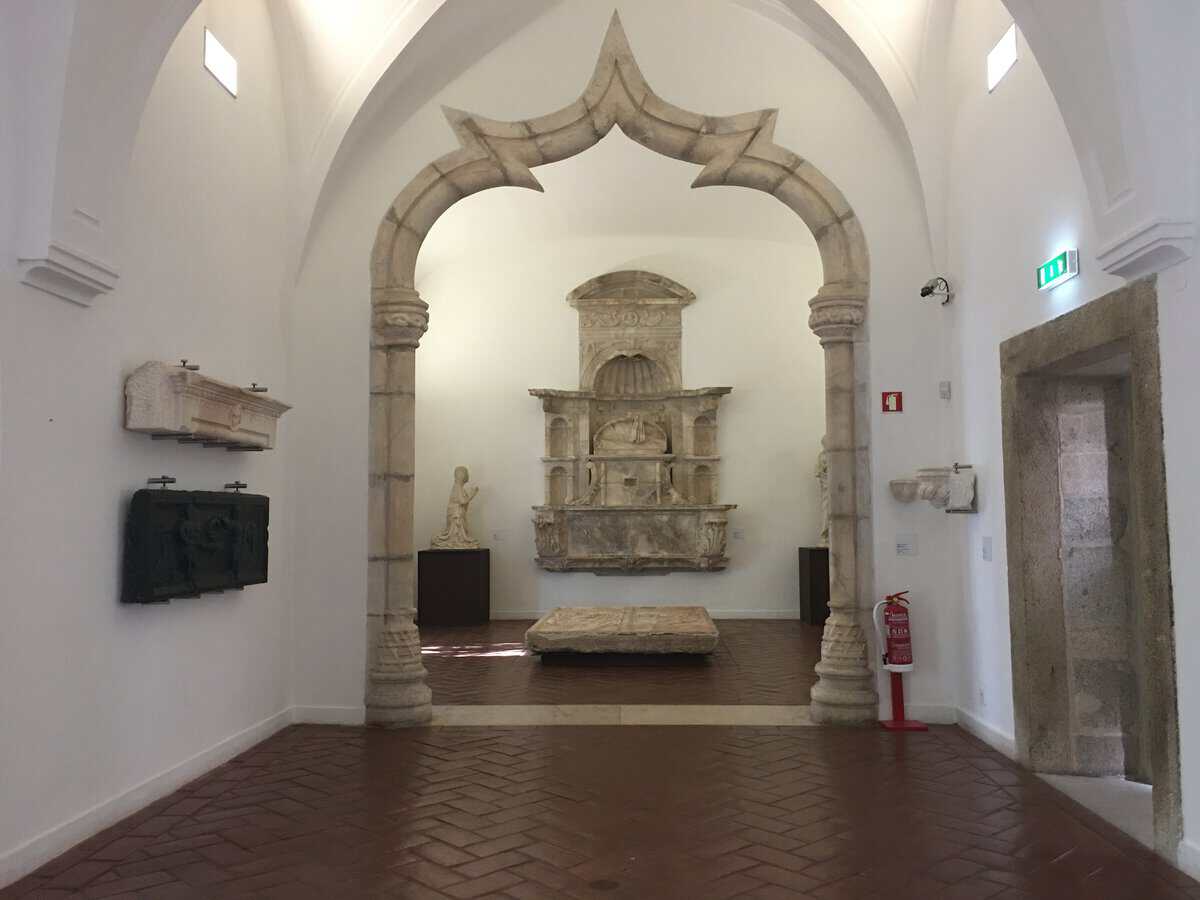
Lisbon’s Museu Nacional de Arqueologia has numerous treasures including megaliths.
We saw our first megalith in Lisbon’s Museum of Archeology and we were intrigued. What were these stones with their strange markings? Where could we see more of them? It turns out the largest collection of megaliths on the Iberian peninsula is located less than two hours from Lisbon in the Alentejo region not far from Evora, the area’s capital city.
Drive in the direction of Nossa Senhora de Guadalup through the beautiful forests of cork oak trees to reach Almendres Cromlech.
There are numerous places to see megaliths in Portugal, many in the Alentejo, but Cromeleque dos Almendres, or Almendres Cromlech, is the largest and most prominent site. Older than Stonehenge, Cromeleque dos Almendres is located about seven kilometers off the main road, the N114, driving towards Evora from Lisbon. We were heading to the Evora after Lisbon and decided to include a stop to see these archeological wonders.
The megaliths are in a large clearing, surrounded by cork oak trees.
Head in the direction of Nossa Senhora de Guadalup through the beautiful forests of cork oak trees. The dirt road is clearly marked with signs–Cromeleque dos Almendres and Menhir dos Almendres– directing you to the site. You will either need a car or a taxi to get here. There is no public transportation available.
Visitors can wander freely around the 95 remaining megaliths, or menhirs, at Almendres Cromlech.
About 95 of the granite megaliths, also called menhirs, still stand in the area and date back to the Neolithic Period (4th and 5th century BC). The stones at Almendres Cromlech are arranged to form two rings and visitors are free to wander all around the area, though touching the stones is discouraged.
The Cromeleque dos Almendres is older than Stonehenge.
It is believed that the earliest stones were placed here in 6000 BC and that ancient peoples used the area at Almendres Cromlech until 3000 BC for religious purposes. There is still a great deal of mystery surrounding the purpose of the stones, their placement and the markings on them, but there is speculation that the site had astrological significance due to its latitudinal location.
The placement, purpose and meaning of the megaliths remains largely a mystery.
There is a map of the enclosure on site, which identifies particular menhirs and describes various markings on the different stones.
Helpful signs in English and Portuguese explain the history of Almendres Cromlech and a map of the area shows where the most important stones are located.
This is identified as megalith number 1 on the posted diagram. The markings are clearly visible.
A careful examination is required to see the ancient markings on many of the stones. Here’s a close up look at one.
Admission to the site is free. Guided tours can be arranged.
We chose to take a self-guided exploration of the area but guided tours can be arranged. We met a Canadian couple who had hired a tour company to take them out to Almendres Cromlech and explain the mysteries of this ancient site and they thoroughly enjoyed their visit. Admission to the site is free and there is plenty of parking.
Portugal’s second largest city, Porto, or Oporto as the British called it, has a vibrant cultural scene, beautiful churches and a fascinating history, but for many, it’s all about the port.
Welcome to Porto!
Port!
Port and port tastings draw visitors from all over the world —after all, the city is named for the fortified wine. All the big port houses are here, along with smaller cellars worth investigating. Just across the river in Vila Nova de Gaia, you’ll find Sandeman, Taylor Fladgate, Grahams, Ferreira, Calem, Croft, Cruz, Ramos Pintos, Kopke, Cockburn and many others. Individual port houses vary in their offerings– there are guided tours, self-guided visits, port tastings, retail shops and several have restaurants on site.
The world- famous port houses Porto is named for are across the river in Vila Nova de Gaia.
Since there is so much to do in Porto and we had already spent time in the Douro Valley where the grapes for port are grown and the production of the fortified wine occurs, we decided to visit just one port house. We chose Taylor Fladgate because we also wanted to have lunch at Barao de Fladgate. Food is an important part of the travel experience!
Taylor offers a self- guided tour (with audio available in English) and port tastings in the garden afterwards. No reservations are needed for tours but they are required for lunch.
The self-guided tour, which includes a visit to the cellars, was fun and informative.Visitors learn about the history of the wine, the area it comes from, and port production through photos, a short film and exhibits at Taylor Fladgate.
We thoroughly enjoyed our tour, which covered the history and “how to” of port production, interesting information about the families behind the cellar, and included a short film, static exhibits, photographs, and a cellar visit.
Afterwards we were entertained by a group of peacocks and one very loud, very busy rooster who was clearly in charge, during our tasting in Taylor’s garden. There is also a well-stocked shop on the premises with relative bargains compared to the prices you’ll pay in the U.S. for ports of this quality.
Visitors have numerous choices for their port tasting. This fellow clearly ruled the roost and let those peacocks know it.
Taylor Fladgate is the only port house we visited in both our visits to Porto, so we can’t give details on the others, though Grahams was also highly recommended. Check with all those you’re interested in for specifics.
Many of the larger port houses have tours and tastings. Check individual websites for updated information and to make reservations where required.
A water taxi goes back and forth from Porto to Vila Novo de Gaia for about 3 euro. It’s a short but pleasant ride and sometimes you can see the local boys jumping off the lower level of the Eiffel Bridge to the river below.
Taking a water taxi is a nice way to cross the Douro after port tasting and exploring Vila Nova de Gaia.
If you are a serious port person or just want to learn more and sample some of Portugal’s best known export, look into a visit at the Douro and Port Wine Institute’s Interpretive Center. A word of warning – port is a high alcohol, fortified wine so taste judiciously.
Museu Serralves– Contemporary Collections
A peek inside the enormous Anish Kapoor installation.
As we said, there’s much more to Porto than port. For contemporary art lovers, the Museu Serralves is a top draw. The museum, which showcases contemporary art from the 1960s through the present, recently celebrated its 30th anniversary. Its vast collection includes more than 4,400 works either owned by the foundation or on long- term loan. Located in a beautiful park-like setting, it’s easy to reach by public transport, cab or Uber.
There are more than 4,400 works of contemporary art in the Museu Serralves’ collections.Numerous models of famous works by Anish Kapoor, including Cloud Gate, informally known as the Chicago “Bean”, were on exhibit when we visited the museum. The Incredible Hulk has international appeal.
There was so much to see and experience, we wound up spending almost all day at the Museu Serralves.
Some visitors practiced yoga and danced inside this Kapoor installation.
Museu National Soares dos Reis–– Porto’s First Public Art Museum
The oldest museum and first public art museum in Porto, the Museu National Soares dos Reis has been located in the beautiful 18th century Carrancas Palace since 1940.
“The Presence of History” by Pedro Valdez Cardoso, greets visitors at the Museu National Soares dos Reis. Duct tape and found objects were used to construct the sculpture. A 1934 terracotta sculpture by Canto da Maya is one thousands of pieces on display at Porto’s very first public art museum.
The museum was created as a repository for confiscated property seized when monasteries in Porto and other Portuguese cities, like Coimbra, were dissolved by the government.
The museum was created to house art and other treasures like these, seized when the government dissolved monasteries throughout Portugal.Ceramics, glassware, textiles and furnishing are among the decorative arts on display here.
The museum’s collections include sculpture, paintings, textiles, furniture, ceramics, jewels and works such as a Roman sarcophagus found in the Alentejo region dating from the 3rd century, an 18th century French tapestry that tells the life story of Portuguese explorer Vasco da Gama, and contemporary sculpture by Portuguese artists like Pedro Valdez Cardoso.
Portuguese Centre of Photography
Stories of spycraft, crime and photography converge at the Portuguese Centre of Photography near the Torre dos Clerigos. Yes, there are photo exhibits, but there’s much more in store for visitors here. The building itself, a former prison, is part of the story.
Housed in a former prison, the Centre of Photography includes exhibits about the people once incarcerated here.
Visitors can see cameras of every description including rare daguerreotypes, antique wooden cameras, spy cameras, and even disposable cameras. There are also exhibits about the prison and the people incarcerated within its walls, including political prisoners during the dark days of Salazar’s reign.
The Centre of Photography has special exhibitions as well as a permanent collection for visitors to enjoy.
The museum has revolving photo exhibitions as well as a permanent collection. We saw a fascinating exhibit of photos by and about the artist Frieda Kahlo.
Spy cameras used during Salazar’s tenure are on display along with vintage cameras and much more at the Portuguese Centre of Photography.Former prison cells now house exhibitions at the Portuguese Centre of Photography.
Clerigos Tower– Torre dos Clerigos
While you’re in the area, consider a visit to the Clerigos Tower–– Torre dos Clerigos. A beautiful example of baroque architecture and a national monument since 1910, the tower offers expansive views of Porto.
Take a tour of this beautiful baroque landmark, a national monument since 1910.
Free or guided tours of this Porto landmark are available.
Se do Porto — The Cathedral of Porto and Churches Worth a Visit
A view of Porto’s Cathedral, or Se, at the top of the Praca da Batalha.
The Catholic Church has a major presence in Portugal and Porto has many marvelous churches filled with exquisite paintings, sculpture and azulejos. Visit the magnificent Porto Cathedral (Se do Porto) located in the Batalha area, the highest point in the city for the art and the views.
Though you’ll often read travel stories where you may be directed to “visit the Se Cathedral”, Se is the Portuguese word for cathedral, like duomo in Italian. Igreja means church. It is free to enter the Se but there is a small fee to visit the tower.
Inside the opulent Se do Porto, resplendent in gold and silver.
The Church of St.Francis or Igreja de Soa Francisco, Igreja do Carmo and the Carmelitas Church right next door, are also worth a visit.
Stop into Porto’s beautiful churches for some quiet reflection and to enjoy the art treasures within.
Located in Porto’s historic center in the building it has occupied since the mid 16th century, MMIPO, the Museum of the Church of the Misericordia is worth a visit for its paintings, sculpture, religious articles and exhibits that tell the history of Porto’s Holy House of Mercy and the city itself. A visit to the museum includes entry to the church and is the only way to see it.
Porto’s Museum of the Church of Misericordia or Holy House of Mercy includes admission to the church, as well as the opportunity to view the fine art on exhibit.
Shop
If retail therapy is what you’re after, head over to Rua Santa Catarina. Santa Catarina is Porto’s main shopping street and is in the highest part of town, beginning at Praca da Batalha.
Busy Rua Catarina is Porto’s main shopping thoroughfare and is limited to pedestrian traffic.
You’ll find all the well-known international brands and plenty of smaller, local stores along the busy street, as well as cafes and coffee shops including the famous MajesticCafe.
The Majestic Cafe, open since 1921, is still a popular spot for coffee or a light meal.
Nearby, you’ll find Porto’s main market —Mercado do Bolhao. This is the place to pick up picnic provisions. If you’re lucky enough to have lodging that includes a kitchen, you can find fresh produce, charcuterie, cheeses, meats, and fish—everything you need to make a marvelous meal.
Sao Bento’s Azulejos
If you arrive in Porto by train and happen to come into the Sao Bento railway station, you’ll be treated to a remarkable display of azulejos – the fabulous blue and white tiles so famous in Portugal. Many people come to the station just to see the tiles, as we did.
The beautiful azulejos at Sao Bento rail station tell the story of Portugal and Porto’s rich history.
Rua da Ribeira Negra– Buskers, Bars and Boat Rides
The Rua da Ribeira Negra area is very busy and touristy but it is fun to walk along the river and enjoy the buskers and people watching. We saw people dancing, making music, and performing magic tricks.
The Rua da Ribeira is a lively area on the riverfront with cafes, bars and buskers.Buskers sang, danced, performed magic, and blew giant bubbles hoping to collect tips from tourists on the Rua da Ribeira.
Most boat rides on the Douro River depart from Rua da Ribeira. We took an hour- long cruise–it was a nice ride and especially fun on a hot day! We did not book ahead—boats run regularly and there are a number of companies offering the same rides at the same prices. We picked the one leaving the closest to the time we wanted to go.
A boat ride on the Douro was the perfect antidote to a hot summer day.Pick the river cruise that suits your departure time and length of journey. Most companies offer the same itineraries and rates.
Souvenir vendors line the riverfront. If you’re looking for cork products, tea towels and “typical” Portuguese goods, you’ll find them here.
Souvenir shopping under the Eiffel Bridge in Porto. Shopping for tea towels for their new life together?
Sleep
Here, as in most cities, there are lodging options for all tastes and budgets. We stayed at the Eurostars Porto Douro just a 10- minute walk along the river to the Rua da Ribeira Negra area. The hotel is comfortable, clean and well- priced. Our large room had a little kitchenette perfect for making a cup of tea or a snack and the view from our balcony of the Eiffel Bridge, the boats and people passing up and down the river was unbeatable.
Our spacious corner room had a fabulous river view from the balcony.We only made tea, but the kitchenette was a nice addition to our room.
Breakfast was included in our rate and offered everything we could want from hot dishes to yogurt, fruit and pastries, including the Portuguese specialty pasteis de nata. The clientele was international and Americans were definitely in the minority here. We met some terrific fellow travelers and the front desk staff couldn’t have been more helpful.
The hotel has a well-priced laundry service (shirts were about 7 Euro), important since we rarely check luggage. There is not a full-service restaurant at the Eurostars but there is a bar serving light fare. There’s also a rooftop terrace with spectacular views and bar service during the summer months.
We enjoyed wonderful views up and down the river from the rooftop terrace at the Eurostars.
We also enjoyed a too-brief stay at the historic Infante Sagres Hotel in the heart of Porto. After an absolutely awful experience with the Rosa Et Al Townhouse’s self-catering apartment on our first visit to Porto, we sought refuge at this magnificent grand dame of a hotel with its lux lobby and beautifully appointed rooms. The elevator has vintage alligator- covered seats so guests can sit and enjoy the ride!
Old world luxury is a hallmark at the Infante Sagres in Porto.Local Portuguese marble was used floor to ceiling in our spacious bathroom.A comfortable bed in a blissfully quiet room was just what we needed after a very long day.
We were lucky to get even one night here at the last minute on a sold-out weekend. Somehow the front desk staff managed to book the next four nights for us at the Eurostars. We will always be grateful for their kindness.
The sumptuous breakfast buffet at the Infante Sagres can be enjoyed in the dining room or peaceful courtyard.
Whether port is your preference or art floats your boat, lace up your walking shoes and discover the myriad charms Porto’s winding, cobbled streets have to offer.
The Vasco da Gama bridge led us away from lively Lisbon to the rural beauty of the Alentejo.
An easy 90- minute drive southeast of Lisbon takes you to the expansive Alentejo region. Home to medieval villages, castles, palaces, pousadas, megaliths, wine producers, and vast agricultural lands, this beautiful area has something to please nearly all visitors. We made Evora, the capital of the region, and a UNESCO World Heritage Site, our headquarters. This delightful small city is a great base from which to launch day trips to the many attractions in the area.
The Alentejo’s capital city is best explored on foot– wearing comfortable shoes, of course.
Remember to look up as you wander!
The historic city of Evora has interesting sites and several museums to explore. Just walking the winding streets is a fine way to spend a day, especially in the area around the Largo Conde de Vila Flor. After a pleasant stroll through the Praca do Giraldo, Evora’s bustling main square, we considered our options.
The busy Praca do Giraldo is at the heart of the city. Numerous shopping streets fan off from the Praca.
Cork is king in the Alentejo and is featured in souvenirs from sandals to handbags.
Portuguese pottery is also a popular souvenir.
Time was short so we had to make choices. We decided to save the Contemporary Art Museum for our next visit and headed over to the Museum of Evora, which was hosting a Chinese porcelain exhibition along with its permanent collections.
The Museum of Evora is housed in a former Episcopal palace built in the 17th century.
Beautiful Azulejos tiles line the stone staircase inside the museum.
Teapots, serving pieces, jewelry and other treasures from China are featured in the current exhibition at the museum.
Placards describe the fine Chinese porcelain plates on display in Portuguese and English.
The museum features paintings from the 15th through 19th centuries, drawings, engravings, 17th and 18th century furniture, and Roman sculpture from the 1st and 2nd centuries.
The museum is known for it’s 17th and 18th century painting and sculpture. This piece is by Antonio Teixeira Lopes.
Religious articles, like St. Blaise’s arm reliquary from the 17th century, are part of the permanent collection.
Visitors can see this striking bronze sculpture, statuary, mosaics and other artifacts from the Roman era.
Interesting archeological finds from the Neolithic Age and a collection of silver and gold religious pieces, and jewelry are also on display. There were few visitors on the day we were there.
Antiquities from numerous ancient civilizations are on view.
Artifacts from the Roman era line a courtyard hallway.
Just outside the museum is the Roman Temple from the 1st century AD. Today, the ruins are undergoing restoration and are under wraps, but it is possible to see several of the Corinthian columns.
The Roman Temple which dates from the 1st century is mentioned in all the guide books, but until the restoration is complete, there isn’t much to see.
There is a small park behind the temple that offers nice views over the area beyond Evora and across the way you’ll find a lovely pousada, once a monastery that is now an upmarket hotel called Pousada dos Loios. Feel free to wander inside and take a step back into Portugal’s past. The restaurant here is open to the public.
Here’s a peek at the courtyard and restaurant at Pousada dos Loios.
This small park behind the Roman Temple provided a nice place to relax and enjoy the views over the city and surrounding countryside.
Many people line up at Evora’s Church of St. Francis to visit the Chapel of the Bones or Capela dos Ossis. The 16th century chapel displays the bones and skulls of monks. We’ve seen the creepy Capuchin Crypt in Rome so felt no need to stop in after our visit to the church. The public gardens beside the church were much more appealing.
Inside the Church of St. Francis.
The Chapel of the Bones is a popular tourist attraction inside the Church of St. Francis.
If you have time, stop into Evora’s Cathedral or Se. It’s one of the largest medieval cathedrals in Southern Portugal and is said to be built on the site of a former mosque.
Here are the marvelously mismatched spires of Evora’s cathedral.
Close to the Church of St. Francis, you’ll find Evora’s morning market. The market is indoors and was smaller than some we’ve visited, but we also arrived fairly late in the morning after many of the vendors had closed up shop. Happily, there were several purveyors of tasty cheeses, cured meats, and fruits and vegetables still open.
Many vendors had already packed up and gone home by the time we arrived at the market but there was still plenty to choose from.
Everything you need for a nice picnic is right here–local pork products, sheep and goat’s milk cheeses and other tasty treats.
Evora has lodging options to fit many budgets and preferences. We chose to stay at two very different, but both delightful properties in and near the city. We began our stay at the lovely Albergaria do Calvario, just inside the walls of the city [email protected].
We enjoyed our stay at the small, well-located Albergaria do Calvario.
Located just inside the ancient Roman walls, it was easy to walk all around the city and access the freeway quickly for daytrips from our hotel.
The location made it easy to walk to Evora’s important sites as well as to dinner each evening. It was also convenient to reach the freeway for our day trips further afield. We’ll discuss dining and day trips in additional posts.
The comfortable bar area welcomes guests for drinks and light bites.
Ours was a large, comfortable room with a big balcony overlooking the hotel’s courtyard where many guests enjoyed breakfast, aperitifs, and conversation. Rooms vary substantially in size so be sure to explore your options when booking.
Our room was large and bright with a huge balcony overlooking the courtyard.
The marble used here is mined nearby. There is a Museum of Marble in Vila VIcosa we”ll visit next time.
There is no restaurant per se in the hotel, but they do provide a substantial breakfast buffet and have small meals, snacks, and drinks on offer in the bar. Anything ordered can be enjoyed in the courtyard, the bar area or one of the comfortable sitting areas.
This is just a small part of the bountiful buffet breakfast greeting guests each morning.
The courtyard provides a pleasant place to enjoy breakfast, drinks, or just relax.
Friendly staff are happy to help with restaurant bookings, excursion ideas or whatever you need to make your stay memorable.
The staff is extremely helpful and will even park and retrieve your car for you. Parking is available onsite at no additional charge. Laundry service is also available at a very reasonable price. The only thing we missed at this charming, small hotel was a pool, but we got that at our next hotel–Convento do Espinheiro Hotel & Spa.
Welcome to the Convento do Espinheiro.
We also spent several nights about 15 kilometers outside of Evora at the stunning Convento do Espinheiro. The converted convent was built in 1458 and when we stayed, was part of the Luxury Collection group managed by www.starwood.com. The property has traditional rooms in the original buildings as well as two modern wings.
We had a large room in the modern wing of the hotel, complete with a nice balcony.
We enjoyed our stay in the modern wing where we had a very large room with a balcony and views over the property towards to the inviting swimming pool. After nearly 10 days of non-stop touring it was the perfect place to take break.
The pool provided the perfect place for relaxation, lunch, drinks and a refreshing dip.
There is also an indoor pool and a nice spa on site where I enjoyed a relaxing massage. There are tours given daily of the expansive Convento which covers the property’s fascinating history.
Ancient olive trees dot the property which dates back to 1458.
These stone benches have been here since the property was a functioning convent.
There is no charge for the tour, which includes a visit to the beautiful church (still in use), monk’s cistern where a complimentary wine tasting is held each evening, the former dining area and kitchen, as well as the vaulted storage cellar which now houses the hotel’s terrific restaurant.
Convento do Espinheiro was one of the three wealthiest convents in Portugal. The church is still in use today.
The bells, one original, ring out to announce a wedding has taken place.
The wine cellar is housed in the monk’s former cistern, which was once filled with water.
A complimentary wine tasting take place each evening at 6 p.m. in the wine cellar.
We ate dinner there each night of our stay. The food is artfully prepared and beautifully presented by top-notch staff. Be sure to reserve for dinner or prepare to be disappointed—the dining room fills up. Should you choose to go offsite for your dinner and prefer not to drive, the helpful staff can arrange for a taxi into Evora.
Fresh local fish elegantly prepared is served with flair.
Luscious lamb chops with squash puree are featured on the menu.
Save room for dessert.
Where monks once stored their wine, olive oil and honey, hotel guests now enjoy a bountiful breakfast buffet. It is possible to enjoy your morning repast out on one of the terraces or in the courtyard area, as we did.
The former storage for olive oil, wine and honey, now serves as the hotel’s elegant dining room.
We also arranged to see some of the traditional rooms including the “royal suite” used by many honeymoon couples. It is truly spectacular in a beautiful old-world way and features a contemporary bathroom and private rooftop terrace.
The “royal suite” often used by honeymooners offers old world charm and opulence.
The suite’s bathroom features modern fixtures like this free standing tub.
A private rooftop terrace, one flight up from the suite provides glorious views of the area around the Convento.
If your travel plans include a trip to Portugal, don’t miss the beautiful Alentejo. We’re looking forward to our return to this fascinating area.
Florence’s Il Grande Museo del’Opera del Duomo has nothing at all to do with opera. Instead, it is all about the work, or opera, involved in building, preserving and maintaining one of the most recognizable Renaissance buildings in the world—Florence’s Duomo, also known as the Cathedral of Santa Maria del Fiore.
A spectacular view of Brunelleschi’s dome from Caffe La Terrazza.
If you’ve ever wanted to see how Brunelleschi’s magnificent dome was constructed, learn what the other options were for the Duomo’s facade, or see the remarkable art treasures once housed in the cathedral, this is the place to come.
Welcome to the recently reopened and reimagined Museo del’Opera del Duomo.
Soaring galleries give visitors a new perspective on the superb sculpture on display at the museum.
Re-opened in October 2015 after years of restoration and reconstruction, the Museo dell’ Opera del Duomo has an exquisite collection of sculpture, paintings and other masterworks displayed on three floors in 6,000 square meters of exhibit space, all designed to showcase the art to its best visual and historical advantage.
A visitor gets an up close look at a statue in the museum.
Most of the works were at one time in, or outside the Duomo.
These sculptures once graced niches in Giotto’s bell tower.
Some of the treasures to be found include the original North Doors created by Lorenzo Ghiberti for the Baptistry of San Giovanni along with the Doors of Paradise by Lorenzo and Vittorio Ghiberti. Replicas now hang on the Baptistry.
Ghiberti’s stunning Doors of Paradise and North Door once graced the Baptistry of San Giovanni but can now be found inside the museum.
Detail of door.
In all, the museum boasts 750 works of art covering 720 years of history.
Arnolfo di Cambio’s stunning Christ with the Soul of Mary
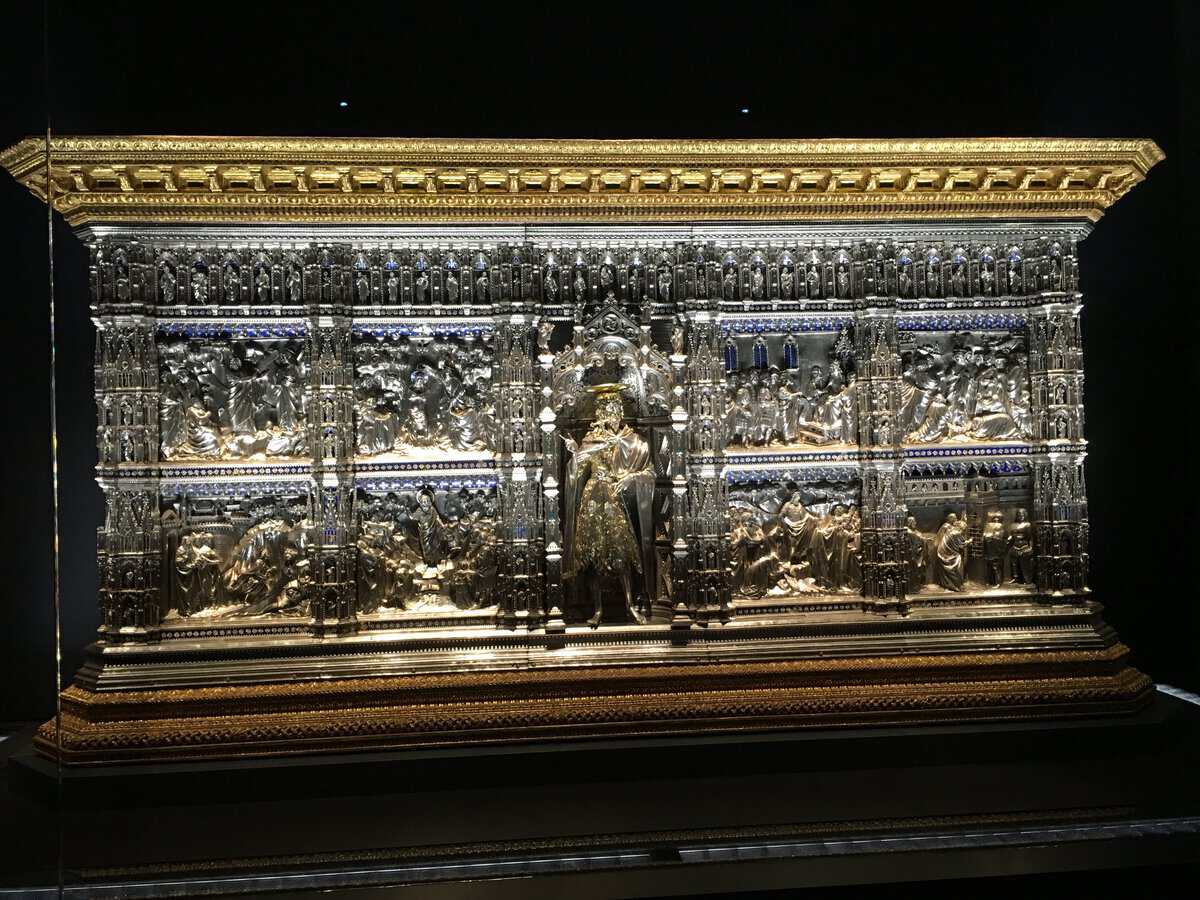
This exquisite silver alter features scenes from the life of John the Baptist and was created by Lorenzo Ghiberti, Betto di Geri, Bernardo Cennini, Antonio di Salvi, Francesco and Leonardo di Giovanni, Antonio del Pollaiolo and Andrea del Verrocchio.
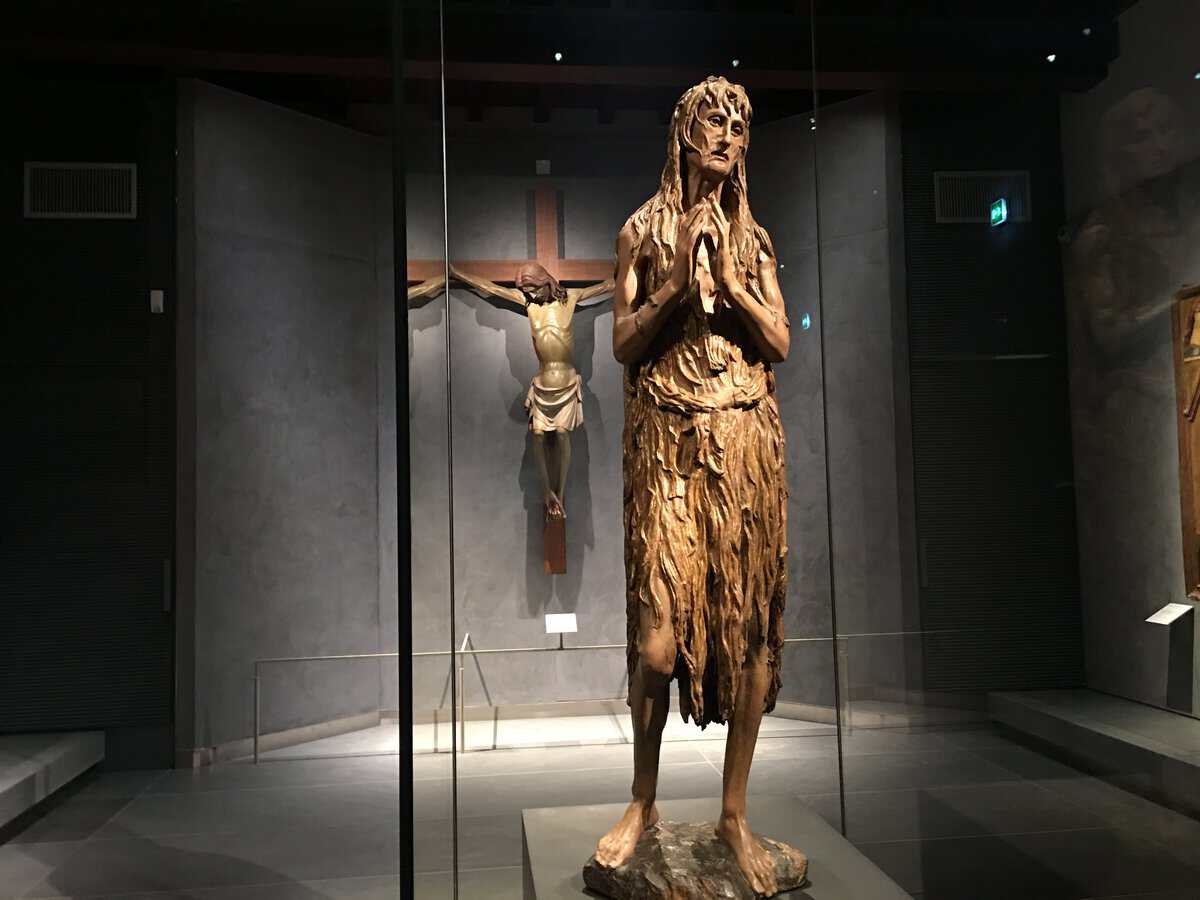
Michelangelo’s poignant pieta, sculpture by Donatello including his magnificent Mary Magdalene as Penitent, and works by Andrea Pisano, Antonio Pollaiolo, Arnolfo di Cambio and other highly regarded Medieval and Renaissance artists are on display.
Michelangelo sculpted this pieta for his own tomb. He later destroyed it. It was reconstructed and acquired by Cosimo de Medici In 1671 and placed in the Duomo in 1722. It was the next to last sculpture Michelangelo ever created.
Donatello’s Mary Magdalene as Penitent draws many visitors.
Sacred items and iconography are part of the museum’s extensive collection.
In the Cappella Musicale, or music gallery, you will hear enchanting sacred music, and find works by Luca della Robbia and others, as well as rare illuminated music books.
Beautiful music fills this gallery where rare illustrated books, sacred objects and art treasures are displayed.
Brunelleschi’s dome, still considered a marvel of engineering, remains one of Florence’s most iconic monuments.
Models of Brunelleschi’s dome show how it was built and why it remains an engineering marvel.
In addition to the art treasures, the museum contains original building materials, equipment and tools, dating back to the Duomo’s 15th century construction.
Wooden pulleys, ropes and other original construction equipment used to build the Duomo can be seen at the museum.
Original 15th century tools and equipment used to build the Duomo are displayed near a continuously running film that explores the design and construction.
Also featured are drawings and models of the dome and Giotto’s bell tower, which was begun in 1334, after Giotto’s death. An outdoor terrace offers splendid views of the dome.
Brunelleschi’s wooden model of the dome fascinates visitors.
A detailed model of the bell tower designed by Giotto is on display near beautiful stained glass windows created by notables including Ghiberti, Donatello, Paolo Uccelli and Andrea del Castagno.
Visitors to the museum will learn about the history of this spectacular cathedral, designed by Arnolfo di Cambio and dedicated in 1412. The name Santa Maria del Fiore means St. Mary of the Flowers or Virgin of the Flowers. Once the largest church in all of Europe, today it is third in size, after St. Peter’s Basilica in Rome and London’s St. Paul’s Cathedral.
A film called Courage to Dare about Florence during the Renaissance and the creation and construction of the Duomo runs continuously in the museum.
A number of possibilities considered for the Duomo’s facade are on display, including this one.
Combination tickets can be purchased for the Duomo Museum, the Baptistery, the bell tower and the Crypt of Santa Reparta, named for the 7th century church that once stood on the site of the Duomo. There is no charge to enter the Duomo, but paid tickets are required for visitors who wish to climb the more than 400 steps to the top of the bell tower.
The Baptistry of San Giovanni always draws crowds. Tickets are required to enter.
Appropriate clothing is essential for entry. In other words, no shorts, short skirts or skimpy, shoulder baring tops on women or men. Bulky bags and backpacks must be checked. Visit www.ilgrandemuseodelduomo.it for information on ticket prices, hours and tours.
Admission to the Duomo is free but take care to dress appropriately or you will be denied entry.
On our visit, we also had free access to a photographic exhibition called Opera di Viva by Michele Pecchioli, which paid tribute to the hundreds of men and women who have worked to preserve the artistic integrity and cultural heritage of the building and the art works within for more than 700 years.
Michele Pecchioli’s photographs pay tribute to the men and women who restore and preserve the art and cultural heritage of Florence’s iconic Duomo.
The photos feature the restorers, artists, employees and security guards who play a role in safeguarding these treasurers and ensuring public access to the works for years to come. Note: This was a temporary exhibition and may now longer be available for viewing.
A close up of a security guard charged with safeguarding the priceless treasures at the Duomo and its museum.
When the sun begins to set in Florence, head over to Piazzale Michelangelo for another perspective on the Duomo —and enjoy the gorgeous vista across the Arno over the city.
Some of the most spectacular views of Florence can be had from the Piazzale Michelangelo. Don’t miss a visit to the beautiful San Miniato al Monte across the street. It’s the oldest church in Florence, after the Baptistry.
Florence’s Duomo viewed from Piazzale Michelangelo.
The department store La Rinescente has a terrace restaurant with fine views of the Duomo, as well as drinks and light fare.
If you crave an aperitivo with your sunset and Duomo views, go to La Rinascente, the department store on Piazza Repubblica. Go directly up to La Terrazza on the top floor and you’ll find a little rooftop café/bar with great views of the city and the iconic dome. It gets crowded so get there early or be prepared to wait.
Sensational sunset view over the Piazza della Repubblica from Caffe La Terrazza.
Descend the staircase in the stunning Palazzo Spini Feroni, which houses the flagship Ferragamo store and serves as company headquarters, and you’ll be greeted by walls of Salvatore Ferragamo’s strikingly beautiful shoes, artfully displayed, of course. Though they play a major role in the Museo Salvatore Ferragamo, a marvelous small museum on Florence’s posh Via Tornabuono, there’s much more to see than fabulous footwear.
Ferragamo’s shoes may themselves be considered works of art.
The Museum tells the story of the man, who grew up outside of Naples, the eleventh of 14 children and became “shoemaker to the stars”; the company, which became synonymous with beautiful and comfortable shoes that were widely imitated; and the city of Florence itself.
Visitors can learn about Florence’s fascinating history at the museum.
Stunning masterworks of 17th and 18th century Florentine art, a look at the palazzo’s chapel with frescoes by Bernardino Poccetti, artful fashion, and company’s history are all part of the museum experience www.ferragamo.com/museo.
There is much more to see than shoes at the Museo Salvatore Ferragamo.
In addition to the innovatively designed shoes for which the company is known, the signed lasts created for Marilyn Monroe, Rita Hayworth, Sophia Loren and so many other movie stars and well-known names, past and present, are on view along with Ferragamo’s leather working tools.
Wooden lasts created for movie stars, royalty and other recognizable names hang on the museum’s walls.
The company’s history is cleverly presented in photographs displayed on racks like tourist post cards.
These “picture postcards” give visitors a glimpse of the company’s past.
Video and still photos tell the story of Salvatore Ferragamo and the company he created.
Beautiful sculpture, noteworthy paintings, historic books, documents, and more from the family’s extensive collection compete for visitors’ attention. Classical music such as Corelli’s Le Sonata per Violino, Violone e Cimbalo plays in various gallery spaces, adding to the ambiance.
Along with the permanent collection, the museum hosts rotating exhibitions.
The famous building, constructed in 1289, is itself part of the museum. Among other things, the Palazzo Spini Feroni was once home to the City Council when Florence was the capital of Italy. Salvatore Ferragamo purchased the Palazzo in 1938, after returning from America, and it has served as Ferragamo’s headquarters since that time.
During it’s long and colorful history, the Palazzo Spini Feroni was home to Florence’s City Council, a hotel and art galleries before becoming Ferragamo’s headquarters.
Salvatore Ferragamo’s widow, Wanda, was instrumental in creating the museum.
Through the efforts of Ferragamo’s widow and family members, Museo Salvatore Ferragamo was founded in 1995 after an exhibition at Florence’s Palazzo Strozzi went on tour, hosted by New York’s Guggenheim Museum, the County Museum of Los Angeles, London’s Victoria & Albert Museum, and Sogetsu Kai Foundation in Tokyo among others. The traveling exhibition became the basis of the permanent collection at the museum.
Private guided tours can be arranged via email.
Private guided tours can be arranged by emailing [email protected].The museum also hosts special events. Check the website for ticket information and additional details.
Written and photographed by Jeanne Neylon Decker
This and all materials published by TravelTawk.com are protected by US Copyright Laws.
This article contains affiliate links. If you click and book, I may earn a small commission at no cost to you. Thank you for your support. I promise not to spend it all on gelato!
If you’ve never been and you’re in the area, it’s worth a stop to see Pisa’s famous Leaning Tower and the Campo dei Miracoli or Square of Miracles. The Tower, or Torre, which was begun in 1173 and not completed until 1399 almost 200 years later, is one of the most recognizable and visited sites in Italy.
Go ahead– it’s why you’re here!
It’s easy to reach Pisa from Florence by car or train. We stopped on our way back to Panzano from Lucca. Park in one of the signed lots close to the piazza. There is a bit of an “element” looking to take advantage of tourists near the Campo dei Miracoli so it’s worth putting your car in an attended, paid lot. If you’ve arrived by train, take the LAM Rossa bus from the station in the direction of San Jacapo and get off at Torre.
Site map of the Campo dei Miracoli shows where everything is located.
If you’re feeling energetic, you can climb the 251 steps to the top of the Tower, for a fee. Children under the age of 8 are not allowed up into the Tower for safety reasons and children between the ages of 8 and 18 must have an adult accompany them. Opening hours and ticket prices are available at here, the official tourism website for Pisa.
Part of the fun is watching everyone else take their photos.
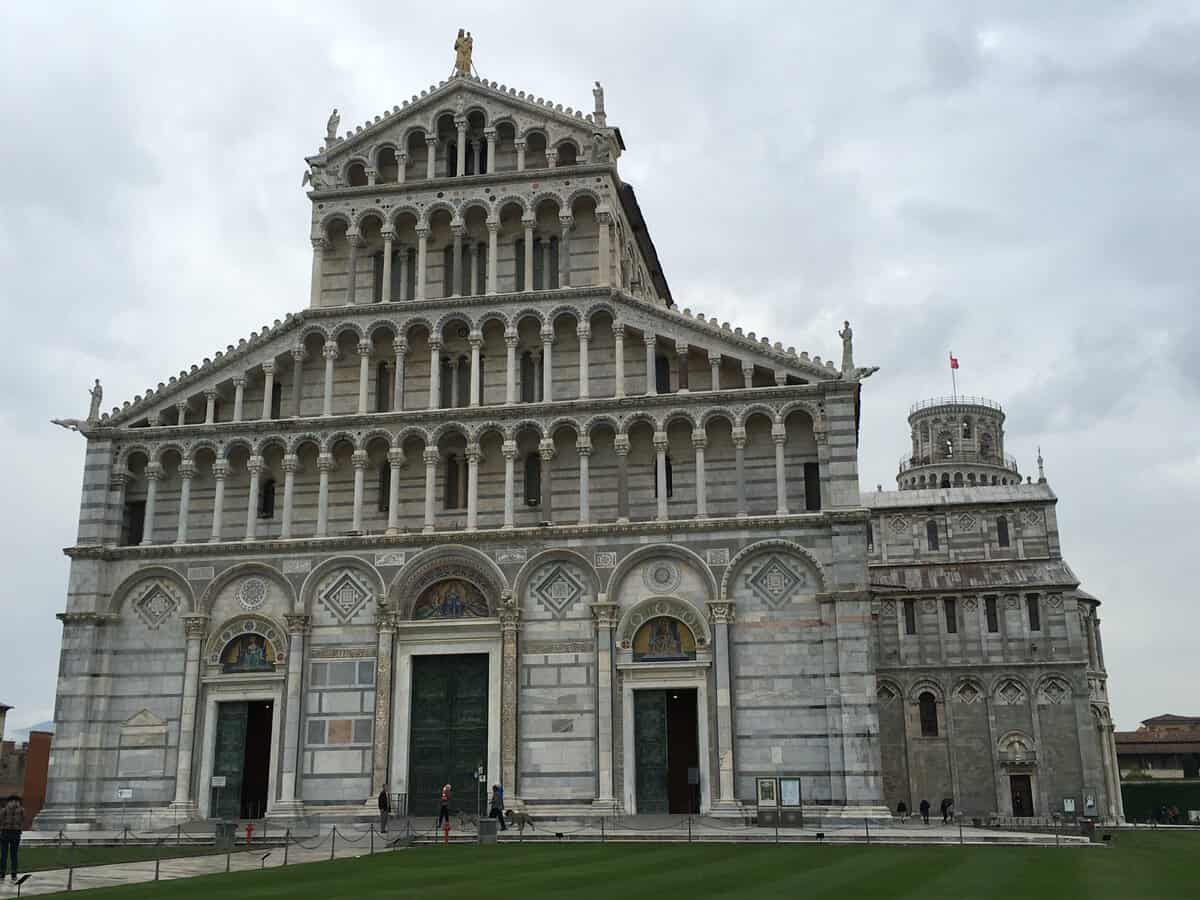
Take the requisite photos, enjoy watching others take theirs, and then visit Il Duomo, Pisa’s cathedral. It is really beautiful and has the holy doors or porta santa open for the Catholic Church’s Jubilee Year of Mercy. Inside, in addition to the spectacular architecture, you’ll find art treasures like 700-year-old depictions from the bible, works by Ghirlandaio, the tomb of the Holy Roman Emperor Henry VII, a beautiful mosaic by Cimabue, and a carved pulpit by Giovanni Pisano. Photos are not allowed inside.
Take the time to come inside. There is no charge to enter Pisa’s magnificent Il Duomo.
The Baptistery, though not as spectacular inside as the duomo, is also worth seeing if time allows. The Museo dell’Opera del Duomo, which contains many of the artworks formerly housed in Il Duomo, the Baptistery and the Camposanto (cemetery) is also located on the Square of Miracles.
Construction on the Baptistry began in 1152 and is the best known work of Pisan architect Diotisalvi.
Entrance to the Cathedral is free but you must collect an entry coupon at the ticket office on the square. For tickets and admission information for the Baptistry, Museum and Camposanto click here.
The lively and lovely small city of Lucca is the birthplace of Giacomo Puccini and a wonderful place to spend one day or several. We’ve had a few day trips from our home base in Panzano in Chianti (www.stayitalia.com more on that in another post) and keep promising ourselves to spend more time here.
Lucca is a popular destination for visitors to Tuscany and easy to reach by car or train from Florence.
You cannot drive inside the walled city. You must park in one of the lots outside. Be sure to look for the pay station if you park in any area with blue lines. White lines mean free parking, but blue lines require payment. We were so excited to get a spot near the Porta Santa Maria that we didn’t even notice we were in a pay zone and came back to find a parking ticket on our windshield. Note—if you get a parking ticket, pay it while you are still in Italy at any Post Office. You can do so with cash or credit card and you’ll avoid paying your car rental company the fee they charge to provide the Italian government with your information plus you’ll avoid the hassle of paying via wire transfer/foreign currency once you return home.
Bicycling is a popular means of getting around in Lucca– inside the city walls and on top of them.
Once you get inside the walls, Porte San Pietro is the main gate–find an Info Point—Porta Santa Maria or Porta San Donato both have them. Pick up a tourism map which has several itineraries for exploring the town. Itineraries are in Italian, English and German and include opening times, closing days, and other important information for the major sites such as museums and churches.
Visitors and locals alike stroll or bicycle around Lucca’s famous medieval walls. Bicycle rentals are readily available.
Lots of people go to Lucca to “walk the wall” or ride bicycles around the city on the top of its ancient fortifications—Passaggiata delle Mura. The medieval walls built in 1544 replaced earlier Roman ones and extend 4,195 meters around the perimeter of Lucca. There are plenty of bicycle rental places just inside the walls, particularly near the Porta Santa Maria. It was a blustery, rainy day when we were there a few weeks ago, so we put this on our list for next time.
Now a place for picnics and soccer practice, the grassy area around the walls was once a moat.
If you have time for a delicious and leisurely lunch (or dinner), go to la Buca di Sant’Antonio, Via della Cervia 3, 55100 Lucca +39058355881 www.bucadisantantonio.com. The restaurant specializes in traditional cuisine of the area and the food is delicious.We’ve had several memorable meals here.You must reserve a table because the restaurant is quite popular.
Put Buca di Sant’ Antonio on your list of delightful restaurants in Lucca.
Maccheroni lucchesi al sugo di coniglio– housemade pasta with rabbit sauce– as delicious as it looks.
Puntarella alla Romana– a crisp, bitter salad topped with anchovies widely regarded as a Roman specialty.
Petto di faraona all’ uva moscato– guinea fowl in a wonderful moscato wine sauce with crispy pancetta. Yum!
The Church of St. Michele in Foro is one of Lucca’s “must visit” sites. It was built on the site of the Roman forum in the 11th and 12th centuries and is still the center of city life. The church has works by Luca della Robbia and Fillipino Lippi, among others.
This beautiful church is worth seeing both for its architecture and the wonderful art inside.
San Michele in Forno.
Piazza San Martino is home to Lucca’s duomo of the same name. Built in the Gothic Romanesque style, this beautiful church contains some important artworks by Ghirlandaio, Tintoretto and Fra Bartolomeo as well as the Holy Face of Lucca, a wooden Christ on a crucifix attributed to Nicodemus, as legend has it.
The anfiteatro is another of Lucca’s attractions. Built in the second century AD, the amphitheater’s former arena is now home to many shops and restaurants built into the ancient Roman walls, which are interesting to see from both inside and outside.
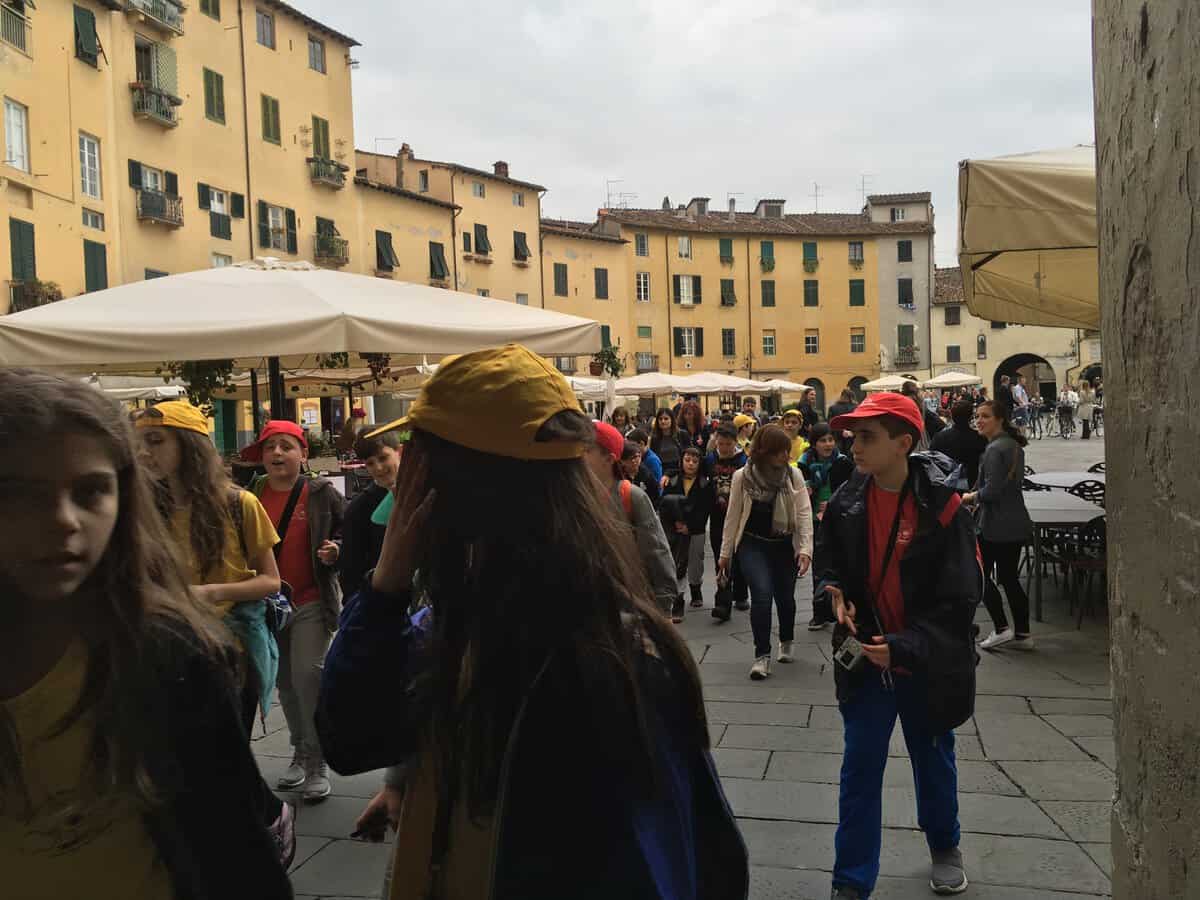
This Roman amphitheater once hosted games and gladiators. Now it’s a popular dining and shopping destination.
The Torre delle Ore, or clock tower, dates back to 1390. It is the tallest tower in town and has 207 wooden steps that ambitious visitors are welcome to climb. In its early days, the time was announced by bells alone but a clock face was added in 1752.
Hardy souls who climb the tower can see the hand-wound clock mechanism from the 18th century. It’s still working!
Lucca has a Puccini Museum, of course, which is at Corte San Lorenzo 9 (near the Piazza Citadella)– the composer’s birthplace. The museum features furnishings, artworks, pianos, musical scores and other personal belongings including letters and notes from and to Puccini.
Shopping seems to be a popular past time in Lucca and there is no shortage of brand names from which to choose.
Lucca has plenty of stores to keep shoppers happy.
This giant sewing machine is a clever advertisement for the Milanese menswear maker.
Lucca is perfectly suited to those who like to wander, and we do, but after awhile we needed a break and stopped in for a gelato at De’Coltelli, 10 Via San Paolina, www.decoltelli.it . Definitely seek this one out for their terrific artisanal gelato offered with complimentary panna (thick, sweetened whipped cream), which just adds to the deliciousness!
Panna is offered free as a thank you to gelato lovers here.
If it’s a drink or coffee you crave, pop in to The Dark Side—a cool little bar at 24 Via San Frediano at the corner of Via Angillara near the Church of San Frediano.
Come over to the Dark Side. You’ll be glad you did.
Step inside San Frediano for the beautiful baptismal font and works by Sienese sculptor Jacapo della Quercia, Matteo Civitali, and Amico Aspertini. The stunning facade features a golden mosiac depicting the Ascension.
Although we had come in for a quick coffee, we stayed for more than a half hour. The bartender was really friendly and he gave us tastes of some popular aperitivos along with descriptions of everything we sampled.
Our knowledgable and friendly bartender at the Dark Side.
The Dark Side’s complementary snacks, served with drinks, looked abundant and delicious, but we were off to Pisa.