A visit to Portland’s world famous International Rose Test Garden is truly a treat for the senses. The heady fragrance of thousands of roses greets you even before you see them. Here on 4.5 acres in the city’s Washington Park, high above Portland’s hustle and bustle, visitors will delight in the sights and aromas of more than 10,000 individual plants and 650 different varieties of gorgeous roses.
About 700,000 people visit Portland’s International Rose Test Garden each year.
With whimsical names like Angel Face, Candy Cane Cocktail, Carmel Kisses, Champagne Wishes, First Crush, Falling in Love and Jump for Joy, giant blooms and tiny tea varieties give approximately 700,000 visitors a year something to smile about.
How about Gold-medal winning Sunshine Daydream to brighten your day?
These beautiful blooms are a delight to the senses.
Barbra Streisand, Bishop Desmond Tutu, Pope John Paul II, Dale Chihuly, Ingrid Bergman, George Burns, Coretta Scott King, Dick Clark, Marilyn Monroe and England’s Queen Elizabeth are among the luminaries who have a namesake rose here.
Well-known people from around the globe including artists, philanthropists, world and religious leaders have namesake roses here.
While the peak month for rose viewing is June, our visit in August was sensational. According to the Portland Parks & Recreation Department, which owns and manages the Rose Garden, roses are in bloom from May through October.
These floral favorites were glorious even in August.
Plan accordingly–we arrived in April one time and were disappointed to see we’d come too early. We enjoyed a stroll through the lovely Japanese Garden across the street instead.
More than 650 varieties of roses are grown here.
“Hot Cocoa” seems right, even in the summer.
The oldest continuously operating public rose test garden in the U.S., Portland’s International Rose Test Garden just celebrated its 100th birthday. The centennial was marked this August with music and other activities.
Portland recently celebrated 100 Years of Roses– that’s why it’s called the Rose City.
During its 100 years of operation the Rose Test Garden has served as just that—a testing ground for new varieties of this floral favorite. During World War I, the Garden also became home and protector of European-grown rose varieties threatened by bombing.
Admission is free and so are guided tours given at 1 p.m. daily from Memorial Day through Labor Day.
To get the most from your visit, download a self-guided tour or join one of the free guided tours offered daily at 1 p.m. from Memorial Day through Labor Day. Enjoy the roses during your visit but remember, absolutely no plantings or cuttings can be removed from the Garden.
Dick Clark’s namesake rose won “Portland’s Best Rose” last year.
Admission to the Rose Garden is free. There is limited metered parking available. Consider taking public transportation or a ride share to reach the Garden. Take Trimet MAX to Washington Park and then use the free shuttle from the station that runs throughout the Park.
The next time Portland, Oregon is on your itinerary, treat yourself to a visit here and find out why it’s called the Rose City. And take time to smell, the well… you know!
The first thing I do when I arrive at Gleneden Beach, a hamlet on Oregon’s Central Coast, is take a deep breath. The clean, crisp air is an intoxicating combination of briny ocean and the refreshing scent of the pines that line the craggy shoreline. In early Spring there are no crowds.
There also aren’t any luxury hotels or fancy restaurants, but the natural beauty of the place draws us back with its tranquility, miles of pristine beaches, wooded hiking trails, a lighthouse or two, and small towns that are somewhere between charming and touristy. So what is there to do? Let’s start with the whales!
Gray whales put on an impressive show off Oregon’s Central Coast in early Spring.
Whale Watching Season
The gray whales begin their 10,000-mile migration between Baja California and the Bering Sea in the late winter months and March is prime viewing season on Oregon’s Central Coast. Weighing in at about 35 tons and averaging around 45 feet in length, thousands of gray whales–20,000 of them according to some sources– pass by Oregon’s coastal communities in early spring through June.
Some estimates have 20,000 gray whales passing Oregon’s coastal communities during their annual migration.
It’s exhilarating to see these amazing animals breach and spyhop so close to shore. We learned that spyhopping is when whales raise their heads vertically out of the water to get a better sense of their surroundings. They often do this when tour boats are nearby—maybe they like to see us as much as we enjoy seeing them.
Boiler Bay is a prime spot for whale watching.
Depoe Bay, the self-proclaimed whale watching capital of Oregon, and nearby Boiler Bay are premium locations for catching the show these leviathans put on at this time of year.
Bring your binoculars and see how many species of whale, dolphins and porpoises you can spot.
Besides gray whales, marine life aficionados with a sharp eye or a good pair of binoculars may spot orcas, sperm whales, dolphins, porpoises, and even blue whales cavorting in the waves.
The Depoe Bay Whale Watching Center is closed now but watch for the reopening.
The Depoe Bay Whale Watching Center was closed for construction in March while we were there, but we visited last year and saw plenty of whales and sea life from both the outdoor and indoor viewing platforms. It was great to come in out of the rain and still watch the whales go by. Helpful staff told us that during the busy summer months, around 100 of these majestic creatures live in the waters right off Depoe Bay.
The Whale Watching Center has indoor and outdoor viewing platforms and a terrific location for spotting these leviathans of the deep. Rangers and volunteers are on hand to answer questions about marine life, seabirds and the region’s many scenic areas.
Volunteers can usually be found at 24 coastal sites marked by Whale Watching Spoken Here signs, charting the whales’ migration and noting the numbers of sea mammals and birds spotted during their watch. Docents will not be at their stations and viewing equipment will be unavailable this year due to the public health crisis. Check out whale watching videos at oregonstateparks.org.
Yaquina Head Outstanding Natural Area and Lighthouse
I think there’s something romantic about lighthouses and this one is particularly captivating. Perched 162 feet above the churning sea, the Yaquina Head lighthouse is visible from miles away. Standing a majestic 93 feet tall, Oregon’s tallest lighthouse has been guiding mariners to safety since August 20, 1863.
The rugged beauty of the Yaquina Head Outstanding Natural Area draws 400,00 visitors annually.
Constructed of 370,000 bricks imported from San Francisco, the second oldest lighthouse on the Oregon coast shines its warning beacon from its original 400 lb. Fresnel lens. The lens, then a technical marvel, was built in Paris and transported through the Panama Canal to what was then called Cape Foulweather—for good reasons.
The rocky shoals below the Yaquina Head lighthouse became the final resting place for many ships and sailors.
Many ships foundered on the rocky shoals off Yaquina Head before the lighthouse was operational. Look for the memorial to those lost at sea at the base of the lighthouse.
The path between the lighthouse and Interpretive Center boasts beautiful vistas and educational information.
Stop by the Interpretive Center before hiking down the path to the lighthouse and tidal pools. There is a wealth of information and knowledgeable rangers available to help you make the most of your visit.
Come to the Interpretive Center for information that will help you make the most of your visit. Admission to the center is free. There is a fee to enter the park.Films, exhibits, displays and helpful staff provide a wealth of information about the lighthouse and the area’s history.
After viewing the short films, photographs, diaries and displays that tell the story of the Yaquina Head lighthouse and the people who kept it running for more than 100 years, it’s not hard to imagine light keepers going up and down the lighthouse’s 114 steps several times a day carrying 20 lb. buckets of tallow in each hand to keep the lamp lit. Instructions circa 1902 warn that the light must be kept burning at all times and at all costs. Inspectors could arrive unannounced, at any time day or night; to be sure the mandate was kept. Life could be hard and lonely. It wasn’t until 1966 that Yaquina Head’s light was automated and light keepers were no longer needed.
Light keepers climbed these 114 steps several times daily. During summer months ranger-led tours allow visitors to follow in their footsteps. A replica of the 400 lb. Fresnel lens demonstrates how the light was constructed and operates.
There are also films and exhibits about the vibrant marine life and seabirds visitors may encounter. In addition to peregrine falcons, pelagic and double-tufted cormorants, tufted puffins, and storm petrels, Yaquina Head hosts one of the Pacific Northwest’s largest colonies of the common murre, a seabird that tends to gather in large groups and float noisily around. We heard them long before we saw them but what a sight it was!
Common murres are among the many seabirds that call Yaquina Head home. A large colony of the noisy birds floats just right of the rocks in this photo.
Today, more than 400,000 visitors come annually to see the lighthouse and grounds, explore Cobble Beach and the tide pools, watch for whales and dolphins, enjoy the seabirds and visit the interpretive Center. Visitors are free to explore the 100-acre natural area on their own and during summer months, when ranger-guided tours are available, it’s possible to go inside the lighthouse.
Take a hike and enjoy the spectacular views.
Take a hike up the hill behind the former vegetable gardens for fantastic views of the lighthouse and the breathtaking coastline or climb down the wooden stairway to the beach to see anemones and other sea life up close. Or do both, as we did.
Visitors can explore Yaquina Head’s 100-acres at their own pace.
Those with impaired mobility may want to drive to the lighthouse. All areas of the Interpretive Center are accessible.
Pacific Maritime & Heritage Center and Burrows House
Pleasure craft and fishing boats crowd Newport’s busy harbor.
Curiosity and shipwrecks drew us to the Pacific Maritime & Heritage Center, a Lincoln County Historical Society Museum. Walking past Bay Boulevard’s touristy shops across from Newport’s bustling harbor, we saw signs for the museum and were intrigued.
Newport is home to the largest commercial fleet in Oregon.
Chippendale dancers, off-track betting enthusiasts and night clubbers frequented this once stately home before a careful eight-year renovation transformed the Smuggler’s Inn into the Pacific Maritime & Heritage Center. Open since 2013, the museum has a wealth of information on the area’s history, the role of the fishing industry in the region’s growth and the many shipwrecks that have been documented along the rugged Oregon coastline since 1852. Maps, photographs, exhibits and helpful docents bring the past to life here.
Exhibits explore the fishing industry’s impact on the region’s growth and development. Visitors interested in shipwrecks, sea lore and maritime history will find the museum fascinating.
Many of items in the museum’s collections were donated by the local community– from maritime gear to artifacts recovered from shipwrecks. Newport’s sister city, Mombetsu, sent the colorful Japanese fishing flags that fly above the galleries. They are meant to bring luck to the local fishing fleet and are a gesture of good will between the cities. Be sure to step out onto the roof terrace and enjoy the expansive views before you leave!
Burrows House, also a Lincoln County Historical Society Museum, is just a five- minute drive away. The Victorian house began life as a private home, and was used as a boarding house and finally a funeral parlor before becoming part of the museum. Touring the modest dwelling, which was built in 1895, visitors get a good sense of what life was like for Newport residents in the 19th and early 20th century. Don’t miss the eight-foot long toothpick model of the Yaquina Bay Bridge.
Clothing, household goods and memorabilia paint a vivid picture of life here in the late 1800s. This eight-foot replica of the Newport Bridge is constructed entirely from wooden toothpicks.
Hatfield Marine Science Center
Looking for family fun and the chance to spend quality time with an octopus? Oregon State University’s Hatfield Marine Center is just across the bridge from Newport’s busy commercial harbor and definitely worth a visit, particularly if you have young ones in tow. We stopped by on a rainy day and it was easy to see why more than 150,000 people a year are drawn to the dynamic marine education center.
Hatfield’s aquatic exhibits bring out a sense of wonder in visitors of all ages.Touch tanks and interactive exhibits entertain and educate visitors.
The Visitors Center’s aquatic animal exhibits, hands-on experiences, and interactive displays make learning fun. The Center’s resident octopus is a big draw. Visitors can watch him “hunt” for his food, play with his toys and explore his environment. Hatfield has an Octocam, so even after returning home, fans can keep tabs on the popular cephalopod.
Go Exploring
Oregon’s Central Coast has so many beaches, trails, natural wonders and small towns to discover that you can be as busy as you like.
Devil’s Punchbowl is at its best at high tide when the sea really churns.
Take a drive to Devil’s Punchbowl and watch the swirling sea churning up inside the hollow rock formation. Stop in to Cliffside Coffee & Sweets and get an ice cream cone or chocolates while you’re there.
Pristine beaches, trails and parks along Oregon’s Central Coast await. Pack a picnic and go explore! Join the agate hunters on Gleneden Beach at low tide. Tsunami safety instructions are posted on this chunk of harbor that washed up in Newport after crossing the Pacific from Japan. Now it’s part of the bayfront along with shops, tourist attractions and restaurants you can enjoy.
Pack a picnic and head over to Fogerty Creek. Check out the tide pools. Hunt for agates during low tide on Gleneden Beach. Head to Lincoln City and search for the “finders keepers” glass floats or make your own at Lincoln City Glass Center.
Free “finders keepers” glass floats are a 20-year tradition on Lincoln City’s beaches. These are for sale at Lincoln City Glass Center.
Stroll through historic Nye Beach for a little retail therapy and enjoy the sandy beach there. Or just sit and watch for whales.
It’s easy to while away a sunny Spring afternoon just sitting and watching for whales.
Practicalities
Unless you live within driving distance, fly into Portland (PDX), rent a car and drive the 2-1/2 hours to the coast. It’s a scenic drive once you’re past the suburban areas.
You’ll share the road with logging trucks on the scenic coastal road.
There are a few hotels and a lot of rentals and timeshares along Oregon’s Central Coast. We rent a fully- equipped condo and need provisions to make breakfast and picnic lunches when weather allows. Chester’s, a mid-sized grocery between Gleneden Beach and Depoe Bay, has a good selection and all the necessities, plus a video rental on-site. Newport and Lincoln City—the two largest towns in this area– have the chain stores and more shopping options.
We’ve stayed at this Wyndham timeshare in Gleneden Beach several times.
As much as I love to cook, I also like a good dinner (or lunch) out. Our favorite restaurants are:
Tidal Raves Seafood Grill –We spotted nine whales during one dinner at this Depoe Bay mainstay! Portions are generous and full meals include soup or salad so you can probably skip the appetizer.
You can’t beat the sunset view at Tidal Raves in Depoe Bay. The halibut is always a great choice. Dinner specials, like this sturgeon don’t disappoint.
Fish dishes are fresh and delicious– try the halibut or the BBQ shrimp for something a little different. Nightly specials have never disappointed and the steaks are good, too. This place is extremely popular with locals and visitors. Make a reservation.
Side Door Café– There are no ocean views, but there is plenty of ambiance at this local Gleneden Beach favorite. The food is hands down delicious and that’s what keeps people coming back for more.
We’ll take the salmon or halibut any way the kitchen is preparing them. Save room for the house made desserts. They’re divine!
Try the Dungeness crab cakes, or the salmon or halibut – however the kitchen is preparing them. The hazelnut crusted pork and rack of lamb are both outstanding. Save room for the homemade desserts! Reservations are essential.
Local Ocean– It’s all about the fresh fish here–right off the boats from Newport’s busy commercial harbor just across the street.
Fresh fish, often from the fishing boats across the street, make this our Newport favorite. The fish and chips are huge, crispy and delicious. The retail market at Local Ocean has great options for fresh, local fish.
We like the crab cakes, fish and chips, fish tacos, albacore tuna wrap and whatever the daily special is. The burgers are good, too. There are terrific harbor views from the upstairs dining area and bar. Local Ocean has a retail seafood market on the ground floor so you can bring home today’s catch, too.
Red Roof Inn— Follow your nose to this Gleneden favorite. The mouthwatering aroma of fresh baked goods and strong coffee kept us coming back day after day.
Everything here is baked from scratch early in the morning. Robert just took this Irish soda bread out of the oven.
The friendly staff will make you feel like a local and their sandwiches are amazing. Open for breakfast and lunch only.
Kyllos-Big and busy, this Lincoln City restaurant is right on the water and serves continually from lunch on.
We like Happy Hour at Kyllos. The Dungeness crab is a tasty treat.Kyllos fish tacos are good, too!
If you’re lucky enough to get a window seat, the views are spectacular. Happy hour, or lunch in the bar, is the budget- friendly way to go. Try the kale salad and fish tacos.
This is just a sampling of the fun and food that await on Oregon’s beautiful Central Coast. Add it to your list of Springtime get-aways! Or summer get-aways, fall get-aways…
Charles and Emma Frye began collecting art in 1893 focusing primarily on French and German artists from the 19th and early 20th centuries. The couple built an impressive Founding Collection of 230 paintings, now on permanent display at their namesake museum in Seattle’s Capitol Hill area. The museum is open to the public at no charge, as the Fryes intended when they established the Charles and Emma Frye Free Public Art Museum in 1952.
The museum has expanded and been updated since it opened at its current location in 1952.
The Fryes had a particular interest in German painters of the mid-19th Century Munich School including Wilhelm Leibl, Franz von Lenbach and Max Slevogt whose works, along with other prominent painters of the period, are part of the Founding Collection.
Henry Raschen’s 1913 portraits of Emma and Charles Frye hang in the Frye Salon.
The Frye’s Permanent Collection includes not only those works collected by Charles and Emma, but also later acquisitions made by the Frye Foundation. These later aquisitions expanded the collection to include American artists as well as European painters other than the French and German artists the couple built their original collection upon.
Acquisitions by the Frye Foundation expanded the collection to include American artists.
Gilbert Stuart and John Singleton Copley’s Colonial Period paintings hang alongside the American Realism works of Winslow Homer and Thomas Eakins. Mary Cassatt, James McNeil Whistler, and John Singer Sargent are among the ex-pat painters whose Impressionist works are displayed.
Paintings are hung as they once were in the Frye home gallery.
Portrait of Chief Seattle by Henry Raschen, 1916.
The vast collection of paintings covers every wall in the Frye Salon with the works hung as they once were in the Frye’s home gallery. The Frye Salon is reminiscent of Boston’s Isabella Gardener Stewart Museum. In other words, there is not much space between the works and they are not hung in any apparent order— historical, religious and allegorical paintings hang beside portraits, landscapes and seascapes. There are several copies of a hardcover guide available to visitors in the gallery that identifies and describes each work and artist.
Visitors reference gallery guide to identify paintings and artists.
The helpful guide is available only in the gallery. There are several other books about the museum and its collection for sale in the shop, but not the gallery guide.
In addition to the Permanent Collection, there are several changing contemporary exhibitions.
The Frye features contemporary art as well as European and American paintings from the 19th and 20th centuries.
We enjoyed the two Andy Warhol exhibitions on view during our visit. During the 1970s, Warhol recorded a reported 40,000 Polaroids documenting his personal and professional endeavors. Warhol’s Little Red Book #178 is a collection of 19 Polaroid pictures of his friends and other celebrities taken in 1970 while he made his film L’Amour.
Little Red Book #178 has 19 of the reported 40,000 Polaroid photos Warhol took in the 1970s.
From 1964-1966, Warhol recorded hundreds of visitors to his studio, called The Factory, using a Bolex camera. Warhol’s12 Screen Tests features artists and celebrities who were instructed to sit still for the length of a 16 mm film—about three minutes. Subjects featured in 12 Screen Tests include Dennis Hopper, Edie Sedgwick, Susan Sontag, Lou Reed, Bob Dylan, Marcel Duchamp and Brooke Hayward. Not everyone was capable of the task assigned. Bob Dylan’s Screen Test shows him smoking a cigarette and fidgeting throughout.
Hundreds of Warhol’s Factory visitors were filmed for his series of “Screen Tests.”
Subjects were meant to be still for the three minute films, but Bob Dylan fidgeted and smoked throughout his “Screen Test.”
Also on view was Structure and Ornament, a multi media exhibition of Leo Saul Berk’s work based on the iconic Chicago-area Ford House, his childhood home.
Berk’s dream about sleeping on the floor at Ford House was the inspiration for “Heat Signature.”
The artist refers to his work as “a riff on the house,” which has historical significance and was designed by architect Bruce Goff. The exhibition includes the history of the home, photographs and films, along with Berk’s sculptures and other works, based upon the unique structure and the artist’s memories of living there.
Leo Saul Berk’s childhood residence, the iconic Ford House, was the basis for the “Structure and Ornament” exhibition.
“Cone Twelve,” Berk’s aluminum composite and stainless steel sculpture.
“Mortar and Marbles” is a to-scale representation of a section of the Ford House’s curved coal walls.
We also saw American Portraits: 1880-1915– a selection of portraiture by artists whose works are included in the Founding Collection.
Museum visitors relax and enjoy the “American Portraits: 1880-1915” exhibition.
The Museum has a nice little café with an outdoor garden. Sandwiches, soups, sweets and other simple but satisfying offerings are available at very reasonable prices.
The Frye’s cafe has a lovely garden area and is a nice option for lunch or coffee.
On our first visit to the Frye Museum, we were told that one of the galleries was closed for yoga, but would soon reopen. While yoga is no longer offered at the museum, the Museum hosts art classes for everyone from pre-schoolers to life-long learners, Mindful Mediation on the first and third Wednesday of the month, art history lectures, jazz concerts, activities for those with memory loss and their families, film presentations and more. Find the complete schedule here.
Charles and Emma Frye would no doubt be pleased to see their wish– that the public enjoy free access to art, that ‘perfection of good-nature,’ continues to be a reality today, thanks to their free art museum.
Art, food and fun highlighted our three-day weekend in the Emerald City. We started off our Saturday morning with a monorail ride from the central shopping area to the Center City area, home of the iconic Space Needle. The monorail, which was built for the 1962 World’s Fair, costs just $4.00 and is only $2.00 for seniors, children under 12, disabled, and active duty military.
It’s a quick but fun ride on Seattle’s monorail.
The trip takes only minutes between Westlake Center Station at 5th and Pine Streets and The Seattle Center Station. Purchase your ticket at the kiosk or from the cashier as you enter the train. The monorail runs every 10 minutes or so from 8:30 a.m. on weekends (7:30 a.m. during the week) and closes between 9 p.m. and midnight, depending on the date and what’s happening downtown. Be sure to check the schedule.
Sonic Bloom greets visitors walking to EMP or Chihuly Garden and Glass. The “sunflowers” move and emit sound.
Seattle’s iconic Space Needle was built for the 1962 World’s Fair.
We’d been to the Space Needle on previous visits so headed right to the Chihuly Garden and Glass.
There’s a reason Chihuly Garden and Glass is on everyone’s Top 10 list. Don’t miss it!
We should have bought our tickets online—the lines were long for the cashiers inside and at the outdoor kiosks, and cost more than the online price. Plan ahead! Once you have your ticket and have reached the admission area, ask to have your arm stamped so that you can return in the evening to view these magnificent glass works illuminated. The sun sets quite late in Seattle during the summer months so keep that in mind when planning your return visit.
Prepare to be amazed. Detail of Chihuly’s Sealife Tower.
The Chihuly Garden and Glass is included in Seattle’s City Pass so if you plan to visit more than one of the included attractions—yes, the Space Needle is one of them—you may want to opt for the City Pass. You’ll save money and time since you won’t wait on line.
Tabac Basket in the Northwest Room.
Once inside, be prepared to be awed. There is a reason Chihuly Garden and Glass is on everyone’s “must see” list. We heard more than a few “wows” as soon as we stepped into the first gallery. Dale Chihuly’s glass art works are artistic, whimsical and beyond stunning.
Mille Fiori– A thousand flowers- delight the senses.
These photos cannot capture the splendid forms, movement, intricacy and vibrant colors in Chihuly’s work but they do give an hint of what you’ll experience at Chihuly Garden and Glass. It is a magical place.
Persian Ceilingfloods the room with color from above.
It seems as you move from gallery to gallery the works get progressively more beautiful and intricate. The lighting, staging and even the music in the galleries combine to create a magnificent experience.
Ikebana and Float Boatscapture the viewer’s imagination.
A stroll through the gorgeous gardens is another delight. The art is so beautifully integrated in the various plantings that you’ll want to linger.
A view in the garden.
Northwest timber is integrated in the glass garden.
We had the added benefit of a spectacular day—clear, blue skies and temperatures in the mid-70s. The soothing background music being performed by a gentleman playing the Eyhu on the street just outside the garden added to our enjoyment.
Soothing music further enhanced our enjoyment of the gardens.
The works on display are included in a fairly comprehensive catalog titled, Chihuly Garden and Glass, available in the gift shop in the lobby. It is one of many available volumes featuring Mr. Chihuly’s art. In addition to the usual museum gift shop items like books and calendars featuring the artist’s work, original pieces of Chihuly’s glass art are also on offer.
This is no ordinary gift shop.
A spectacular souvenir.
If you’ve worked up an appetite after your stroll through the garden, head over to the Seattle Center Armory a few steps away. Originally built in 1939 to house the 146th artillery and its half-ton tanks, it was repurposed for the 1962 World’s Fair and became the city’s first vertical shopping mall, called the Food Circus.
Once home to an artillery unit and half-ton tanks, the Armory now features food and family fun.
Today, in addition to a public space that hosts more than 3,000 free family entertainment and cultural events each year, you’ll find a food court that’s got something for everyone. Though Starbuck’s and Subway do have a presence here, they share the main floor with more interesting offerings from the likes of Eltana’s Wood- Fired Bagel Café, Seattle Fudge, MOD Pizza, Kabab, Cool Guys Fry Bar, Ceres Roasting Company, Bigfood BBQ, Quincy’s (burgers and seafood) , Blue Water Taco, Plum Pantry (vegan and organic selections), The Confectional and Skillet Counter.
The Seattle Center Armory is a busy place at lunchtime.
Mediterranean street food, beef baracoa, fish tacos, Belgian style fries, individual cheesecakes, pizza, vegan fare, and a terrific fried chicken sandwich are among the tantalizing possibilities we deliberated for lunch.
So many choices…
We chose Skillet Counter where the Fried Chicken Sammy with a fennel seed crust, kale, and jalapeno aioli on a potato roll called out to my traveling companions. I had a delicious curried carrot soup and a salad. We met Chef Mike “Mookie” who kindly shared his recipe for the soup and the aioli. Looking forward to whipping up some of that at home!
Skillet Counter’s Chef Mike aka “Mookie”
If you’ve got little ones in tow—you’re in luck—Seattle’s Children’s Museum is just downstairs. Here you’ll find interactive exhibitions, hands on, and age appropriate activities for children ages 10 months to 10 years.
Seattle Children’s Museum is lots of fun for the little ones.
After our satisfying lunch at Skillet Counter, we headed down towards Elliott Bay to the Olympic Sculpture Park, part of the Seattle Art Museum. So much to see and do in the Emerald City!
Written and photographed by Jeanne Neylon Decker
Protected by US Copyright Laws.
Note: Things change. Please be sure to verify opening times and pricing for any and all places and activities mentioned.
Air Force One, the Concorde, the Space Shuttle Trainer, the first fighter plane, and many more remarkable aircraft are just a short drive south of Seattle in Tukwila, WA, home of the largest private non-profit aviation museum in the West.
Seaplanes to space craft are all on display at the Museum of Flight.
The Museum of Flight http://www.museumofflight.org is located at the King County International Airport on Boeing Field and has more than 150 aircraft plus interactive exhibitions, rare photographs, films, newsreels, memorabilia and much more. Exhibits take visitors on a fascinating journey from the earliest days of aviation, to the moon, and back to the present.
Military aircraft make up a significant part of the Museum’s collection.
After purchasing tickets inside the Museum of Flight, come back outside and climb aboard some of the most iconic aircraft to ever take flight. The outdoor exhibits close before the museum does.
The very first Air Force One jet.
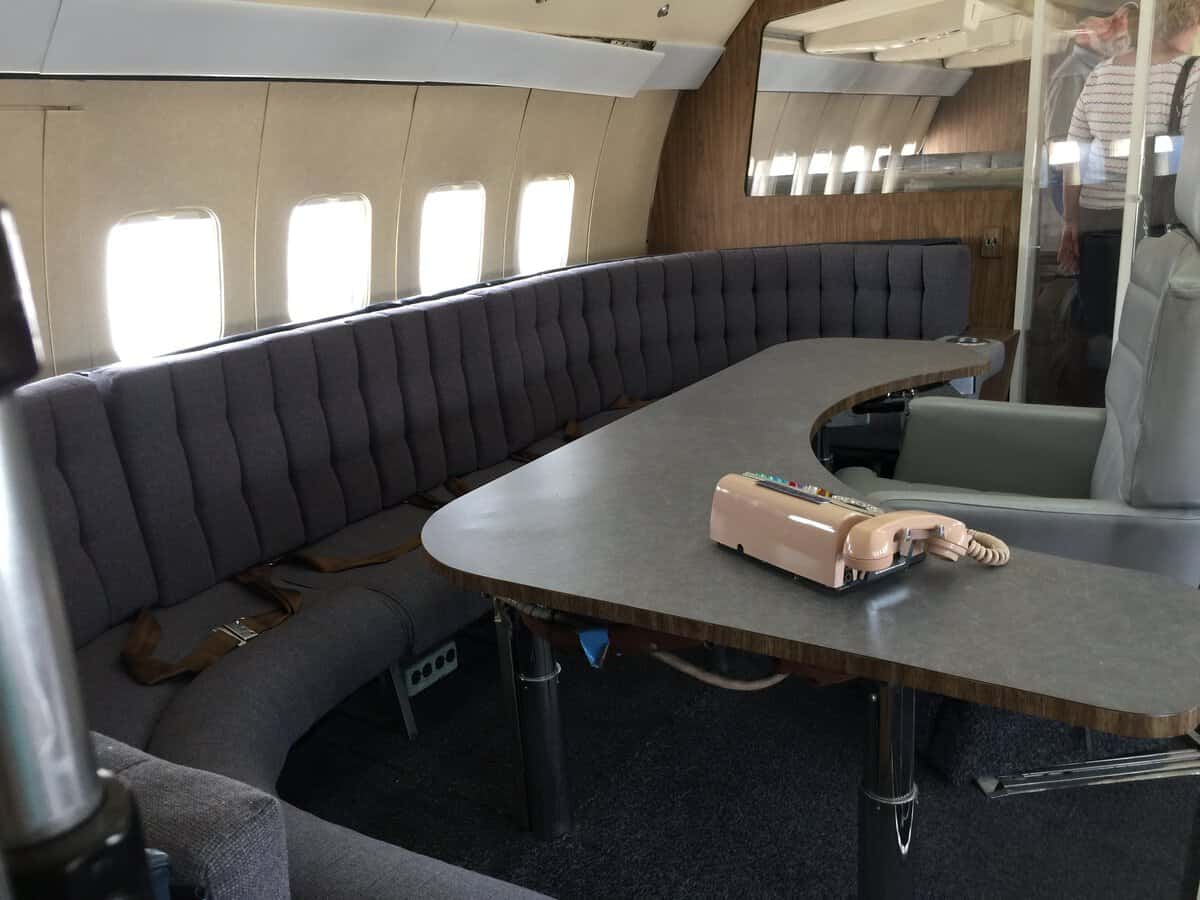
Just outside on the Boeing Field, the first jet used as Air Force One, a specially constructed Boeing 707-120 called SAM (Special Air Missions) 970, is open for touring. Presidents Eisenhower, Kennedy, Johnson and Nixon and numerous dignitaries traveled the world aboard this particular aircraft. Kennedy’s pipe rack, Johnson’s hat rack, the safe where the president’s secret nuclear codes were kept, “Press Section” seating and the president’s private quarters are all on view.
This area was the president’s private sitting area and popular for naps, we were told.
Personal memorabilia from several presidents are still onboard.
The world’s fastest commercial jet, one of only 20 Concordes ever built, is on display outside the Museum, too. Courtesy of British Airways, guests can tour this compact aircraft. We were surprised at just how narrow the cabin was.
One of only 20 Concordes manufactured.
Speed was more important than spaciousness on the Concorde.
At the other end of the spectrum, guests can visit Boeing’s 787 Dreamliner, one of the most fuel efficient commercial airliners to take to the skies, according to the company.
A wide array of aircraft are on display and open for touring. Helpful docents are on hand at most.
There’s plenty of room to relax on this Boeing 787, at least in the forward cabins.
Also on the field is a US Air 737, which now serves as a theater for those interested in viewing Time Flies: Century of Flight.
Back inside the Museum, guests can trace the history of aviation from its earliest days right up to the present. The Red Barn, where the Boeing Company began, is part of the Museum today and gives guests an excellent historical perspective on the development of commercial aviation.
Inside the Red Barn.
Visitors can learn about the men and women at the forefront of aviation in America.
Rare photographs, news stories, film clips and more tell the story of flight.
Memorabilia from Boeing’s beginning.
The Museum has displays of every imaginable aircraft from the Taylor Aerocar III—AKA the “car plane”, which actually did take flight as a film clearly shows; to all manor of military aircraft, including the first fighter plane, the Italian built Caproni Ca.20; to planes used to deliver mail in Alaska and newspapers in the Midwest and much more.
The Aerocar was one of my favorite aircraft. The wings folded into a handy trailer for driving after landing.
There is a hole in the floor of the plane for the pilot to drop newspapers through.
There are even miniature planes. The Holtgrewe WWII Model Collection has more than 400 1/72 scale models of military aircraft used by most of the countries who became combatants in the second world war. Another marvelous miniature is the 1/10 scale model of the Montgolfier Brothers’ Balloon on display in the Museum’s lobby.
A model of a Montgolfier Brothers Balloon greets visitors in the lobby.
Military craft from many nations attract visitors’ attention.
A Vietnam War era helicopter.
The U.S. Space Program is well represented, too. Visitors can track America’s race to space from its earliest days to the present. There are photographs, magazine and newspaper articles, films and news reels, exhibits on the animals used in space program, space suits worn by U.S. Astronauts and Soviet Cosmonauts, and a vast assortment of memorabilia from moon rocks to the cowboy boots worn by a famous test pilot. Apollo 17 Mission Models and the only Mars Viking lander still here on Earth are also at the Museum.
Here’s how the cosmonauts suited up for space.
Primates and pups launched before our first astronauts.
Guests can also walk through the Space Shuttle Trainer Crew Compartment where U.S. astronauts trained for every Shuttle mission. A separate 30- minute tour of the Trainer is available for an additional fee for visitors 10 years and older. Tours of the Boeing Field are also offered for an additional fee.
Apollo 17 models are just some of the fascinating exhibits on space exploration.
There are numerous flight simulators, exhibits on every aspect of aviation including rocketry and “spacebots”, a research library, aviation advertising, and so much more for visitors to see.
Aviation advertising from the days when flying was fun.
An American Airlines advertisement.
There is so much to see and experience at the Museum that many visitors will not be able to enjoy all that is on offer in one day. Happily, discounted return tickets are available so take your time and come back again.
After a beautiful morning at Chihuly Garden and Glass and lunch at Seattle Central Armory’s Skillet Counter, we headed down to the Olympic Sculpture Park, part of the Seattle Art Museum. On the way we passed a Duckload of friendly tourists.
Seattle’s Duck Tour is one way to see the sights in the Emerald City.
We enjoyed the view of snowcapped Mt. Ranier in the distance and the cruise ships docked nearby.
Seattle is a popular jumping off point for Alaskan cruises.
And finally reached our destination– the Olympic Sculpture Park.
All are welcome at Seattle’s Olympic Sculpture Park. Admission is free.
Jaume Plensa’s 46- foot Echo, towers over visitors with her eyes closed to the sea beyond.
This beautiful urban art park was once an industrial site. Now, less than 10 years later, the nine acres on Elliott Bay is Seattle’s largest downtown green space and home to spectacular sculpture by some of the most influential and respected artists in the world including Richard Serra, Ellsworth Kelly, Alexander Calder, and Louise Nevelson.
A view of Richard Serra’s Wake.
It’s an entirely different visual experience to wander among the panels of Wake.
Alexander Calder’s The Eagle provides a brilliant pop of color and a shady place to rest.
Typewriter Eraser by Claes Oldenburg and Coosje van Bruggen must add a touch of whimsy to the daily commute.
With views toward the Olympic Mountains and Puget Sound, thought provoking and attention getting art, and its beautiful waterfront location, the award-winning Olympic Sculpture Park ought to be on your list of “must sees” in Seattle.
Cargo ships glide by Bunyon’s Chess by Mark di Suvero.
Puget Sound makes a beautiful backdrop for these sculptures.
di Suvero’s Schubert Sonata has a prime location.
The nine-acre sculpture park has lovely wooded paths to explore.
The Olympic Sculpture Park is pedestrian and bicycle friendly, handicapped accessible, and admission is free.
Roy McMakin’s Love and Loss was commissioned for the Olympic Sculpture Park.
Beverly Pepper’s Perre’s Ventaglio III is right at home among the vegetation.
What a fantastic place to spend a beautiful day in Seattle! Next, dinner decisions, The Frye and we take flight to Boeing Field–a visit to the Museum of Flight.
Note: Banner image is Louise Bourgeois’s Father and Son. Each figure is in turn concealed and revealed by the water in which they stand, separated, arms outstretched.
We chose Terra Plata www.terraplata.com for our Sunday supper and we’re glad we did. This Capitol Hill restaurant features a large bar and rough-hewn wooden tables mostly filled by groups of young people and families all obviously enjoying their meals and beverages. It was another warm summer Seattle night but the big open windows helped to keep it cool inside.
Terra Plata has a fun, casual vibe.
There are cocktails and a nice selection of beers and ciders on tap or in bottles, including local brews from Washington and Oregon at Terra Plata. The reasonably priced wine list features plenty of good choices from the Northwest, Italy, France and Spain. We began with a glass of sparkling rose from Chatau Moncontour in the Loire Valley for $13, and a round of Bale Breaker IPAs at $6 each. We chose a refreshing rose from Chateau Teulon in Costieres de Nimes at $32 to accompany our meal.
The large bar area filled up as the evening progressed.
Terra Plata’s menu is divided into snacks and starters, earth, sea, and land. Like at many Northwest restaurants, sharing is heartily encouraged. Starters ranged from Moroccan olives at $6, to $13 for blistered Shishito peppers or roasted grapes with olives, walnuts and crostini, and topped out at $22 for the generous charcuterie plate.
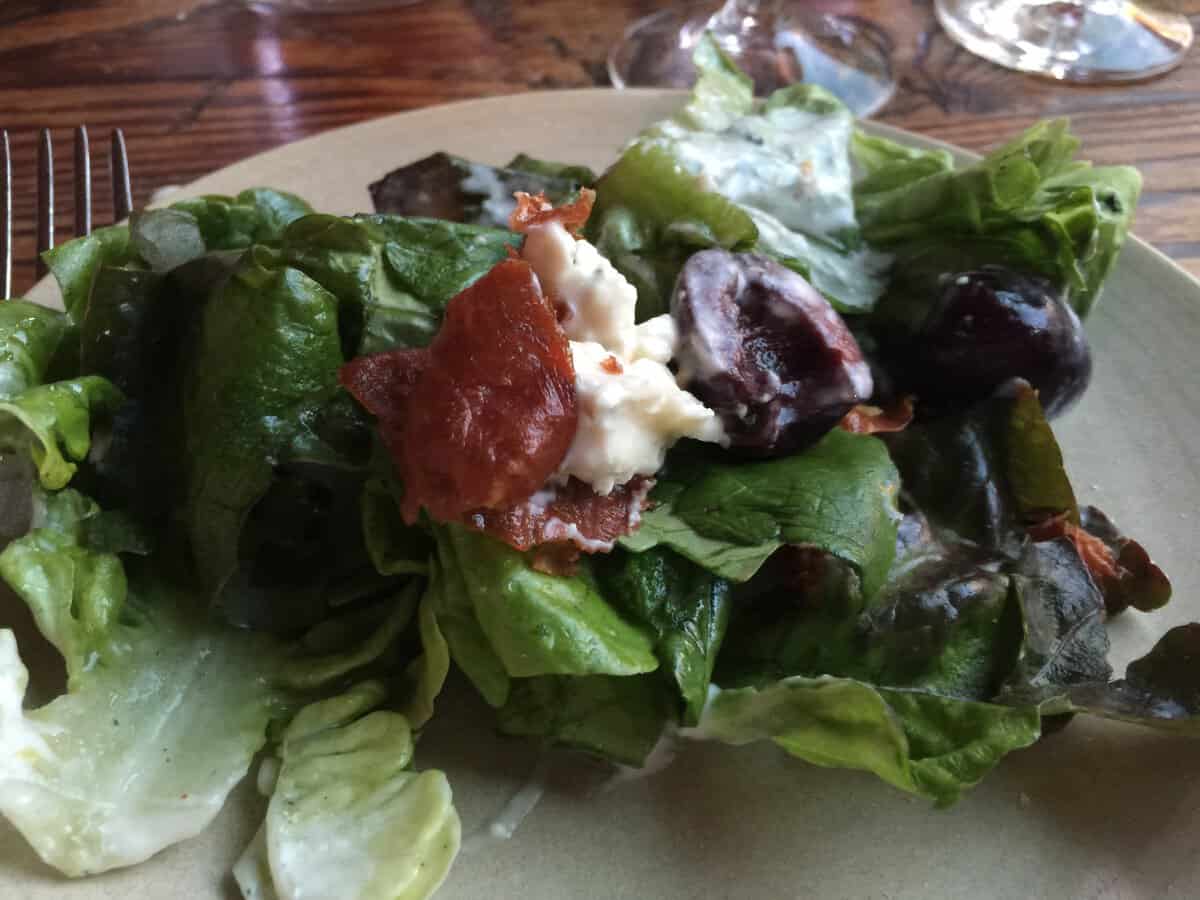
Serrano ham and cherries punched up the flavor profile of this tasty salad.
The butter lettuces served with Cabrales dressing (a blue cheese), cherries and crisp Serrano ham from the “earth” category was $14 and perfect for sharing—which we did. Other choices included beets with sheep’s cheese, arugula and pistachio at $20; a radish plate with English pea butter, anchovy butter and “roof top” herbs for $11; or a risotto with peas, mint, mascarpone, parmigiano and pea leaves for $26.
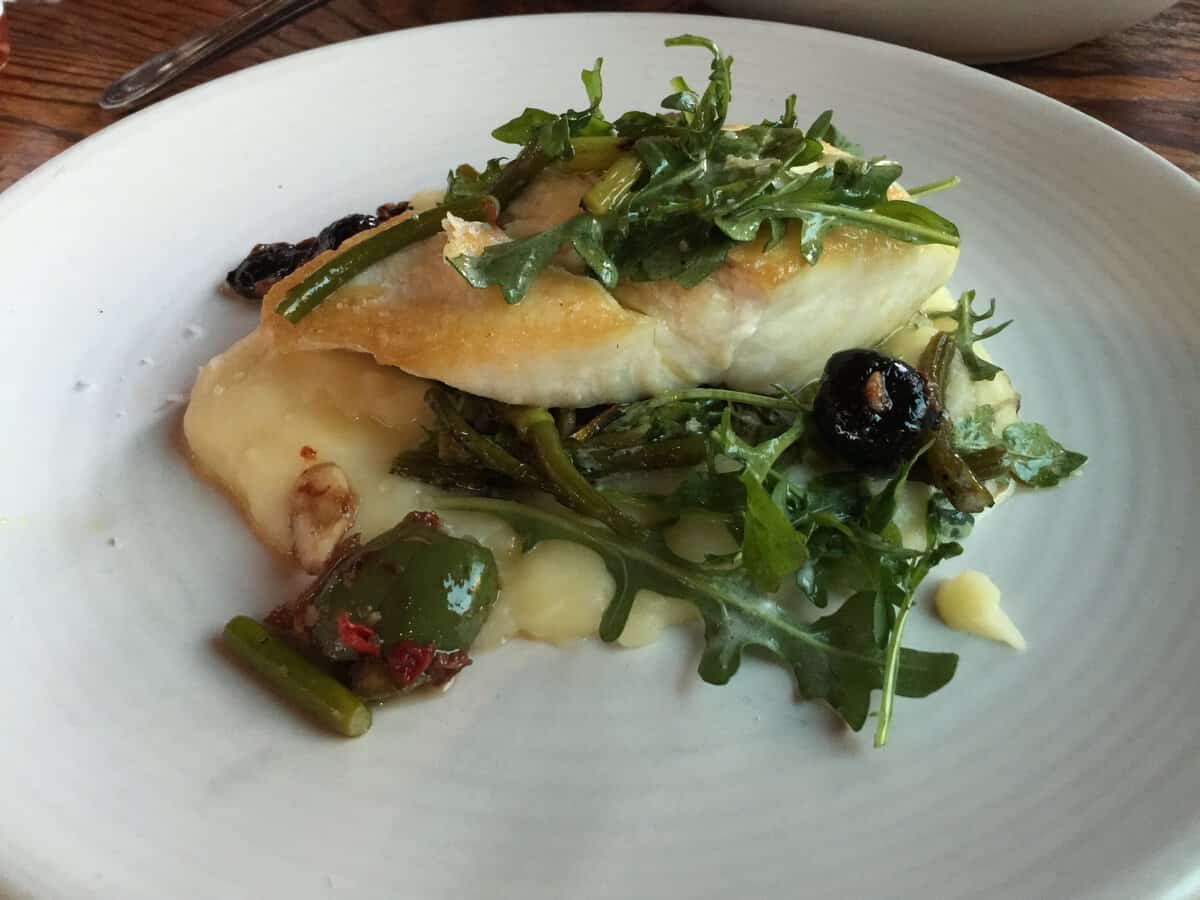
We would heartily endorse the halibut.
We opted for our own entrees, though shared tastes of course. The halibut with skordalia, charred garlic scapes (a member of the green onion family), crushed olives and lemon tahini vinaigrette was perfectly prepared and beautifully presented. It was well worth the $32. The others at the table enjoyed the succulent roast pig with chorizo, clams, hot smoked paprika, chicharron and “bay scented” potatoes. The $30 roast pig was so large that two people could easily have shared one portion.
Crunchy chicharron were a perfect foil for the succulent roast pork.
Once again, we were too full for dessert, but several at our table chose to sample a few of the Madeiras ($7 and $9 per glass) on the wine list–a perfect ending to a delicious meal. Terra Plata’s wait staff was very friendly and knowledgeable and gave us excellent guidance throughout the evening. We will definitely return!
Wild Ginger www.wildginger.net has been part of Seattle’s restaurant scene since 1989. We have visited the Asian eatery and satay bar several times during numerous visits to the Emerald City. This time, we chose it for lunch.
Wild Ginger can accommodate large groups in its multi-level downtown restaurant.
The downtown location (there is also one in Bellevue) is huge and has multiple dining rooms on two levels. Wild Ginger offers an expansive menu with dishes from Thailand, Vietnam, China, Indonesia and Malaysia. You’ll find lots of traditional favorites on the menu, including gluten free and vegan options, which should appeal if you have a large group. There were a number of these at our recent visit.
The expansive menu has vegan and gluten free options.
Starters include Siam lettuce cups at $18.50/ $22.50, traditional Chinese potstickers for $9.50/$13.50, and Vietnamese style chicken wings for $13.50. We began with fresh and tasty “Buddha rolls”– spring rolls served with a pineapple dipping sauce, $9.50.
Tasty Buddha Rolls started our meal.
We decided to skip the soup and salad category which ranges from squash and sweet potato stew $5, to green papaya salad $11. Though many of the main dishes, like the fragrant duck $16.50/$28 and green curry chicken $13.50/$17.50, sounded delicious, we opted for several luncheon specials, which we shared. Luncheon specials rotate regularly, about every other week. These typically include poultry, fish, meat, and vegetable options, and a “chef’s special” fried rice dish.
The chicken curry was delicious. We wanted more.
Our waiter recommended the special yellow chicken curry with bok choy $14, and told us he ordered himself any time it appeared on the menu. We agreed it was delicious! He also touted the grilled prawns $15, which sounded tasty, but we found the dish pedestrian and disappointing. If you’re planning on sharing, be aware that servings were quite small, at least among the dishes we chose.
Seafood, poultry, meat and vegetable options are available as lunch specials.
If you’re interested in imbibing, Wild Ginger has a large, well thought out wine list as well as cocktails, beer, and of course, teas and soft drinks. Overall, Wild Ginger offers a wide variety of good Asian food, but if you don’t choose wisely, you’ll find yourself with an expensive tab at the end of the meal.
Bar Sajor is owned by the same people behind Sitka and Spruce, along with several other Seattle eateries www.sitkaandspruce.com. We enjoyed one of our first communal table meals there several years ago—a very popular concept in the friendly Northwest. Bar Sajor www.barsajor.com has an open kitchen with a large wood burning fireplace on which a number of dishes are prepared. The room is open, airy and has a very casual vibe but there is an undercurrent of hip pretentiousness, which didn’t bother us. It was a warm evening but the windows were open wide to allow in the welcome breeze. The restaurant was busy but still fairly quiet for a Saturday night.
Bar Sajor’s airy, casual dining room.
Bar Sajor, like Sitka and Spruce is dedicated to the farm–to- fork concept using local purveyors for nearly everything on offer. The menu, which changes regularly to reflect seasonally available ingredients, is meant for sharing. Diners are encouraged to choose a selection of dishes to share with the entire table. Many dishes are available in several sizes to accommodate larger groups and appetites. Food is served as soon as it is ready in the kitchen, typically in no particular order. If you have a desire to receive your dishes in a specific order, you can ask, or just order a few items at a time, pausing between orders, which is what we did.
It’s fun to watch the chef preparing dishes in the fireplace.
We started our evening with beers (local drafts and foreign and domestic bottles are served) and a nice glass of rose—perfect for a sultry summer evening. Bar Sajor is another of those restaurants that charges $5 for bread but theirs is “naturally leavened” and served with the very “of the moment” cultured butter and flake salt. It was really tasty and the cultured butter, which had a nice tang, was served in an oyster shell.
Cultured butter in an oyster shell adds a touch of whimsy.
The “simple” salad was anything but. It featured crisp snap peas, Shunkyo radishes, fava beans, and fiddlehead ferns– which added a nice texture and an earthy element. All of the vegetables were perfect. The green goddess dressing was light and balanced, unlike the gloopy goo that was poured from bottles many decades ago. The salad is available in two sizes at $13 or $17. It made a delicious first course.
There’s no excuse not to eat your vegetables when they’re this good.
Next, we enjoyed a beautifully presented “Grand Aoili” with dipping vegetables including seaweed, hard cooked egg, and a nice assortment of local fin fish and shell fish including Dungeness crab, shrimp, and house-smoked mussels. My only complaint—the dish could have been heavier on the seafood and perhaps the largest sized platter is. This dish is available in three sizes at $30, $55 or $95. We had a nice flinty Sancerre with the Aoili.
The Grand Aioli brought back memories of France.
Our meat course was a juicy, perfectly prepared ribeye. The meat was cooked over coals and served with baby squash and Meyer lemon. It was a pricey $56 but certainly satisfied the carnivores at the table and their voracious appetites.
The ribeye was a meat eater’s delight.
The Sequim strawberries and warm coppa arrived at the same time as our ribeye. The berries were perfectly ripe and the ham was an excellent compliment to the fruit. These were served with lavender and black sesame seeds. Delicious! The price was $16.
The coppa complimented the berries beautifully.
With the meat and berry courses, we enjoyed a bottle of Domaine Philemon, a red varietal made with Braucol grapes from Gaillac, in the Southwest of France. The wine has a nice spiciness and a woodsy, floral aroma, perfect with those dishes.
We were much too full for dessert. Besides, we had our dessert much earlier in the day when we stopped at Cupcake Royale www.cupcakeroyale.com. Highly recommended to us by a Seattle friend, Cupcake Royale has multiple locations. We stopped in at the one near the Pike Place Market www.pikeplacemarket.org.
No need to choose between cake and ice cream at Cupcake Royale. Try both.
The small storefront has delicious cupcakes in seasonal flavors like Raspberry Pavlova, Blackberry Brown Butter and Blueberry Lavender Honeycomb, and at least a dozen rotating ice cream flavors. You don’t have to choose between cake and ice cream here—have both. They also have coffee drinks– this is, after all, Seattle. There is limited seating available inside.
Cupcakes and ice cream worth the wait!
If you haven’t satisfied your sweet tooth after Cupcake Royale, pop into the wine and chocolate shop next door. While we were enjoying our ice cream cones, one of our traveling companions took advantage of the complimentary wine tasting going on there. Next, another day, another delicious dinner.
Gone are the days when it was possible to drive up and down Route 29 or the Silverado Trail and pop into wineries for complimentary tastings. Though there are plenty of wineries that are open to all during posted hours, many are open for tours and tastings by appointment only. Most now require reservations due to the Covid-19 crisis. It is also rare to find a winery that offers complimentary tastings. Buses, and even limos, are discouraged at most wineries these days, too. We think these are all positive changes and if you’ve ever seen large, loud groups who’ve clearly been doing more drinking than “tasting” you’ll probably agree.
B Cellar’s owners preserved many of the older oak trees on the property when they built the new winery facility.
The Napa Valley has nearly 500 wineries with tasting rooms so to make the most of your trip, it’s important to do some homework. Look at a map of the Napa Valley and find where your favorite wineries’ tasting rooms are located because sometimes they are not where the wine is actually made. You won’t want to waste time driving up and down the Valley backtracking, so plan your itinerary with location in mind. Our rule of thumb is no more than three winery visits a day and only two if the tours and tastings are very extensive. Do some research and contact your favorite wineries to see what they offer and reserve accordingly. Many offer a range of “experiences.”
When walk-in visits were allowed and most people just turned up, by booking a visit you’d frequently get to taste special bottles and have the chance to really learn about a particular winery and its wine maker. You’d also avoid the crowded tasting room experience, though the current public health crisis limits the number of people allowed at wineries.
B Cellars open demonstration kitchen.
On our last visit to Napa Valley we began with a trip to B Cellars in Oakville. We had first visited them back in 2014, when the winery was being built and our tasting took place in a construction trailer. The wines were spectacular then too, but now the setting befits the wine! The Hospitality House, with several tasting areas inside and out, is situated on gorgeous, expansive grounds and includes a demonstration kitchen, a culinary garden, chicken coop, wine production facilities, wine cave and event space.
The grounds are populated by Seward Johnson’s lifelike sculptures of people involved in daily tasks like shopping, gardening and just relaxing.
The winery, which was founded in 2003 by Duffy Keys and Jim Borsack, with the highly respected Kirk Venge as winemaker, offers several tasting experiences. Most take about 90 minutes. Since we would be coming right after lunch, we chose the Sojourn, which included B Cellars Flagship wines and several delicious local cheeses.
We were greeted with a taste of the 2013 Juliana Vineyard Sauvignon Blanc, which we enjoyed on the expansive terrace. We moved over to an umbrella- shaded table and began our tasting in earnest with a 2012 Dutton Ranch Chardonnay.
The Hospitality House has tasting areas inside and out.
Red wines we tasted included the 2013 Manzana Vineyard Pinot Noir, a 2009 Blend 24, and 2012 Ehrlich Cabernet Sauvignon. Our delightful and knowledgeable wine host Alex also poured us several wines not typically included on the Sojourn tasting including a 2012 Blend 26.
Our knowledgeable wine host Alex.
The wine cellar has plenty of private event space.
After our tasting we elected to tour the grounds and wine cave with Alex—a lovely and memorable afternoon at B Cellars and a great place to begin our Napa Valley wine adventure.
Note– I have updated this post to reflect the need for reservations during the current coronavirus crisis. Please check with individual wineries for details and requirements.