Browsing Tag

dining

Strasbourg in November: The Calm Before the Christmas Markets

Half- timbered buildings n Strasbourg's Petit France.

There’s much more to Strasbourg than its world-famous Christmas Markets, which attract visitors from around the globe every December. When we visited in early November, the city already felt festive, with a chill in the air and a palpable sense of anticipation.

Christmas tree with cathedral spire in background
Strasbourg’s Christmas tree stands ready for decorating in Place Kleber. The Cathedral’s spire towers in the background.

Galeries Lafayette had unveiled its third-floor Christmas boutique and storefronts throughout the city were getting dressed for the season. The enormous Christmas tree had already gone up in Place Kleber, crews were testing the lights, and holiday decorations were beginning to sparkle across the city.

Galerie Lafayette department store with tram passing by.
Galerie Lafayette was already showing its holiday finery.

Residents told us that once the Strasbourg Christmas Markets officially open, from November 26 through December 24, the streets become nearly impassable. Markets pop up in every neighborhood, which adds to the magic, and the crowds, as December progresses. November felt like the perfect time to be in Strasbourg: festive and wonderfully uncrowded.

A Rich History

Strasbourg calls itself the Capital of Europe, not only because of its central position in the historic Alsace region, now part of France’s Grand Est, but also because it hosts both the European Parliament and the European Court of Human Rights.

Half- timbered building on the River Ill
Its captivating fusion of German and French culture, cuisine, and architecture makes Strasbourg a unique destination.

For centuries, Strasbourg shifted between French and German rule, and that cultural blend makes Strasbourg feel distinct from anywhere else in France. You’ll see it in the architecture, taste it in the food, and hear it echoed in the language. There’s no place quite like it.

What to Do and Where to Go in Strasbourg

Strasbourg Tourism Information office
Make the Strasbourg Tourism Office your first stop for a Strasbourg City Card, information, and recommendations.

Strasbourg has fascinating museums, beautiful churches, historic neighborhoods, lovely parks, walking tours, boat rides, and even tiny train tours. Make the Tourist Information Office in Cathedral Square your first stop and pick up a Strasbourg City Card, which gives discounts on museums, attractions, and transportation. Here are some highlights to help you plan your visit:

The Iconic Cathédrale Notre-Dame

Cathédrale Notre-Dame de Strasbourg is the city’s star attraction and the most visited cathedral in France after Paris’s Notre-Dame. Construction began in 1180 and continued until 1439. One of the first things you’ll notice is the single spire. Although builders had centuries to add a second one, wars, finances, and concerns about the stability of the landfill beneath the cathedral likely were the reason the spire is solitary. The result is an unforgettable, asymmetrical masterpiece. Its 142-meter tower made it the tallest building in Europe until the 19th century.

Notre Dame Cathedral de Strasbourg
Cathédrale Notre-Dame de Strasbourg is the city’s most visited site.

The cathedral has a wonderful blend of Romanesque and Gothic architecture. Remarkably, much of its medieval stained glass, including the spectacular rose window, has survived centuries of conflict and remains intact.

Note: The cathedral closes to tourists during mass but welcomes worshippers. Once mass ends, everyone must exit immediately. I learned this firsthand when I had to convince the guard to let me stay long enough to light a candle!

Tick Tock—Don’t Miss This Clock!

Check the posted sign to see whether the cathedral’s extraordinary astronomical clock will be presented that day. It wasn’t until our fifth and final day that we finally saw it.

When the clock is available for viewing, enter through the side door near the gift shop. Arrive before noon to buy your 4 € ticket and claim a good spot for the 12:30 p.m. presentation. Tickets cannot be reserved, and even in November the area around the clock fills up quickly. More than three million people visit the clock each year.

Strasbourg's astronomical clock
The skeleton hammers, the cock crows and the apostles circle around Christ at exactly 12:30 PM.

While you wait, watch the excellent video (German and French with English subtitles) explaining the clock’s history and inspired engineering. Commissioned in 1547 and completed in 1571, the mechanism tracks not only time but ecclesiastic holidays, phases of the moon, solar cycles, and the movement of the zodiac. This is an astonishing feat of 16th-century ingenuity, mathematics and craftsmanship.

At precisely 12:30 p.m., the show begins: a skeleton chimes the hour, a rooster crows, and the twelve apostles parade past the Christ figure three times. This exquisite centuries-old marvel is one of Strasbourg’s must-see experiences.

crowd of people looking at antique clock
Get to the Cathedral by noon to stake out the best viewing spot.

This is the third astronomical clock built for the cathedral. The first clock, built 1352–1354, stood in the south transept across from the current timepiece. It was replaced by a second in 1574, whose complexity, precision and craftsmanship brought fame to the mathematicians, clockmakers and artists who built it. It was dismantled in 1838 and has been displayed in the Decorative Arts Museum since 1924. The current clock, completed in 1840, incorporates parts of the earlier clock including several original figurines, and paintings by Tobias Stimmer who worked on the second clock.

After the presentation ends, you’re free to wander the cathedral. For an additional fee, climb the tower for panoramic city views.

Palais Rohan’s Three Must-See Museums

Just across the square from the cathedral, the elegant 18th-century Palais Rohan, often called “Little Versailles”, showcases lavish Baroque interiors, glittering gilding, and centuries of history in its three museums. Over the years it has housed nobility, monarchy, university offices, and now belongs to the municipality. With a Strasbourg City Card, admission to all three of its museums is only 8 €.

Palais Rohan courtyard
The beautiful Baroque Palais Rohan houses three important museums.

Musée des Beaux-Arts

The Fine Arts Museum features more than 2,000 works by European masters including Giotto, Raphael, Tintoretto, Tiepolo, Canaletto, Memling, Rubens, Van Dyck, Zurbarán, Goya, El Greco, Courbet, and Degas. The collection of paintings, sculpture, and religious art spans from the Middle Ages through the 20th century and is a must for classical art lovers.

Musée des Arts Décoratifs

Perhaps the palace’s most enchanting space and my favorite, the Decorative Arts Museum includes the opulent apartments of the Prince-Bishop, designed between 1732 and 1742 by Robert de Cotte, First Architect to the King, for Cardinal Armand Gaston Maximilien de Rohan-Soubise. Though damaged during the French Revolution and again during World War II, the palace has been meticulously restored. Visitors today can wander through the Guards’ Room, the Bishops’ Hall, the King’s Chamber, the Assembly Hall, the library, the private chapel, and rooms decorated for Napoleon I and Empress Josephine. Marie Antoinette, Louis XV and Charles X were among the royalty who slept here.

Opulent bedroom for Napoleon 1
This cozy study was converted to a bedchamber for Napoleon I.

Each of the stately palace rooms have signage in French and English explaining their use and describing the provenance of the furnishings and artworks. The tapestries, sumptuous furnishings, carved stucco and other materials are exceptional.

Hannong ceramic tureen and platter
The fanciful porcelain designed by Paul Hannong is a highlight at the Decorative Arts Museum.

Don’t miss the Paul Hannong ceramic and porcelain collection. From whimsical oversized cabbage-ware to ornate terrines shaped like a giant boar’s head and a large turkey, this is tableware fit for a king, or at least a Prince-Bishop, for whom they were designed. There are also playful platters of porcelain eggs and pickles that leave little space for actual food but are delightful to look at. The silver collection, with objects ranging from cutlery to liturgical vessels, is equally captivating.

astrolabe and clocks
Spend time with the historic astrolabe, clocks and globes on display. They’re truly extraordinary.

The Decorative Arts Museum is a treasure trove of art, furnishings, tableware, silver, books, manuscripts, religious objects, and other remarkable and well-preserved antiques like the astrolabe, clocks and globes in the museum’s collections. It is the perfect place for a history buff or would-be time traveller to spend an afternoon.

Musée Archéologique

The Archaeological Museum is the oldest museum in Strasbourg. Housed on the Palais Rohan’s lower level, it holds an extensive collection of artifacts dating from prehistoric times from to the first centuries of the Middle Ages; the period ruled by the Frankish Merovingian dynasty which lasted from the 5th century until 751. This is one of France’s most important archeological collections and we were sorry to miss it on this visit.

More Museums Worth Visiting

The Historical Museum of the City of Strasbourg offers an excellent overview of the city’s origins and development. If you’re curious about how Strasbourg was founded, who lived here, and what daily life looked like in its earliest centuries, here’s where you’ll find the answers. Housed in a building originally used for butcher stalls, the museum’s exhibits cover 900 years of Strasbourg history and include everything from military artifacts to pottery. Most displays feature English-language signage and there are audio guides available.

Exhibit of a building at Strasbourg City Museum
Interactive and static exhibits tell the story of Strasbourg’s fascinating history at the City Museum.

There are also interactive exhibits that younger visitors will love. Try on a medieval helmet to feel its weight or lift one of the stone balls once used as cannon projectiles. The museum also houses an array of medieval weaponry and full suits of armor for both soldiers and horses, always a crowd pleaser! The museum was closing before we got through all the galleries, but we will be back!

The Museum of the Cathedral’s Treasures was closed during our stay due to a national holiday.The Alsatian Museum is closed for renovation at least through the end of the year.

As always, check websites for current hours and prices. Many museums offer discounts with the Strasbourg City Card.

Locks and Landmarks

A Batorama boat tour is a relaxing way to experience Strasbourg. Departing from a pier on the River Ill just a short walk from the Strasbourg Cathedral, the company offers several itineraries and operates both open and closed boats, depending on the weather. We had a closed boat due to threatening rain, though an open-top boat would have offered better views of the city’s landmarks during the 70-minute cruise.

Headphones provide commentary in multiple languages, including English, French, German, and Italian, as you glide through Strasbourg’s scenic and historic areas. Buy tickets in advance, especially on weekends and holidays. Tours often sell out.

Locks on the River Ill in Petit France
You’ll pass through locks in Petit France and learn a lot about this charming city on a Batorama boat tour.

Our itinerary was the most comprehensive and included Petit France, Strasbourg’s most picturesque neighborhood. Known for its half-timbered houses, Petit France’s cobblestone streets are lined with cafes, restaurants, and boutiques. In medieval times, the area was home to tanners and slaughterhouses, and the upper galleries of the buildings used to dry animal hides are still visible. Under German rule, the area was derisively nicknamed “Petit France” after a hospital for Napoleonic soldiers being treated for syphilis was built here. The area’s notorious past is quite a contrast to its modern day charm.

The boat also passes through Neustadt, or “New Town,” built by the Germans in the 1800s to showcase their influence and affluence. Neustadt, which significantly expanded Strasbourg’s geographic footprint, is characterized by grand boulevards, stately colonial buildings, and expansive public spaces. It is the opposite of the narrow, winding streets of Petit France. Neustadt is home to lovely parks and key government buildings, including the Ministry of Justice, the Courthouse, and the National and University Library (BNU). The BNU is the second largest library in France and holds about 3 million books, documents, rare works, ancient manuscripts, coins, and maps.

Park and government buildings in Neustadt
Stroll Neustadt’s grand boulevards and relax in one of the beautiful parks here.

During the tour, the boat passes through several locks, providing a fascinating look at how boats are raised and lowered along the river. Along the way, you’ll enjoy beautiful views of Strasbourg’s historic architecture, covered bridges, gardens, and modern structures like the European Court of Human Rights. You’ll likely want to return to many of the places the boat passes. We did.

Take a Walking Tour

I like to take a walking tour in every new city I visit. It’s a great way to get to know a place and ideal for first-timers. Our guide, Halima, shared fascinating stories and local lore from architectural quirks to quaint customs. Fun fact: In the Middle Ages, heart-shaped cutouts in shutters signaled marriageable daughters within!

yellow building with blue shutters with heart cut outs
Shutters with heart cutouts advertised daughters of marrying age in Medieval times.

Halima also provided us with recommendations for restaurants, bakeries and bars. We had a spontaneous stop at a bakery along the way to buy freshly baked macaroons. Though GuruWalk is technically “free”, participants generally give the guide 15-20 € per person at the end of the tour.

Tiny Train Tours

Strasbourg’s tourist train takes two routes; one leaves in front of the Cathedral in the historic center, and the other goes through Neustadt. It’s a fun option for families or travelers with mobility concerns, but we found Strasbourg extremely walkable, often clocking more than seven miles a day.

tiny tourist train
All aboard! The Petite Tourist Train is fun for all ages and is a great option for those with mobility concerns.

A word of caution: cyclists are everywhere, and bike lanes aren’t always obvious, so be alert! If you’re staying in the city center, plan to walk or use Strasbourg’s excellent public transit system. Leave your car in the hotel garage; street parking is nearly impossible, driving is stressful, and the city center is a pedestrian-only zone.

Sip and Savor

Strasbourg is in the center of one of France’s important wine- growing regions. The Grand Est is known primarily for white wines including Riesling, Gewürztraminer, Pinot Blanc, and Pinot Gris. Pinot Noir is the predominant red wine here because it is best suited to the climate and terroir.

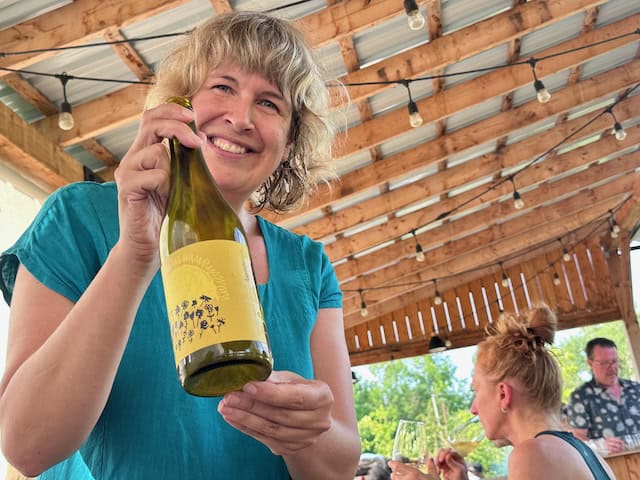
woman with wine bottles
There’s no need to leave the city to taste local wines and chat with winemakers.

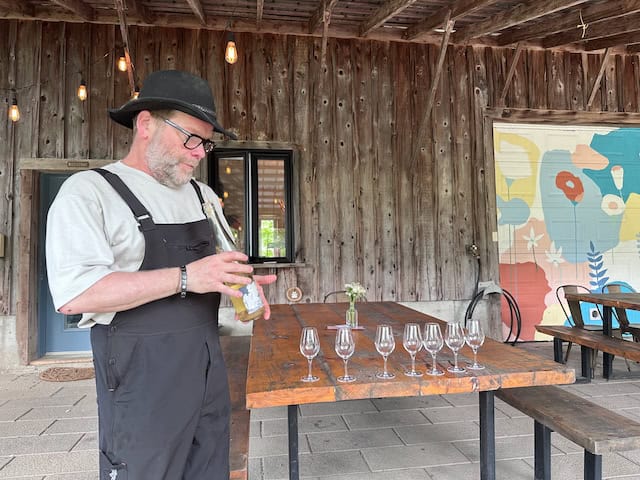
We had planned to drive to the countryside to visit wineries, but instead discovered Comptoir des Vignerons right in Gutenberg Place. The wineshop specializes in local wines and features a Vignerons du Jour program, or winemaker of the day, where a local winemaker pours and discusses their wines. For 8 €, you’ll sample five wines and chat with the vintner. Guided tastings (20 €) are also available. The shop is closed Sundays and Mondays.

Strasbourg also has its own locally brewed beer, Meteor, which you’ll find in many bars and restaurants.

Where to Eat: Try Our Favorite Tables

The culinary combination of German and French cuisine makes Strasbourg a seriously delicious dining destination.  While there are plenty of international offerings, we focused on Alsatian cuisine, both traditional and innovative. Traditional dishes usually feature pork and sauerkraut, fish and sauerkraut, sausages, and hearty, meaty stews. Onion tarts, foie gras, charcroute garnie, veal kidney, and wild game are also popular Alsatian dishes. We ate most of them. Some of our favorite tables were:

  • Pompette: Small and elegant, the restaurant features locally-sourced dishes with a modern twist, like roasted endive with citrus to start and lamb with black olives for the main. Pompette is slang for tipsy!
  • Foundrefeu: We celebrated my husband’s birthday here with creative, vegetable- forward cuisine. Think mushroom mille-feuille with butternut cream.
  • Winstub Le Clou: Traditional, hearty Alsatian fare is served in a cozy atmosphere. We were surprised when the hostess sat another couple at our table, but we had a lovely evening with the English-speaking French couple from Normandy.
  • Restaurant Au Pont Corbeau: Popular with locals, expect classic Alsatian cuisine in a lively atmosphere. Dining here is also a communal experience. Chat with your neighbors! We met a nice Australian couple and three friends who work in the wine and hospitality industries. One happened to be bar manager at our hotel.
  • Vino Strada Restaurant: This is part wine bar, part restaurant. It’s got an Italian name, but the cooking is Alsatian and elegant. Beetroot with duck breast, figs and blackberries was an excellent starter. Our evening got livelier when a birthday group started a conga line through the restaurant!

Something Sweet

Judging by the sheer number of patisseries and bakeries in Strasbourg, Alsatians must have a collective sweet tooth. Try Patisserie Avelina for exquisite cakes and baked goods. L’Atelier 116 was also good but very crowded and there’s always a line.

cookies and baked goods
It’s easy to satisfy a sweet tooth in Strasbourg! Gingerbread and other seasonal sweets were already in the shops in early November.

Where to Stay: Art Deco Delight

Strasbourg offers hotels at every price point, but we loved Maison Rouge, a Marriott Autograph Collection property housed in a historic Art Deco building. It’s full of character and within walking distance of nearly everything we were interested in seeing.

The service at Maison Rouge was exceptional. Hotel staff were gracious, knowledgeable and incredibly helpful. On our first night, we were unsure how to get to the restaurant we had booked, and Paloma, the front desk associate who had checked us in, offered to walk us there on her way home. It was a generous gesture that we genuinely appreciated, along with her tips for navigating the city!

Why Go to Strasbourg in November?

Cathedral at night
Strasbourg’s iconic cathedral lights up the November night.

Visiting in early November turned out to be ideal. Hotel rates were still reasonable, the weather was cool but pleasant, and we could explore the city at a relaxed pace. River-cruise groups had begun to arrive, but nothing like the peak-season surge locals described. If you want to enjoy Strasbourg’s holiday spirit without the Christmas Market crowds, a late autumn visit offers the perfect blend of atmosphere and breathing room.

Written and photographed by Jeanne Neylon Decker

This article and all materials published by TravelTawk.com are protected by US Copyright Laws.

This post may contain affiliate links. If you click and book, I may earn a commission at no cost to you. Thank you. I promise not to spend it all on ice cream!

Berlin’s Little Istanbul and the Turkish Market

Berlin is home to the largest Turkish community outside of that country. In fact, approximately 200,000 Berlin residents claim Turkish heritage making them the city’s largest ethnic minority.  The Kreuzberg neighborhood in central Berlin, known as Little Istanbul, is home to many of them, including our server at the Ritz Carlton. It was she who suggested we visit the popular Turkish market on Maybachuferstrasse.

IMG_0393

Berlin’s Turkish Market is held Tuesdays and Fridays from 11 a.m. until 6:30 p.m.

Tuesday morning we jumped on the Number 2 Ubahn line at Potsdamerplatz, changed at Alexanderplatz (a major transit hub) to the Number 8 line and took it to Schonleinstrasse. We walked a few short blocks on Schinkestrasse heading East towards the Landwehrkanal and Maybachuferstrasse—home of Berlin’s largest outdoor Turkish market.

IMG_0386

Kreuzberg in central Berlin is known as Little Istanbul for its large number of Turkish residents, the largest community outside of Turkey.

IMG_0378

Fresh produce, spices and herbs are in abundance at the Turkish Market on Maybachuferstrasse.

IMG_0394

Shoppers line up to take home these kabobs.

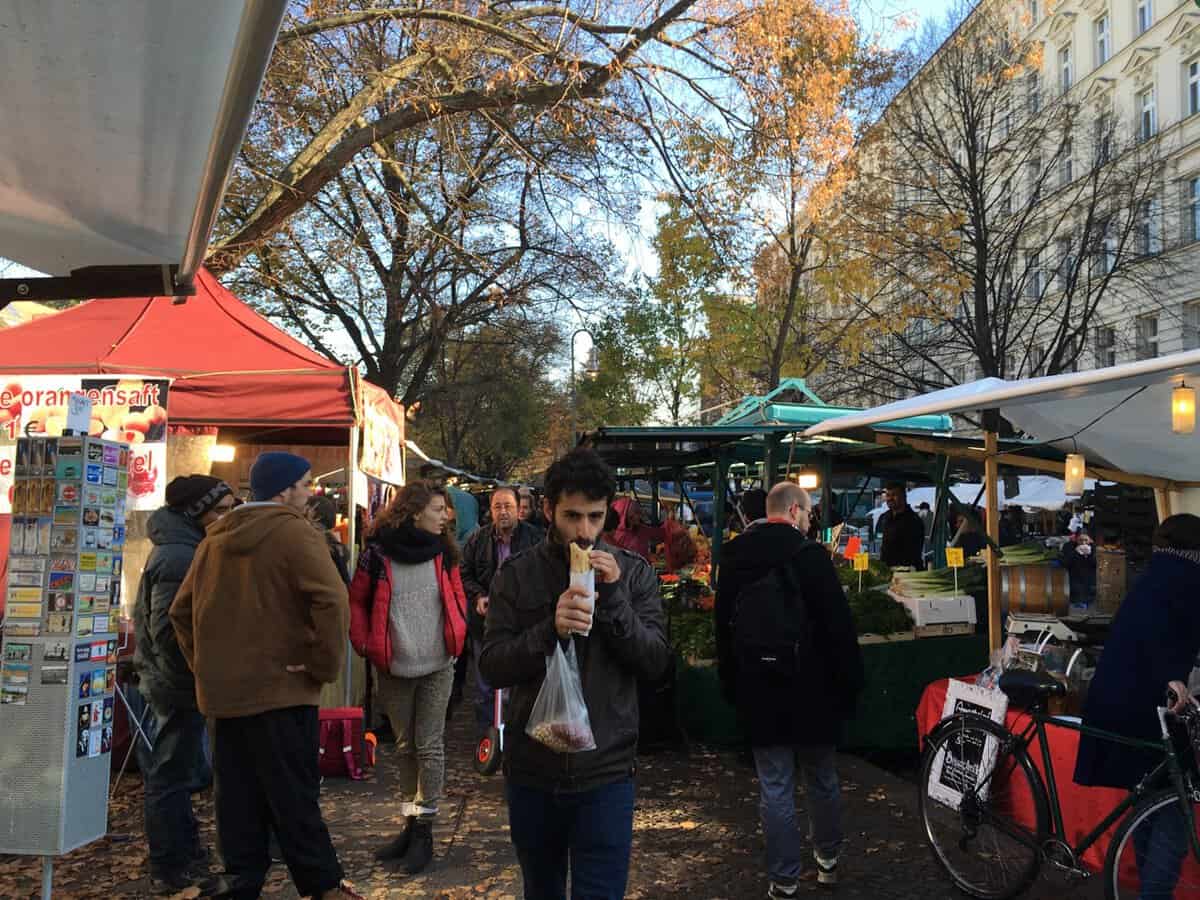
Vendors set up shop from 11 a.m. until 6:30 p.m. on Tuesdays and Fridays and draw quite a diverse crowd from young mothers pushing their strollers to older residents in traditional garb to tourists looking for a quick bite from one of the many food stalls.

IMG_0408

The Turkish Market draws a diverse crowd.

IMG_0400

Fresh baked breads are one reason people flock to the market.

IMG_0416

Fish doesn’t get much fresher than this.

Merchants hawking fresh produce, baked goods, fresh fish, cheese, spices, flowers, clothing, toys, electronics, leather goods, table linens and a surprising quantity of fabric and sewing notions line the approximate half-mile on Maybachuferstrasse.

IMG_0410

Thread, buttons, ribbons, trim, and other sewing needs are all available at Berlin’s Turkish Market.

IMG_0385

Stalls with brightly colored bolts of fabric for clothing and household needs line Maybachuferstrasse.

Young people lounge along the canal enjoying impromptu musical performances by buskers while neighbors shop and chat. It’s a very lively scene.

IMG_0418

A cup of subtly spiced saklep, a hot beverage akin to a milky tea, is just the thing on a chilly autumn day.

IMG_0422

It was hard to resist these delicious looking, aromatic Anatolian delights.

We were very tempted by the delicious looking food on offer at the market but had reservations for lunch at Hasir, so we continued on.

IMG_0436

Hasir is a popular Turkish restaurant with authentic cooking and a casual vibe.

Though we probably could have walked, we were really hungry so we got back on the Ubahn and took the Number 8 one stop to Kottbusser Tor. A quick walk northeast on Adalbertstrasse brought us to the heart of Kreuzberg’s Turkish neighborhood and Hasir, located at Adalbertstrasse 10.

The casual restaurant features traditional Turkish dishes with lamb and kabobs playing a major role on the menu. The service was efficient but friendly, and the meals were well priced.  They get quite a crowd here and even after the typical lunch period, the restaurant was full.

IMG_0433

Lamb, salad and roasted pepper with traditional bread made a delicious lunch at Hasir.

IMG_0434

Entree portions are large enough to share.

After a delicious lunch we walked past several other eateries that were also part of the Hasir group, including a Hasir Express.

IMG_0441

We stopped into a local bakery and treated ourselves to some just baked baklava—delicious!

IMG_0440

We weren’t really hungry but the pastry looked so good we had to stop in.

On our way back to the Ubahn, we took a detour at the Istanbul Supermarket—an enormous Turkish grocery fronted by fresh produce stands.

IMG_0445

From the fresh produce outside, to the bounty within, this supermarket has everything a well-stocked kitchen needs.

IMG_0446

Tea time!

The market had everything from meats, cheeses, canned and packaged goods, to walls of teas and spices. I would have happily filled my shopping bag had we not been staying in a hotel on this trip.  Next time!

Note: This post has been updated from one I published earlier and contains affiliate links.  If you book through TravelTawk.com, I will earn a small commission at no cost to you.  Thank you for your support!


Written and photographed by Jeanne Neylon Decker

This article and all materials published by TravelTawk.com are protected by US Copyright Laws.

O Canada! A Culinary Adventure Awaits in Southern Québec

Wine and Cheese? Oui, Merci!

Canada may not be the first country that springs to mind for wine tourism, unless you think of the Okanagan Valley in British Columbia with 284 wineries and 4,486 hectares of vineyards, or Ontario, known for it’s world-class ice wine. Québec, with 125 wineries and 775 Hectares dedicated to viticulture, is Canada’s third largest wine region and a growing force in the country’s wine industry.

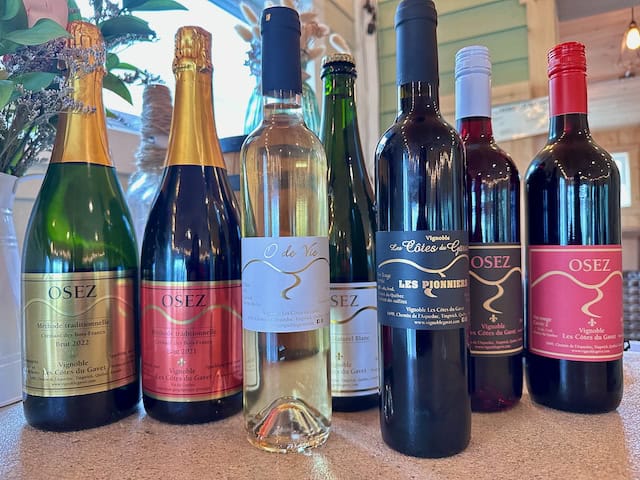
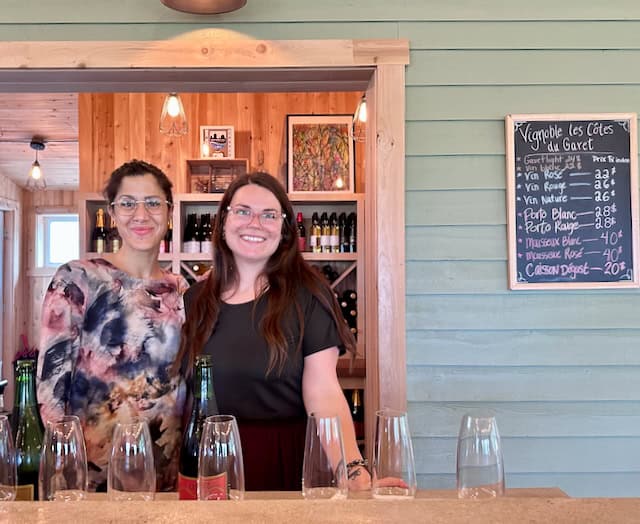
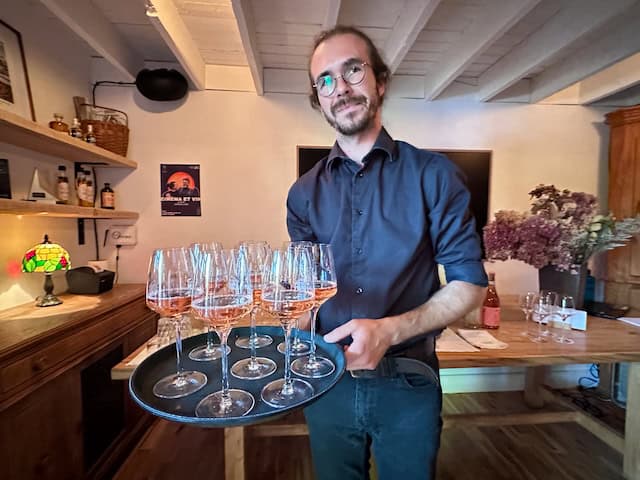
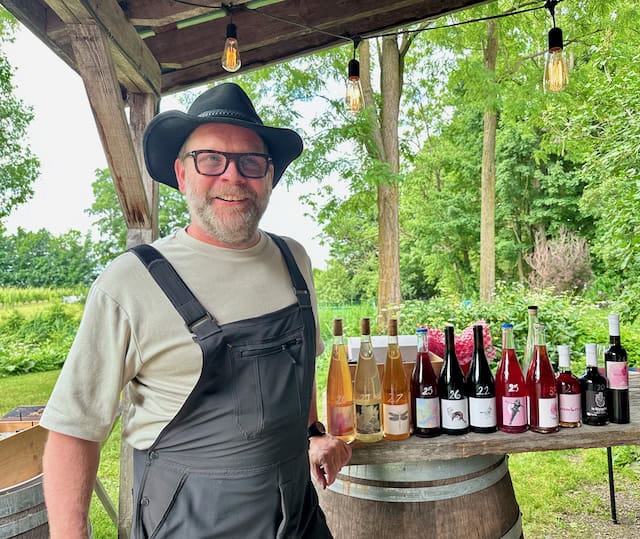
Our journey began with a visit to Vignoble Cotes du Gavet, a family-run, award-winning winery in Centre-du-Québec. The Marchand family has been making wines here since 2023 from vineyards that have been producing since 2000. We sampled several of their wines including their pet nats (petillant naturel).  I was particularly partial to the sparkling rose. The wines, under both Cotes du Gavet and Osez labels, are made using local hybrid grape varietals like Frontenac Blanc, Frontenac Noir, Louise Swenson, Sabrevois, Petite Pearl and Crimson Pearl.

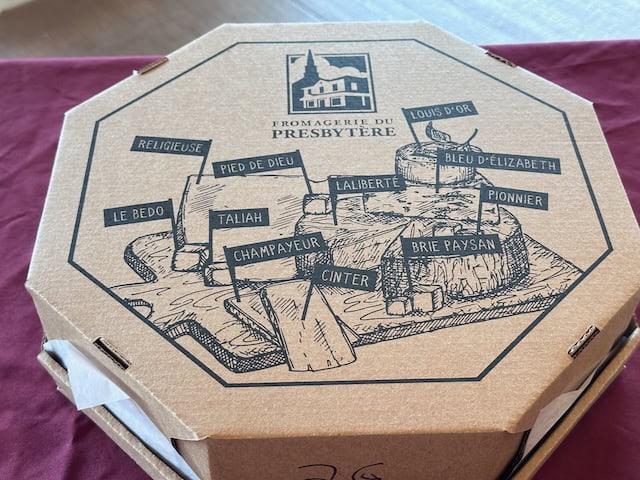
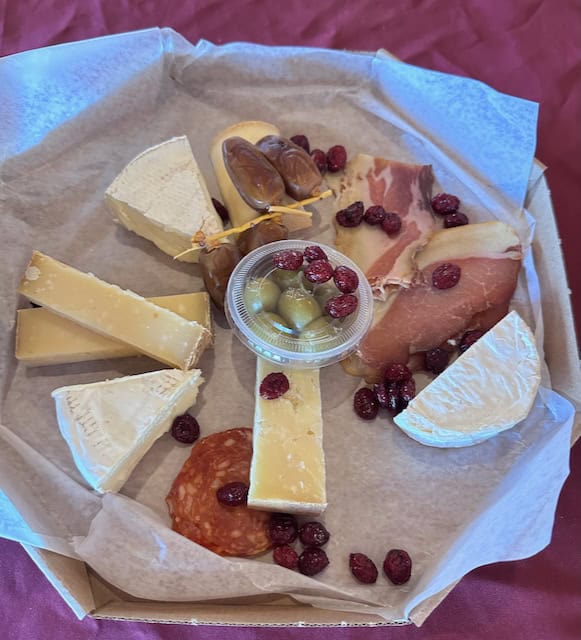
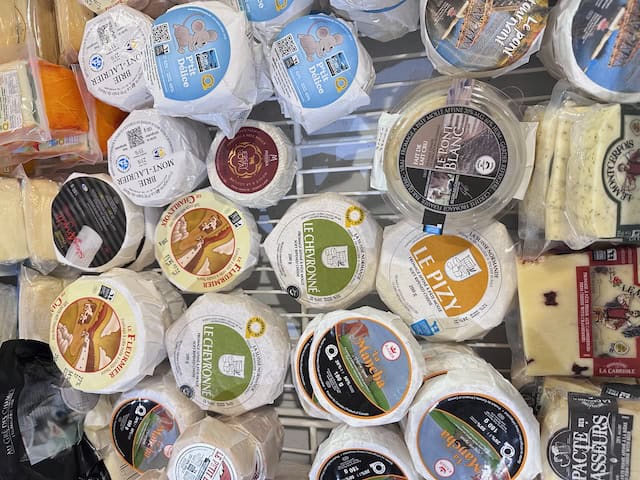
The wines were accompanied by delicious cheese from Fromagerie du Presbytère.  Their award-winning cheeses are produced nearby by the Morin family using milk from their dairy farm, Ferme Louis d’Or, and aged in a former church, which retains a small chapel for worship.  Our cheese platter featured Louis d’Or aged 24 and 36 months, Religieuse, Bleu d’Elizabeth and Laliberte.  I’d love to visit their shop in St. Elizabeth du Warwick during one of their famous Friday summer picnics, featuring live music and open to all.

Poutine!

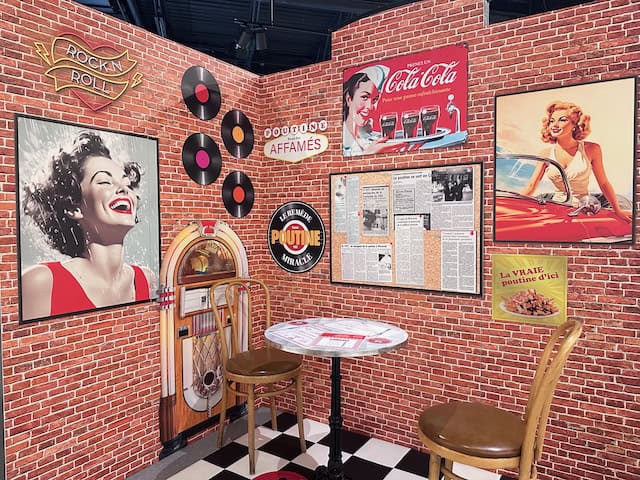
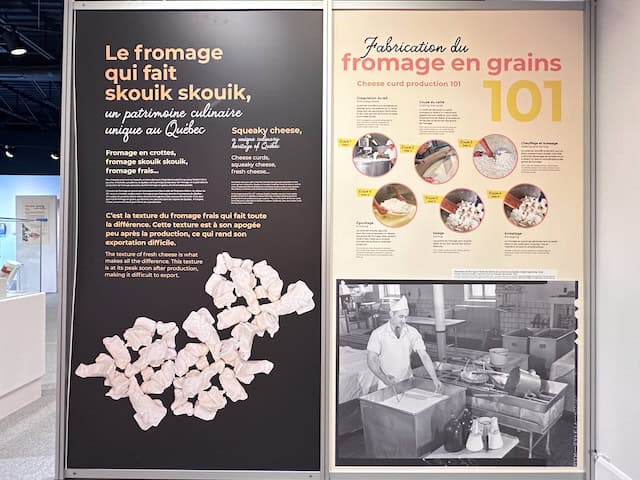
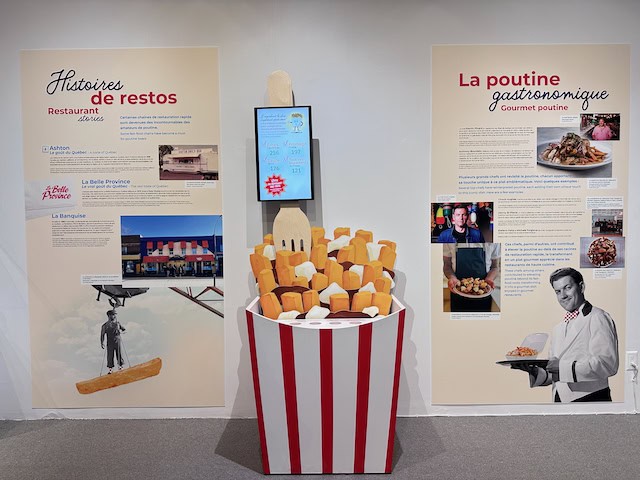
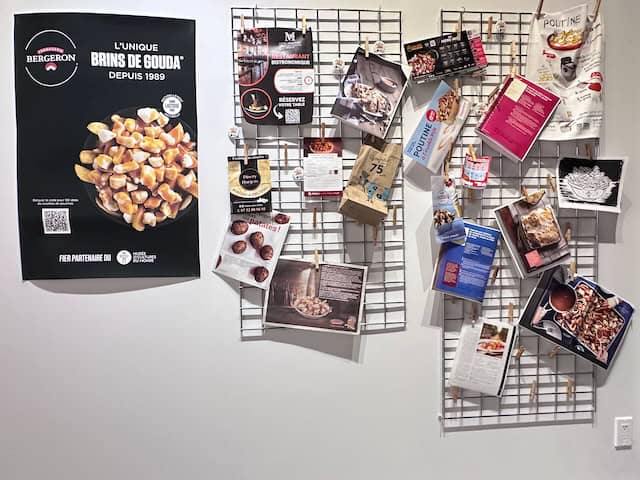
Poutine is almost synonymous with Québec and at the Musee des Cultures du Monde we learned all about this beloved regional dish and its controversial beginnings.  We discovered how the iconic dish which is traditionally made from French fries, gravy and cheese curds, has been adapted globally to reflect local tastes in nearly every corner of the world.

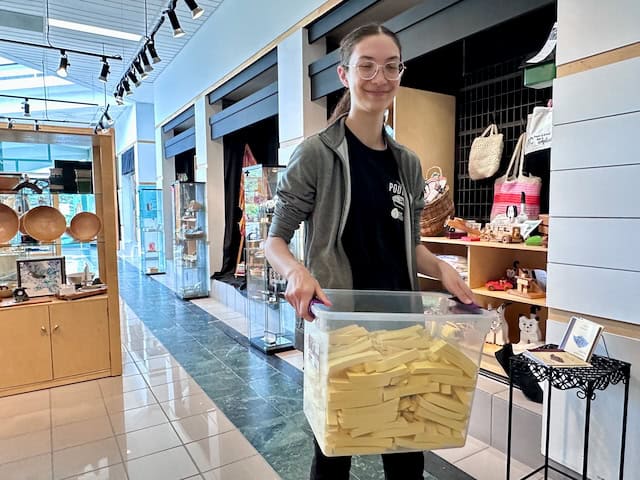
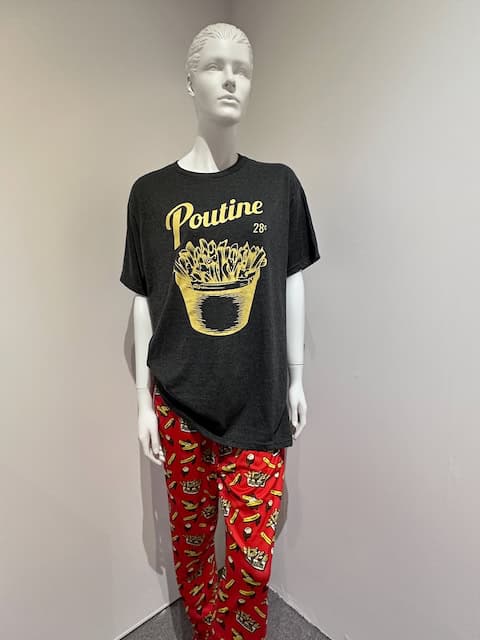
We had fun voting for our favorite origin story and most important ingredient using giant plastic French fries. The only thing missing here was actual poutine, which I think we were all craving at the end of the exhibit, but the poutine-themed merch in the gift shop was impossible to resist and made up for missing the tasty dish.

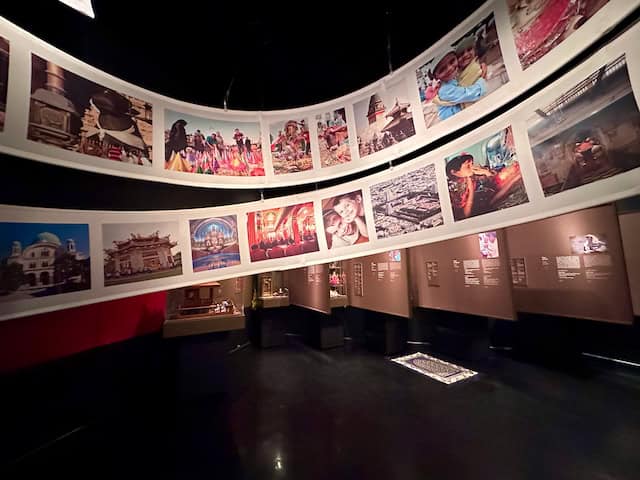
Poutine: A Culture of all Flavors is a special exhibition and closes September 28 but there is more to see at this small museum in the Centre-du-Québec.

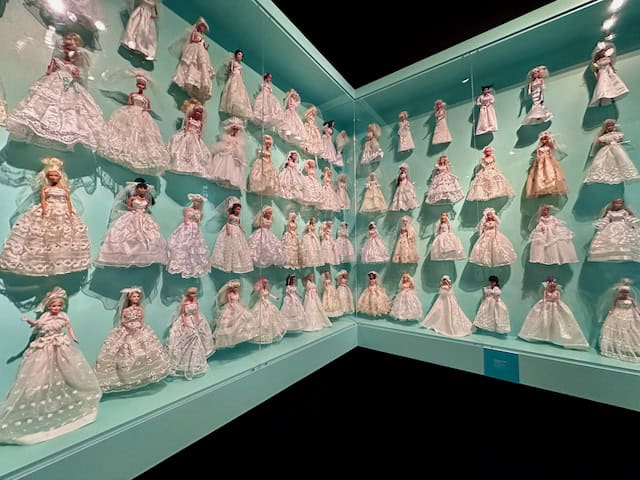
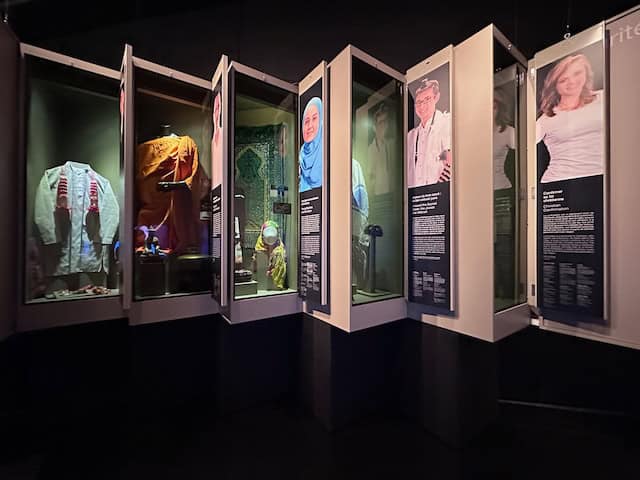
The museum has ongoing exhibitions about world religions including a massive display of Barbie dolls illustrating wedding customs from many cultures.

Elevated Cuisine at Au Paturage

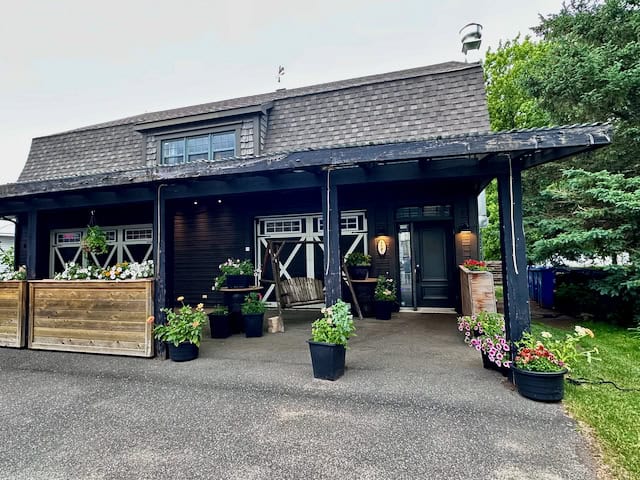
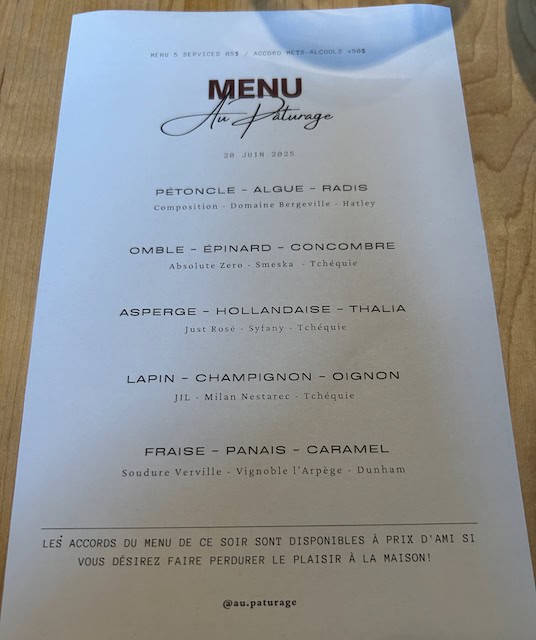
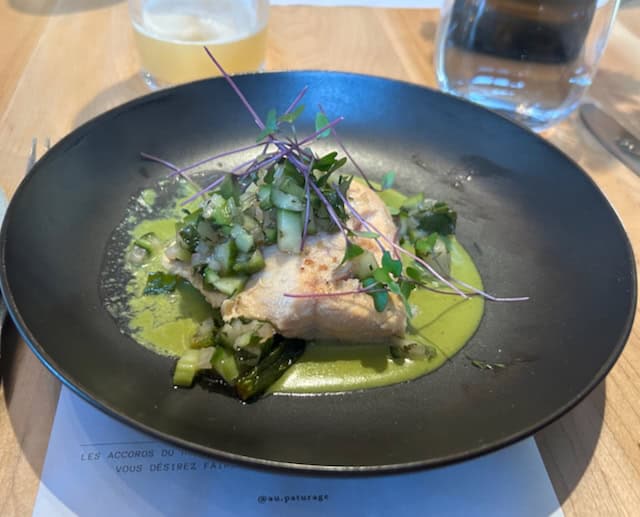
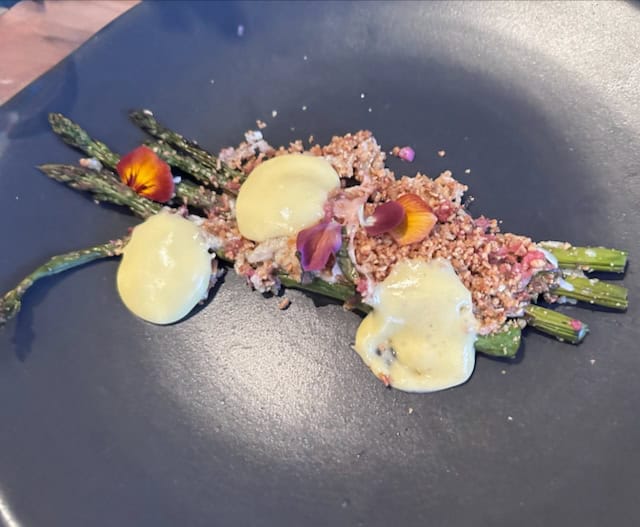
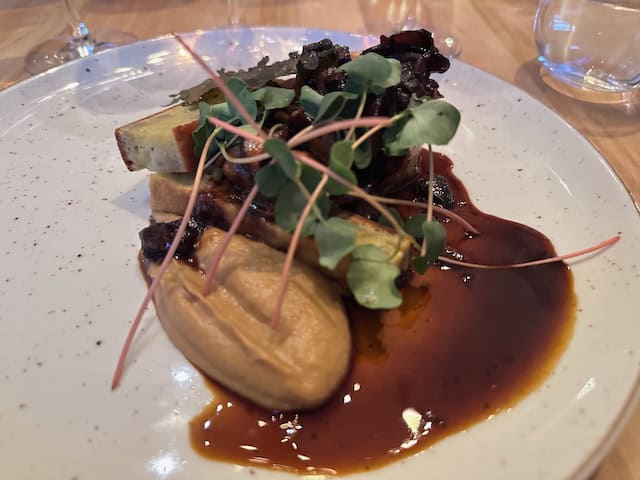
Au Paturage roughly translates to at the pasture and the restaurant is indeed surrounded by agricultural fields and flower- filled meadows. The elegant Au Paturage- Espaces Gourmand,

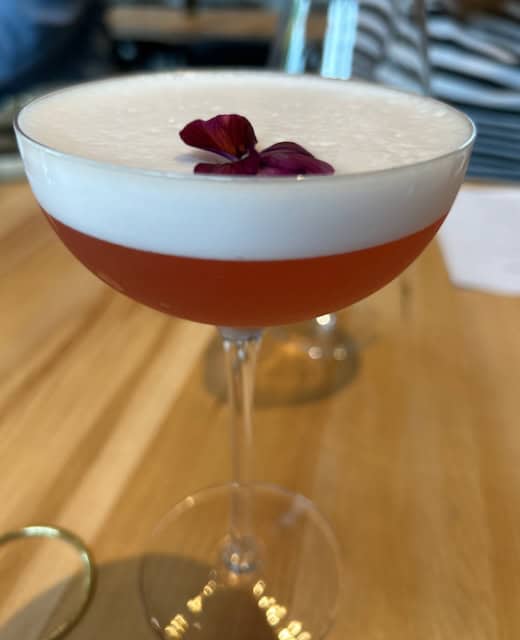
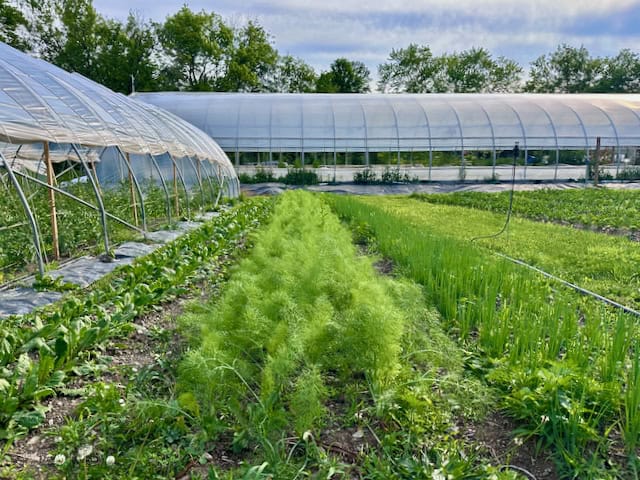
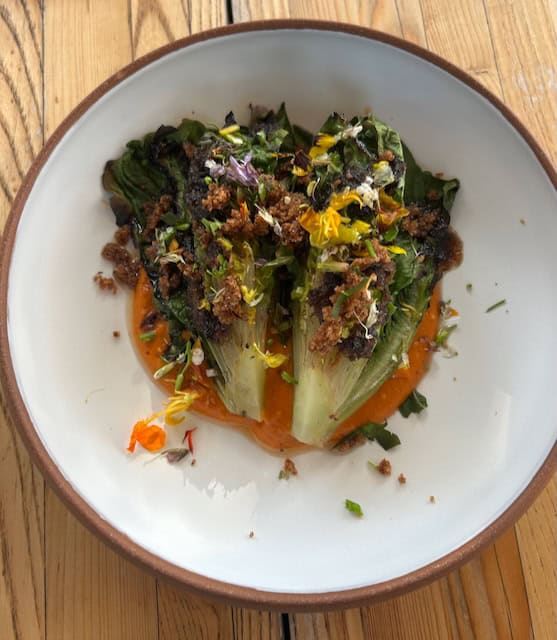
focuses on seasonal, locally sourced foods, including produce grown on their own three-acre farm, right outside the restaurant. Their cheese comes from Fromagerie Presbytère and meat from Ferme le Roy du Cerf. After a welcome cocktail, it was time to taste the vegetable-forward menu.

Prepared in the open kitchen by Chef Chloe Ouellet, the meal was spectacular and interestingly, was paired with wines from Québec and Eastern Europe. During summer, their dog-friendly 55-seat terrace is open. Be sure to make a reservation.

The (Very) Old Mill

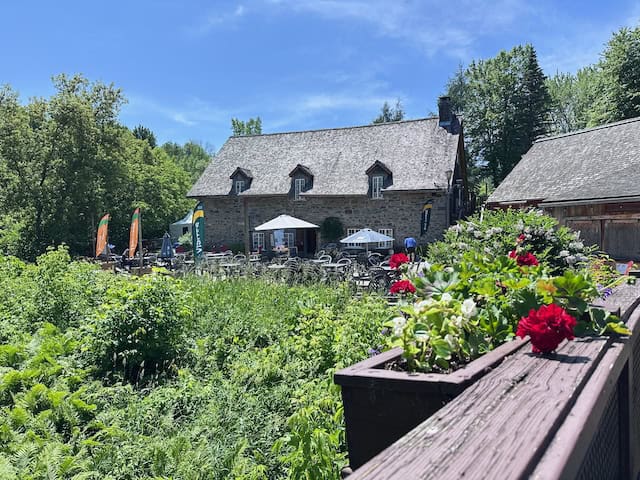
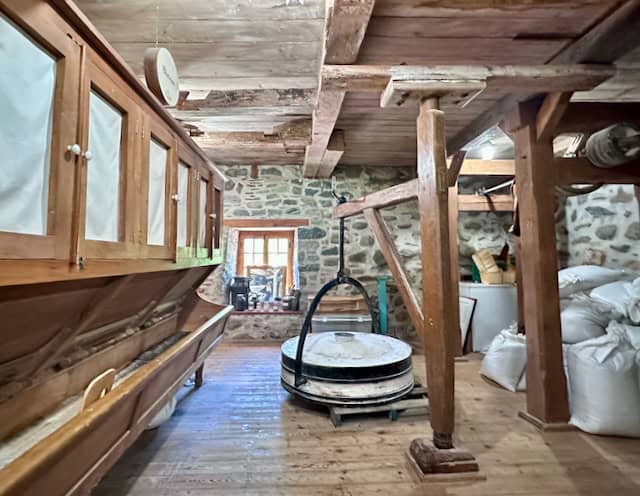
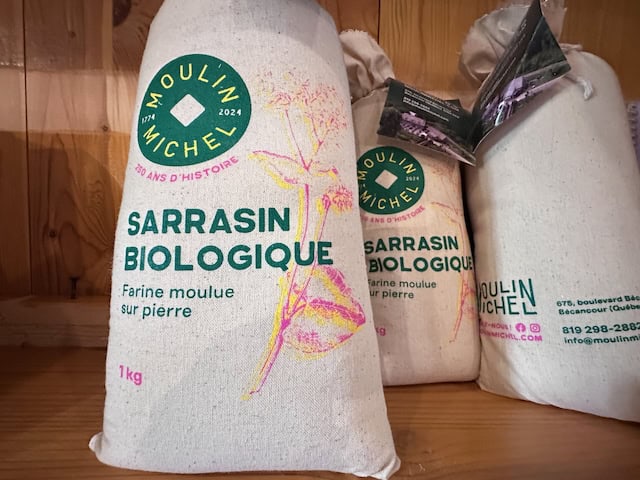
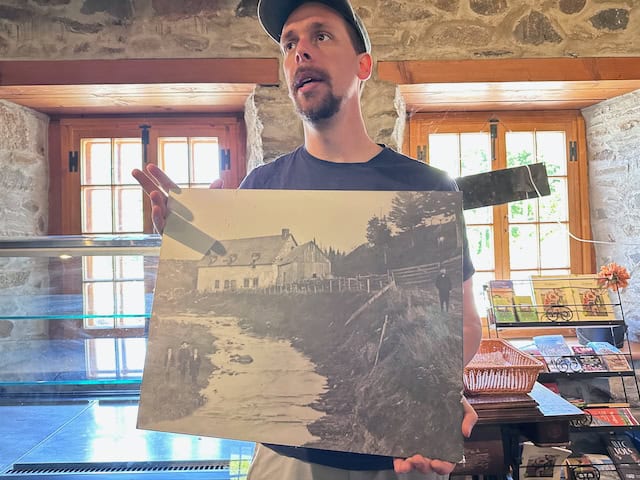
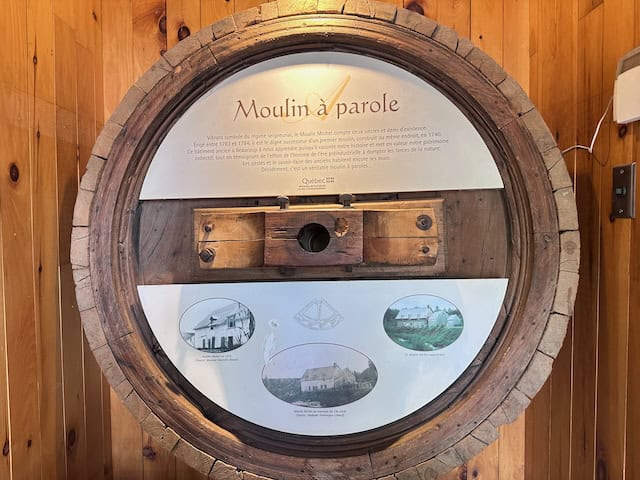
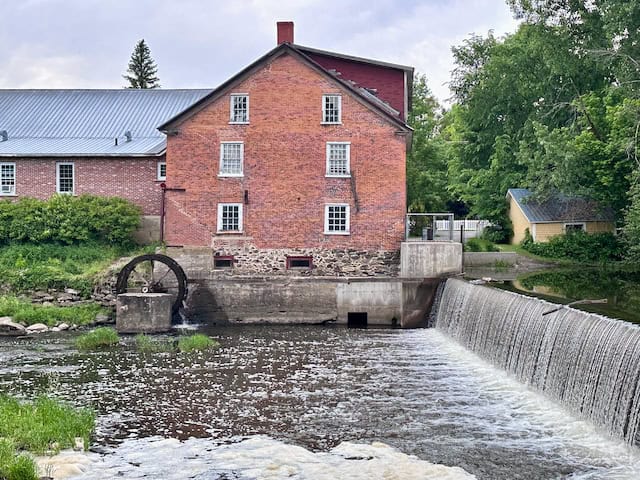
After a night at Hotel Montfort in Nicolet, it was time to move on to Bécancour and a visit to the historic Moulin Michel which has been grinding buckwheat into flour since 1743 in the traditional manner. The current mill has been operating in the Centre-du-Québec since 1774, after a fire destroyed the original mill.  

We had the opportunity to see the hydraulic mechanism and learn about the fascinating history of buckwheat, the 18th century mill, and the area, from owner Philippe Dumas. Fun fact, in lieu of cash, farmers left a portion of their grain as payment to use the mill, which was available to everyone.

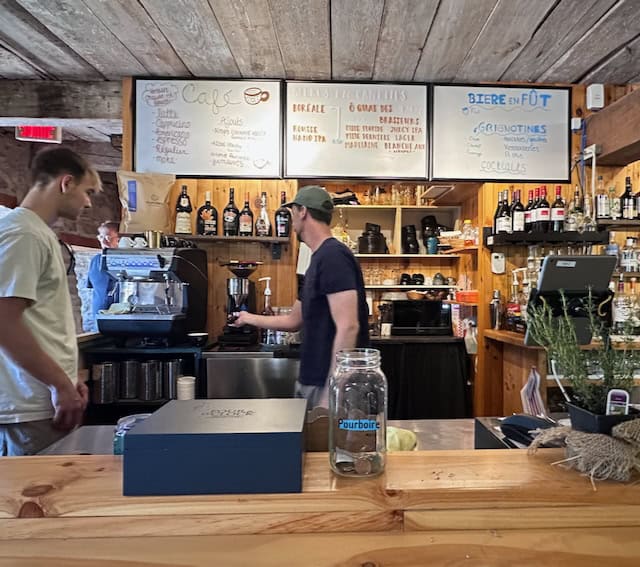
Inside the historic mill building you’ll find a café and shop with delectable pastries, coffee and local products for sale.  In the evening it becomes a bar.

During summer months, the sprawling grounds behind the mill are transformed into an entertainment venue and hosts a Blues Festival, now in its fifth year, that draws 1,200 people to this town of 2,000.

Take a Hike or Bike

We needed to walk off all those goodies and did so with a guided hike at the beautiful Parc des Sommets, a popular natural recreation area in Bromont in the Eastern Townships. In summer, the 150 kilometers of hiking trails draw outdoor lovers of all ages and abilities. It’s also a great place to bike. Let the kids try out the climbing wall or just enjoy a picnic here.

Southern Québec boasts six national parks perfect for outdoor endeavors like hiking, biking and kayaking during lazy summer days and snow sports of all kinds when the winter weather beckons. 

L’Espace Old Mill

Having met our exercise goal for the day, it was time for dinner at one of the toughest tables to get in the Eastern Townships; L’Espace Old Mill. 

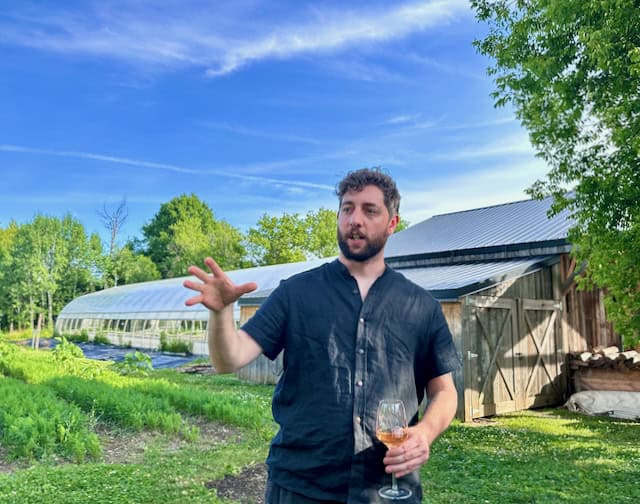
Inspiration and education are on the menu at this extraordinary restaurant that serves only what grows in its greenhouse and gardens (even in Québec’s frigid winter months) and what it can procure from nearby farms. We enjoyed a glass of local sparkling wine while we toured the expansive gardens with Executive Chef Eric Gendron before heading inside the airy dining room to feast on summer’s bounty.

The hyper-local focus is on the cuisine of the Brome-Missiquoi region here. Farmer/owner Jean-Martin Fortier came by and shared his vision for L’Espace Old Mill and their ongoing commitment to sustainable and regenerative farming, widely embraced by farmers in the Eastern Townships.

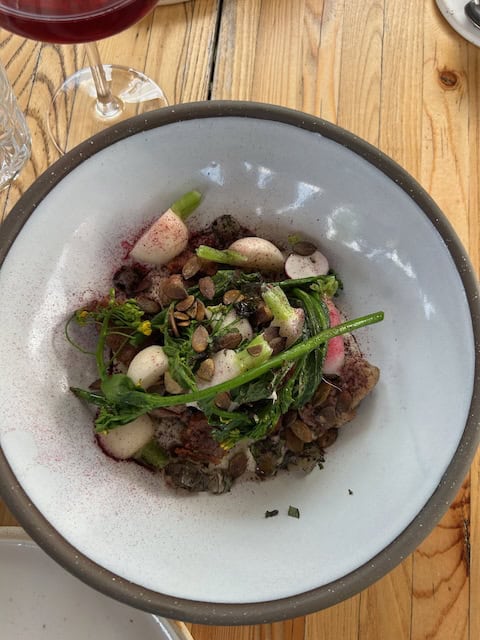
The Michelin Green Star-awarded restaurant’s menu is naturally vegetable-forward, though not vegetarian. I don’t think I have ever had peas or radishes that tasted so sweet and delectable! The wines poured to match the courses were also local. After a remarkable meal, we were off to nearby Hotel Chateau-Bromont, our lux and comfortable home for the night. 

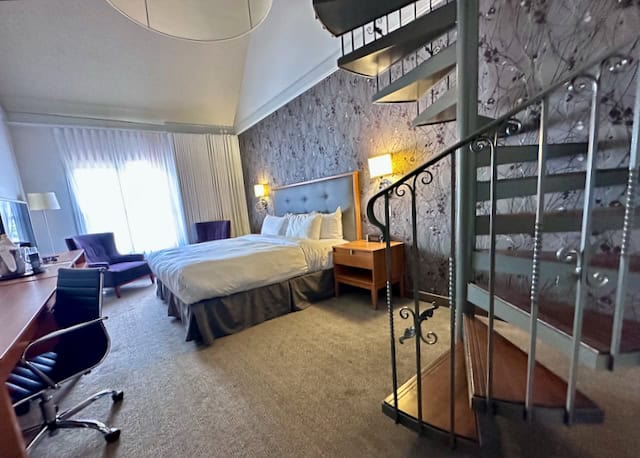
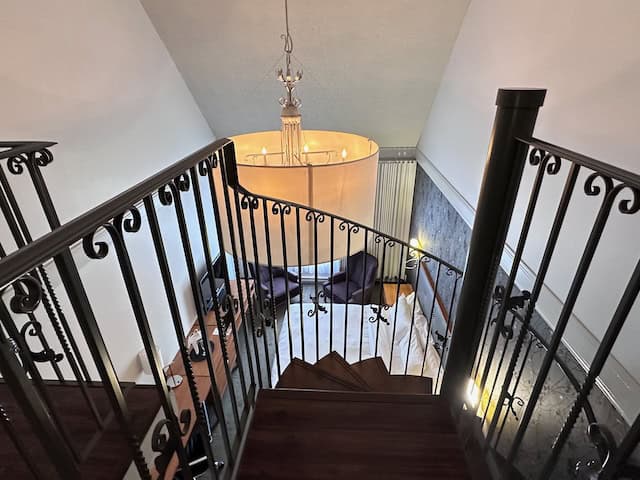
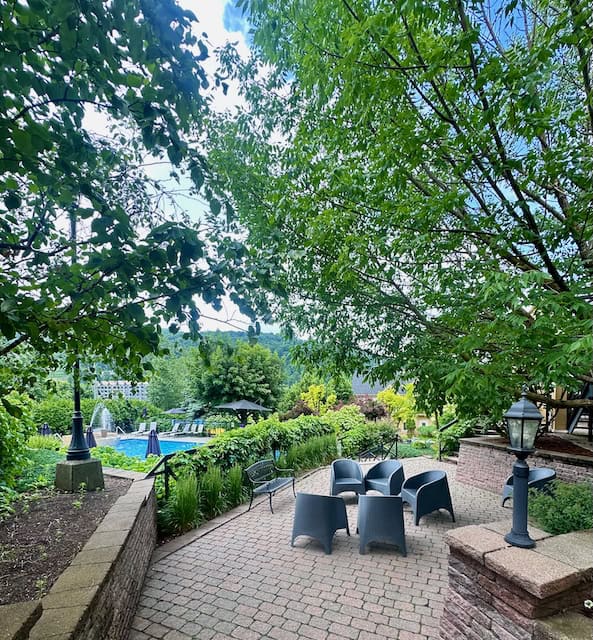
We had a beautiful bi-level room at Hotel Chateau-Bromont with a gorgeous view of the mountains.  After our abundant breakfast, we explored the property, wishing we had more time to lounge around the spa and pool area.  We need a return visit to take advantage of the wellness offerings here and revisit the beautiful nature park! Another dinner at Old Mill would be wonderful, too.

Beer and Brunch

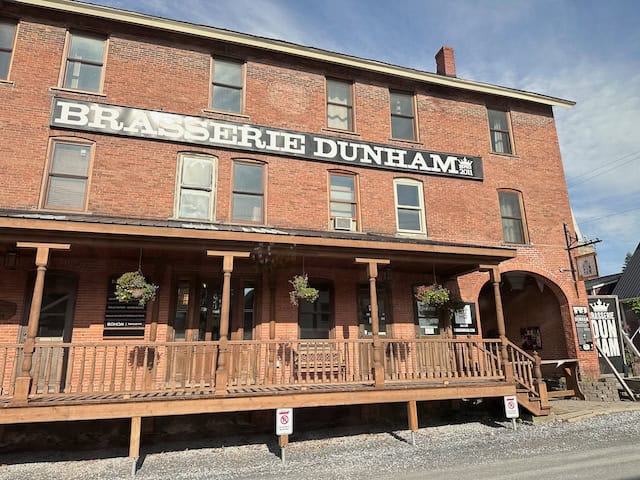
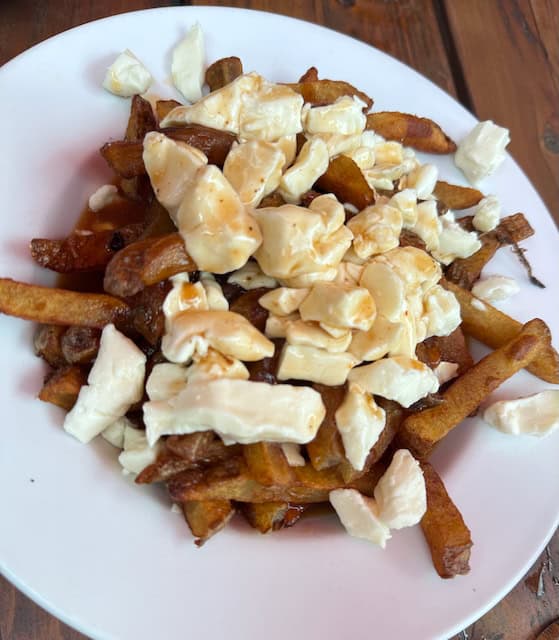
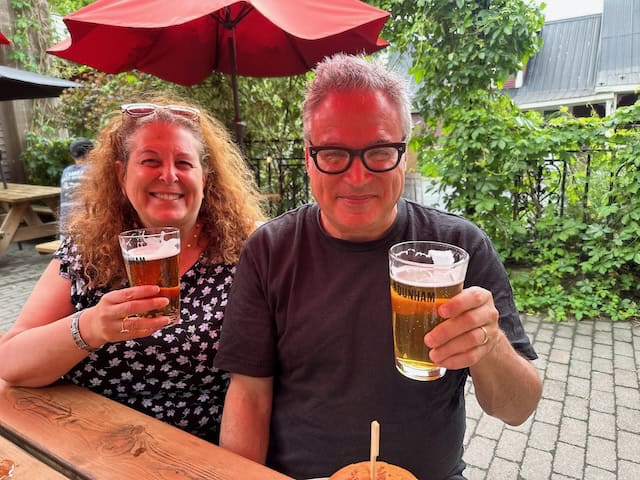
It was time to move on to the charming town of Dunham and the Brasserie Dunham, which brews its own beer. We took a table in the outdoor beer garden and finally, poutine was on the menu! We couldn’t resist ordering a plate to share. 

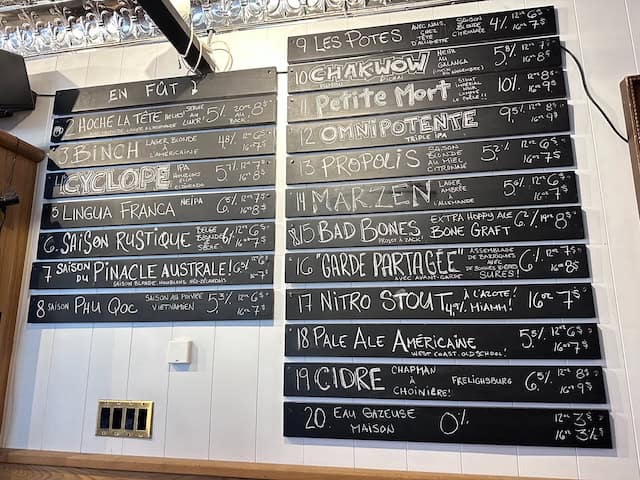
Hearty sandwiches, salads, burgers and other beer-friendly fare make the Brasserie popular for lunch and dinner. The brewery offers beers from blonde lagers to IPAs to seasonal ales and stouts. Our group sampled several. Our wonderful driver Dave was behind the wheel so were able to indulge in adult beverages.

On the Wine Route

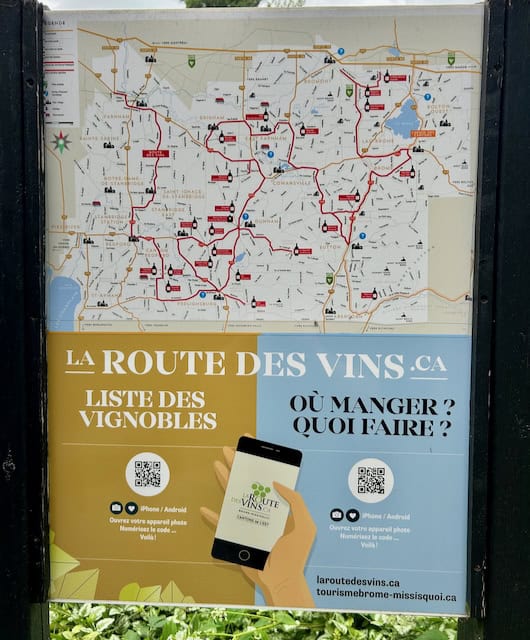
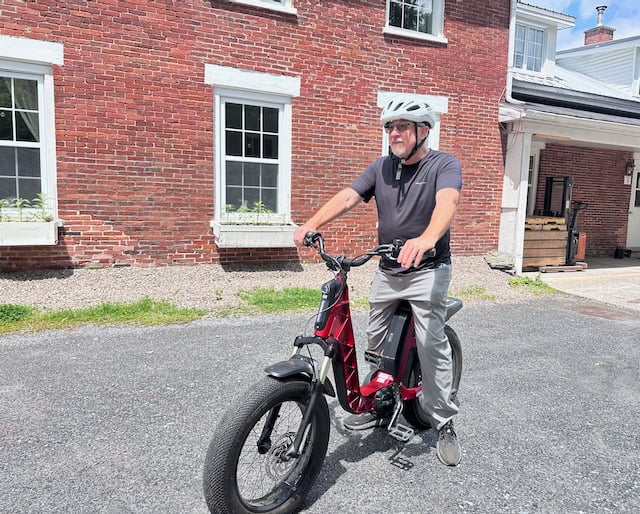
Our stomachs full, we headed out to explore the wine route of Brome-Missisquoi where about 60 percent of Québec’s wine is produced. Now home to more than 20 wineries, the 160-kilometer route winds through beautiful countryside, rolling hills and several pleasant towns in the Eastern Townships. There are itineraries for cars and bicycles available.

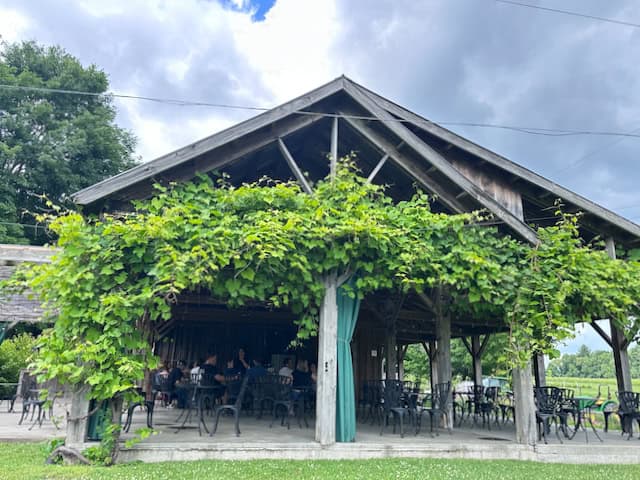
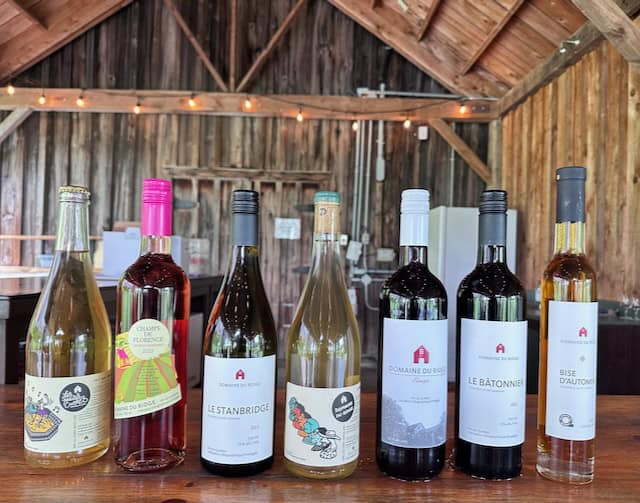
Our first stop was at Domaine du Ridge, a 200-acre property that includes fields, woodlands and 40 acres of vineyards. It’s a popular venue for weddings and other special events. Tours and tastings are by reservation at this 26-year-old winery.

In addition to still and sparkling wines, Domaine du Ridge produces a late harvest made with Vidal Blanc grapes called Bis d’Automne (Autumn Kiss), a dessert wine in the style of Pineau des Charentes, and Mystic, a vermouth. After sampling several still wines from their recent vintage it was time to move on to Vignoble de l’Ardennais.

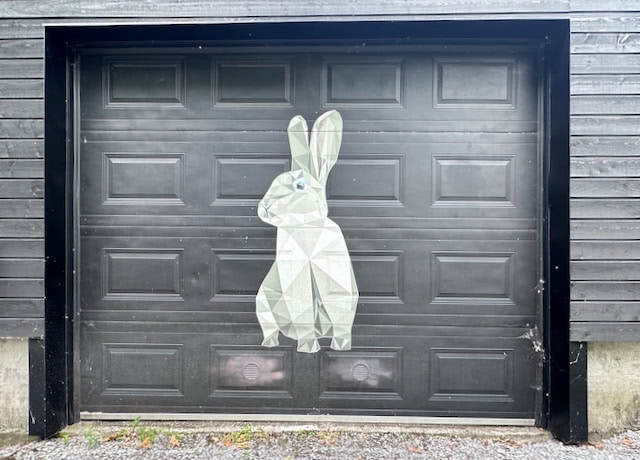
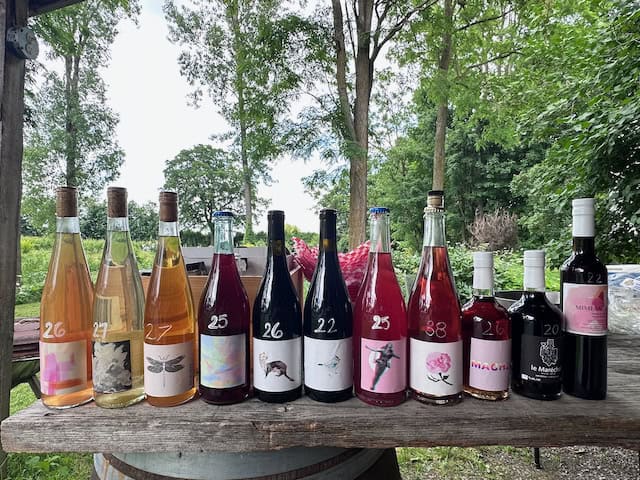
You’ll know you have arrived at Vignoble de l’Ardennais when you see the giant bunny painted on the garage. This was my favorite, both for the wines and the charming owner, Pier Cousineau, who with his wife Stephanie Thibodeau, and adult children Charlotte and Eliot, run every facet of wine production from label design to vinification.


Other than Pinot Noir and Riesling, the grape varieties used here were unfamiliar to me. Seyval Noir, Chancellor, Petite Pearl, Frontenac Noir, Cayuga, and Marquette are hardy hybrid varietals that grow well in the often unforgiving Québec climate. Monsieur Cousineau uses them to full advantage to produce excellent wines and has been since 2016 when they acquired the property. The vineyards had been established by the previous owner in 1994. Grab a glass of Berthe rose and relax in the Adirondack chairs or picnic tables. That’s my idea of a perfect summer Sunday afternoon.

Dining en Plein Aire

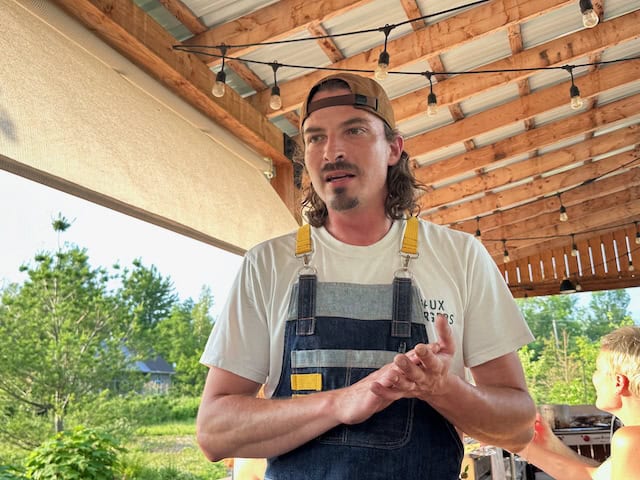
It was a pleasant surprise to find that our Sunday dinner at Les Cocagnes in Frelighsburg would be prepared by chefs Emile Trembly and Sylvain Dervieux from Faux Bergers in Baie St. Paul, where we had spent the weekend before arriving in Québec City. 

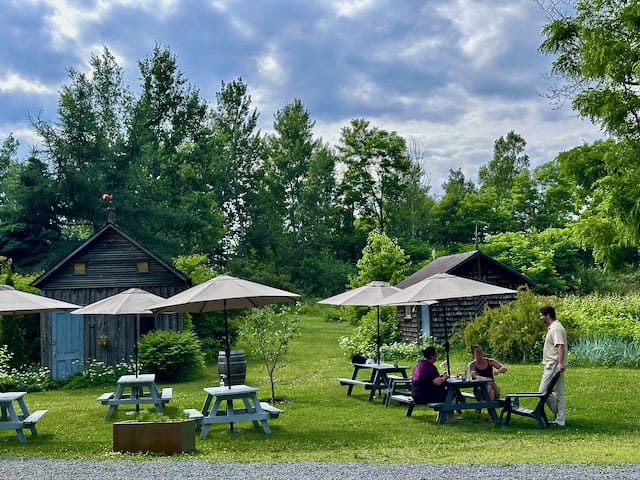
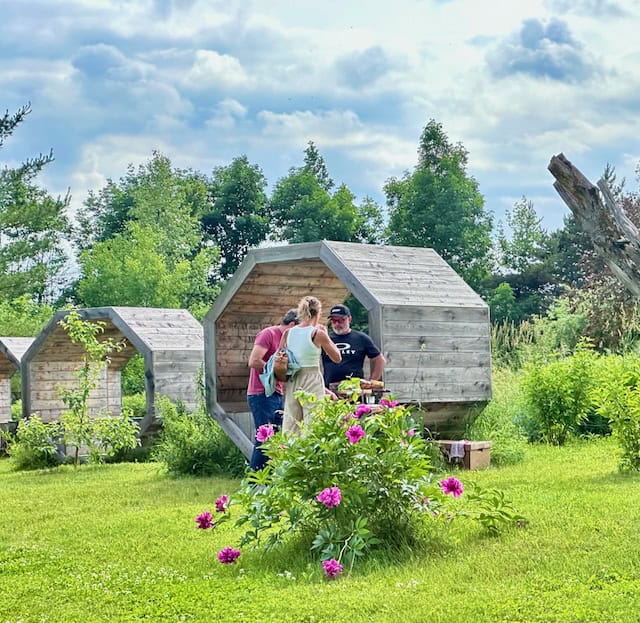
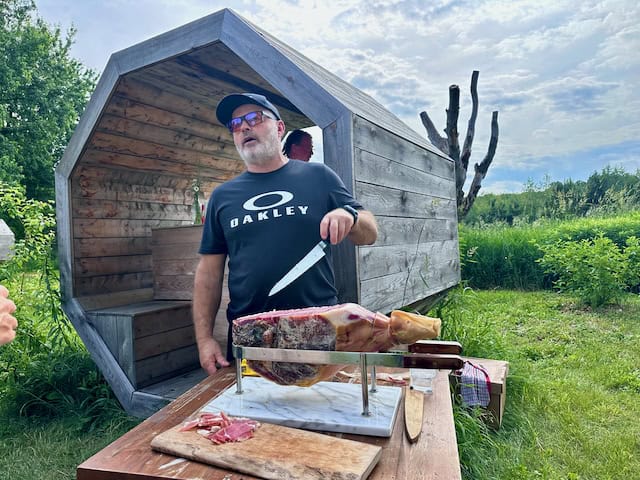
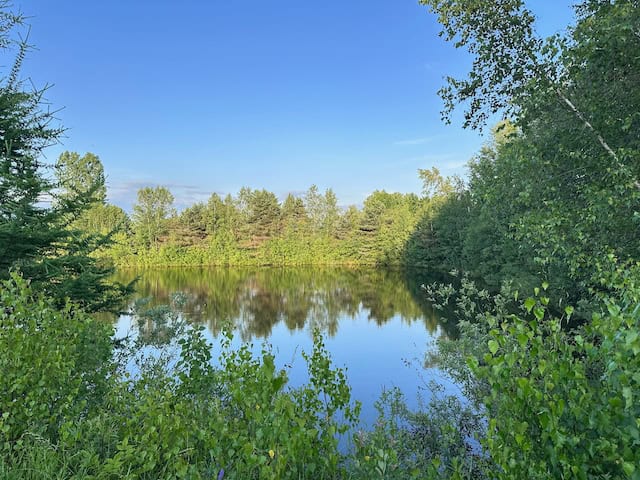
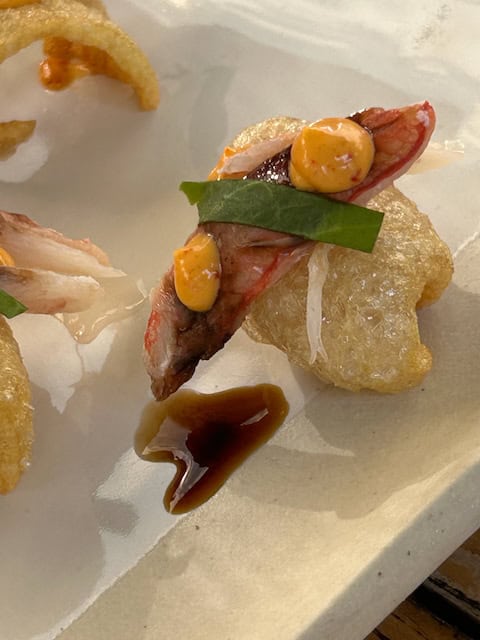
Each summer weekend, chefs from throughout Québec set up shop at this bucolic spot in the Eastern Townships. After an aperitif and hand-sliced local prosciutto, we followed our hostess through the fields and vegetable gardens to the outdoor dining room for a memorable five-course tasting menu paired with local wines. Reservations are essential.

It was time to leave the Eastern Townships for Montérégie. La Cache du Lac Champlain across the street from Lake Champlain was our home for the evening. After depositing our bags in our large room with a golf course view, we headed out for a moonlight walk along the lake.

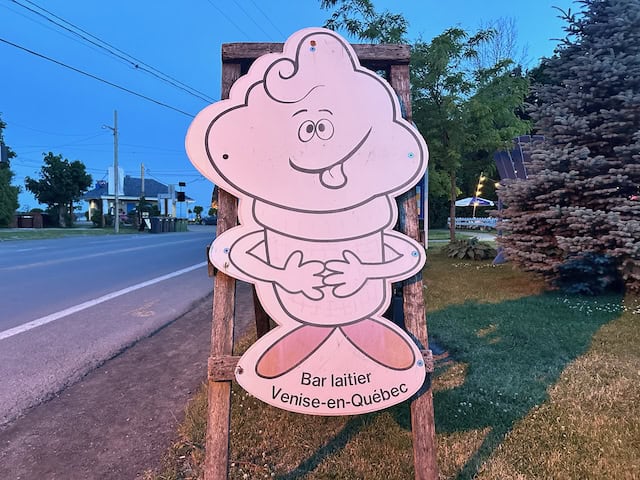
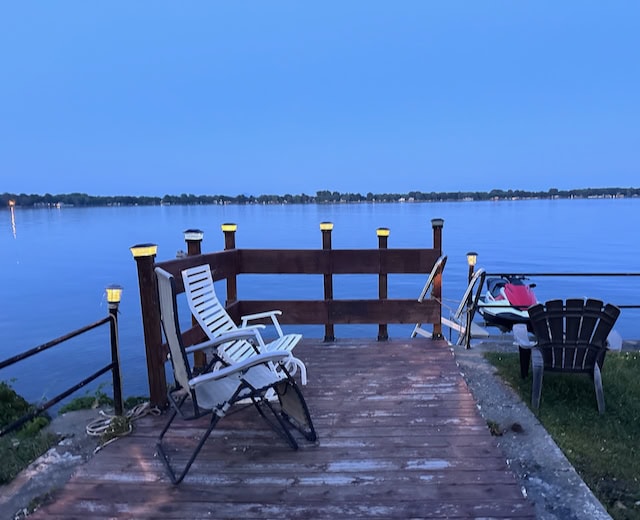
We couldn’t resist a local ice cream stand a few blocks away and enjoyed our cones while admiring the public art and private terraces along the lake front. These terraces, with outdoor furniture and boat docks, dot the lakefront while the homes are across the road.

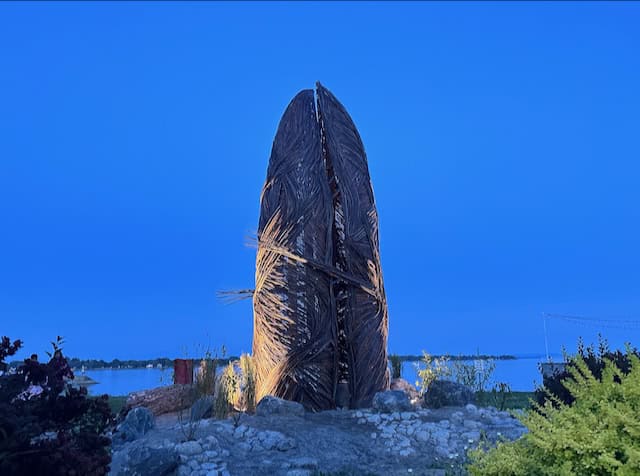
Les Amoureuses (The Lovers) by Veronique Pepin and Patrick Monast has space inside for two. It is the first work in a public art installation in Venice-en-Québec and will be on view through May 2026.

Ferme Guyon and Bonne Saint Jean

We heard people at breakfast greeting each other with “Bonne Saint Jean.” Saint Jean Baptiste (John the Baptist) is the patron saint of Québec, and the Fete de la Saint Jean is a national holiday in the province. This called for a slight change of plans and a trip to Ferme Guyon.

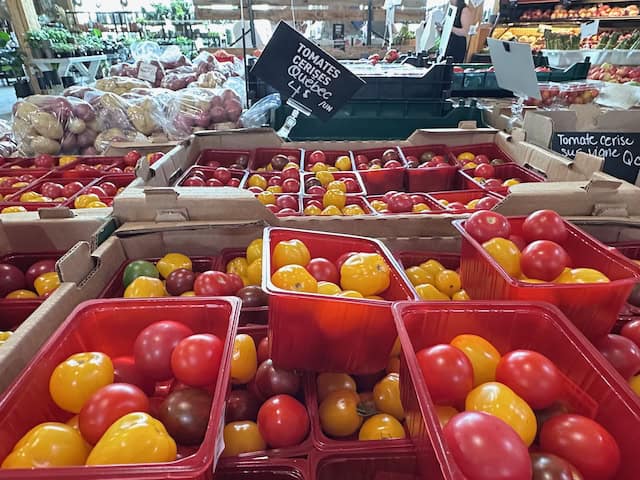
Just 30 minutes from Montreal, this is the supermarket of my dreams. Farm-fresh produce, fine cheeses, charcuterie, maple sugar everything (cotton candy!), and an extensive selection of local ciders, beer and wines, plus Québecois handicrafts make this a one-stop shop for picnic provisions or any meal you’d want to prepare. If you don’t have time to visit local fromageries, wineries and farms, a trip here will definitely give you a taste of local flavors!

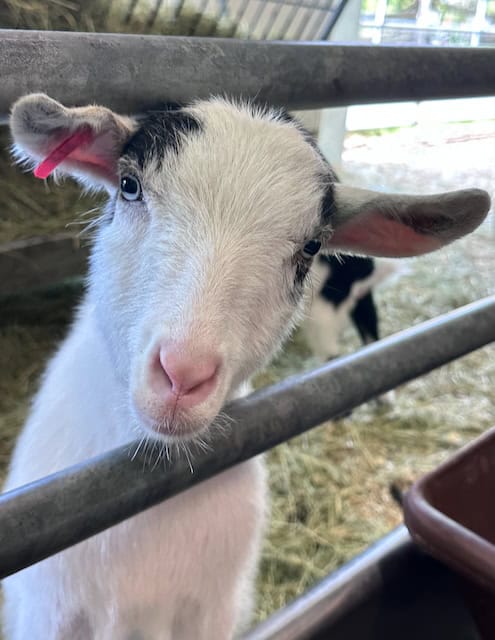
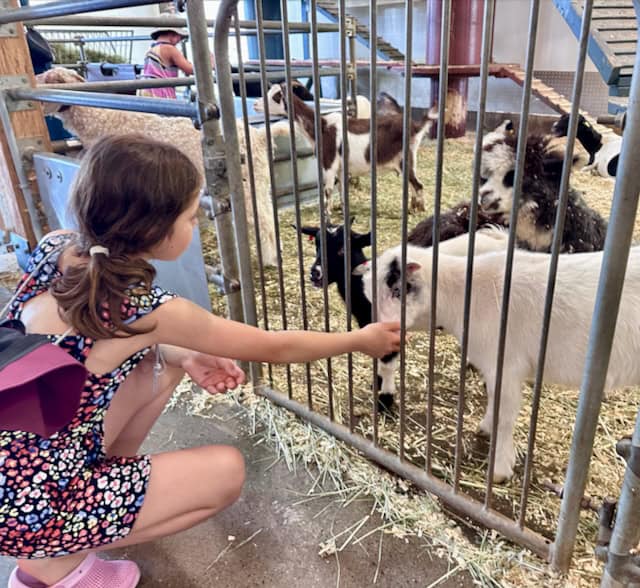
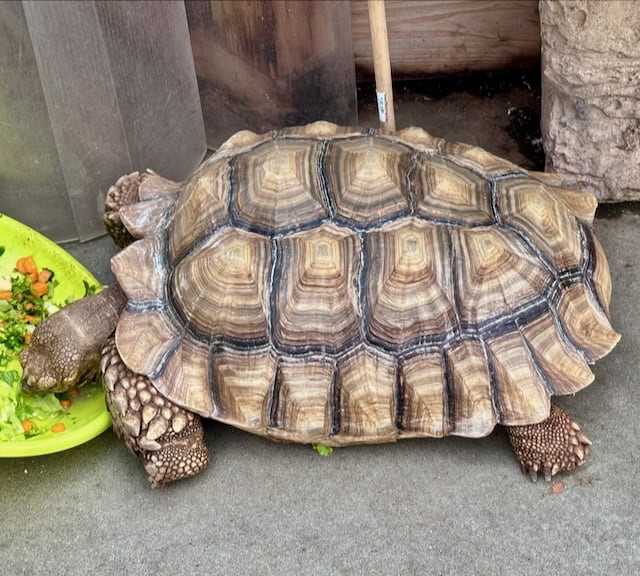
The Ferme Guyon also has an educational farm with adorable baby animals and a butterfly pavilion, which in addition to housing lepidoptera, is the habitat of Oscar, a 14-year old tortoise.  I could have spent the whole day here, but shopping completed, we headed off to Cidrerie Michel Jodoin on the Rougemont Cider and Montérégie Wine Route.

Cider and More Wine

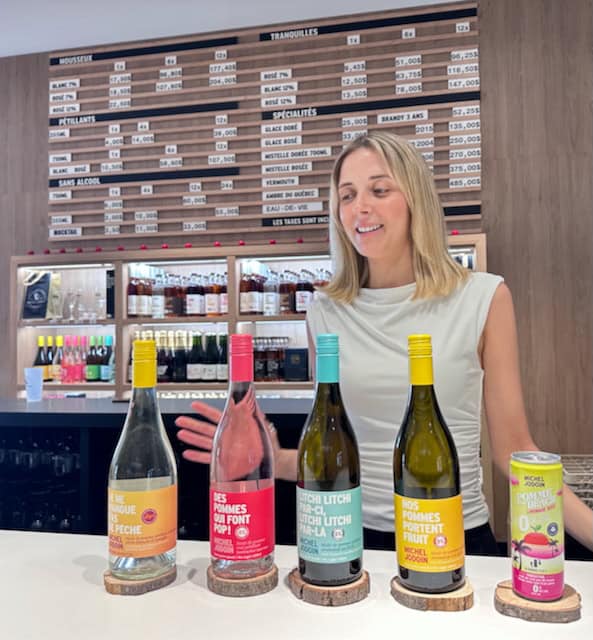
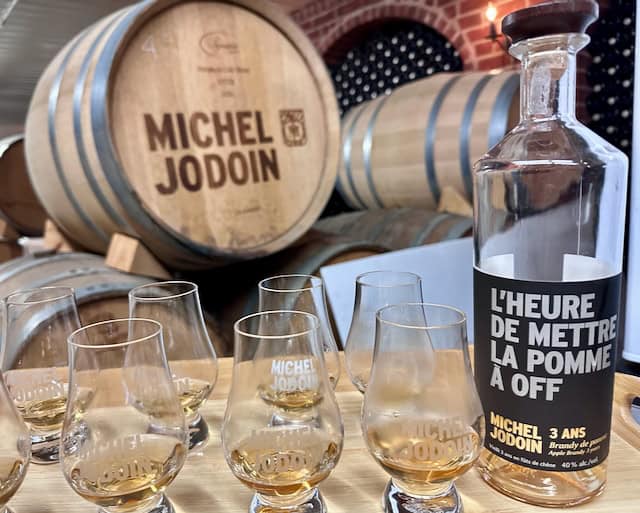
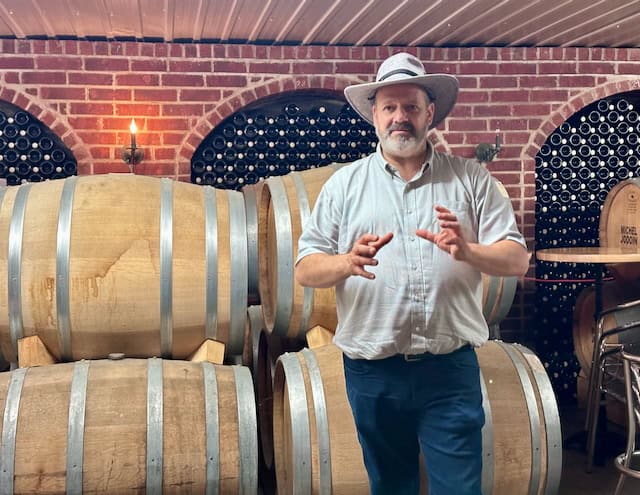
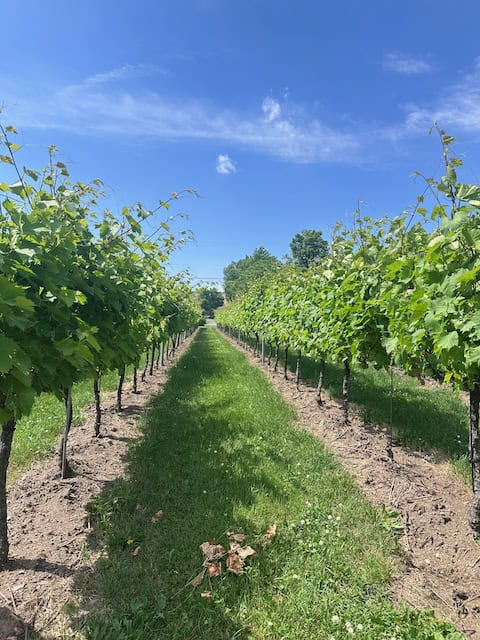
I adore champagne and was intrigued to learn that Monsieur Jodoin had worked in France’s Champagne region in the 1980s and returned to Québec with a plan to make a sparkling wine from apples using the traditional methode champenois.  His family has been in the apple orchard business for five generations, ever since Jean-Baptiste Jodoin purchased 100 apple trees in 1901. Jodoin is now the largest grower of Geneva apples in North America.

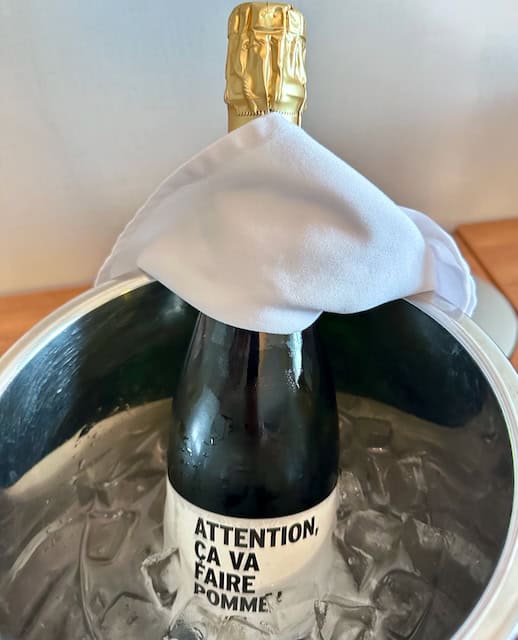
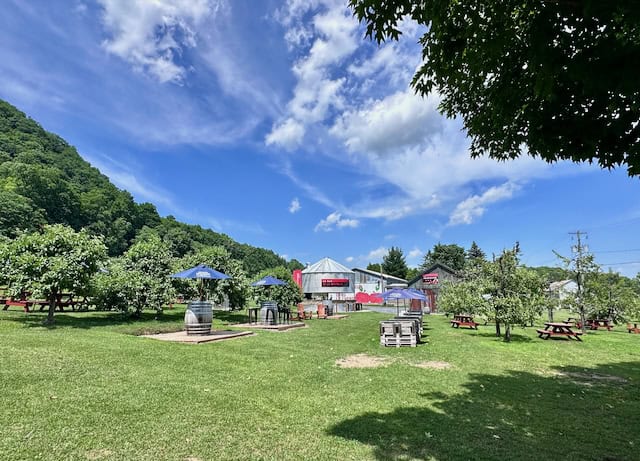
Their award-winning ciders were delicious, and we enjoyed them thoroughly with our picnic lunch in the cidery’s cellars. My favorite was Attention Ca Va Faire Pomme! It’s packaged to look like champagne and captures the wine’s characteristics right down to the perlage or tiny bubbles in the glass. Jodoin makes several refreshing roses from apples, a broad range of fruit flavored ciders, vermouth, and non- alcoholic drinks.  They became the first micro distillery in the country in 1999 and we tasted their spirits, too.  No reservations are needed to visit the Cidrerie Michel Jodoin tasting room. Visitors are welcome to enjoy their picnics outside and can access the hiking trails here. During the summer their grounds are often the site of evening entertainment.

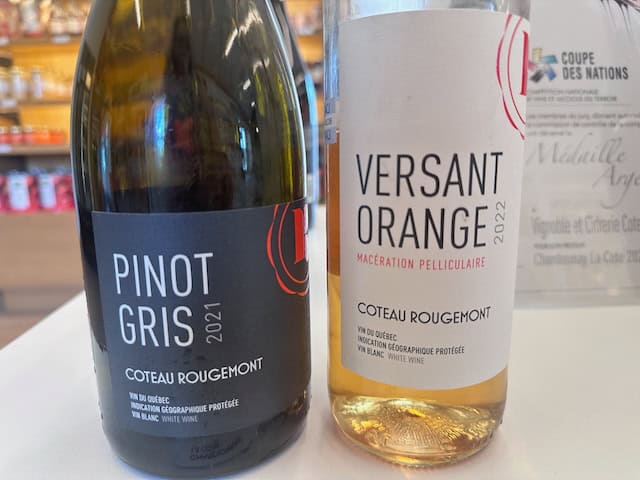
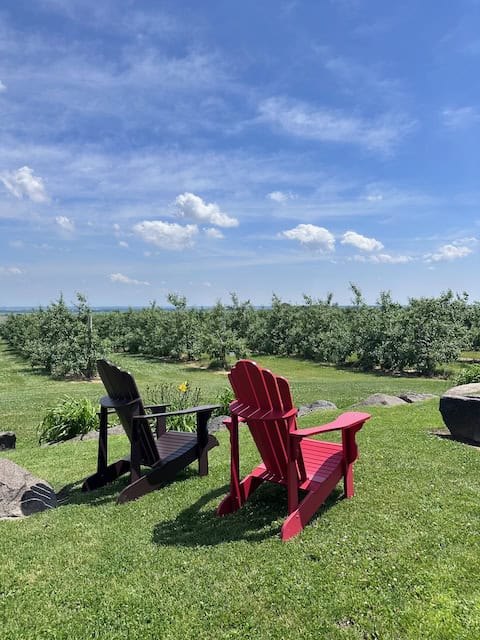
Next, we stopped into Coteau Rougemont just down the road from Jodoin, to sample their wines. The winery was quiet due to the holiday, so we enjoyed a leisurely tasting outdoors overlooking the beautiful gardens and rolling hills of Montérégie. They also sell local honey, jams and maple syrup at the winery.

Spaaaah

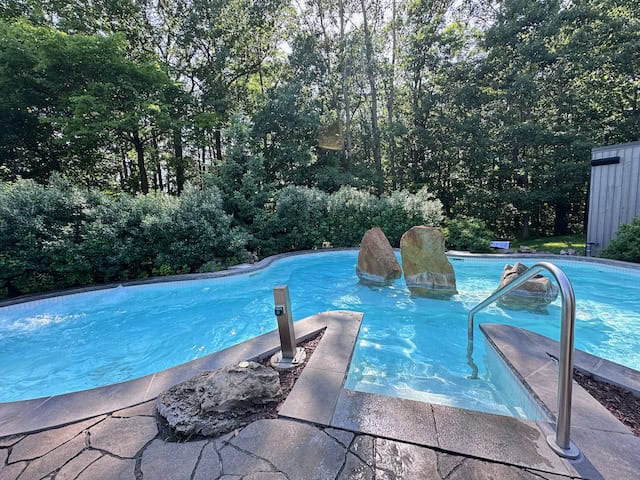
It was time for a break. Bonjour Québec arranged a wonderful afternoon of complete relaxation at Strom Spa Nordique. The thermal waters and serene surroundings are the draw here and we took full advantage, moving from one temperature- controlled pool to another on the recommended circuit. After several hours of blissful soaking, it was dinnertime.

The menu at Bistro Nord at the Strom Spa spotlights artfully and healthily prepared local produce and every course was both. Executive Chef Raphael Podlasiewicz came out to describe each delicious dish to us. Reservations are required at the Strom Spa Nordique locations throughout Québec and in their restaurants as well.  

We spent our last night in Québec at the Hotel Rive Gauche, just 20 minutes from Montreal. The hotel is on the Richelieu River, and we were able to see a bit of the Fete de la Saint Jean fireworks launched further upstream.

Sugar Shack

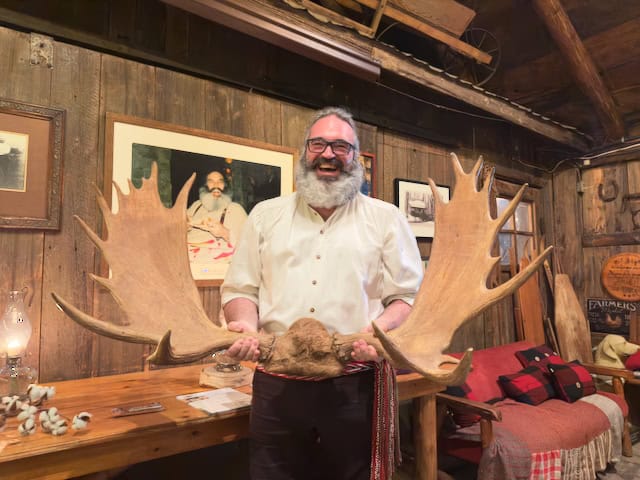
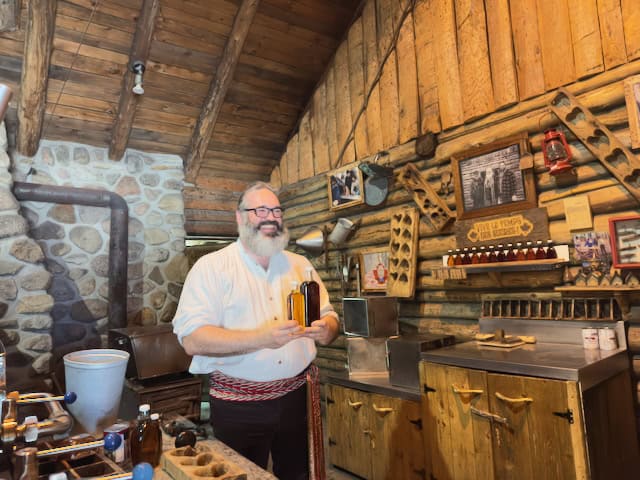
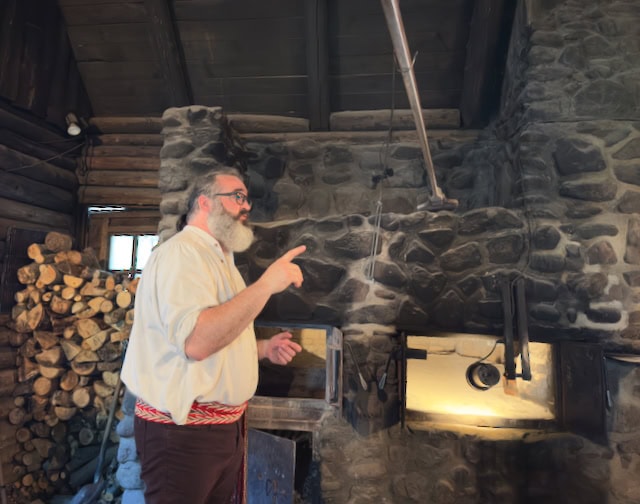
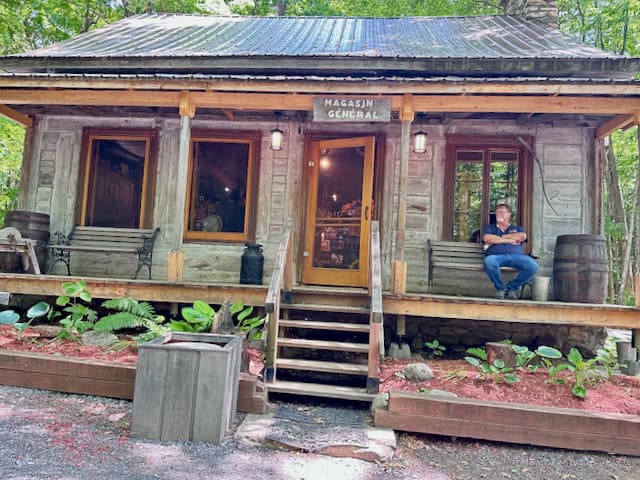
Our last stop on our extraordinary epicurean adventure was a visit to Sucrerie de la Montagne. This traditional “sugar shack” has been a site for maple syrup production in Montérégie since the 1930s and has been owned by the Faucher family since 1978. Unlike most, it is open all year long, not just March to April during the “sugaring off” season.  Owner Steven Faucher (shown above in front of a photo of his father) showed us where and how they make syrup.

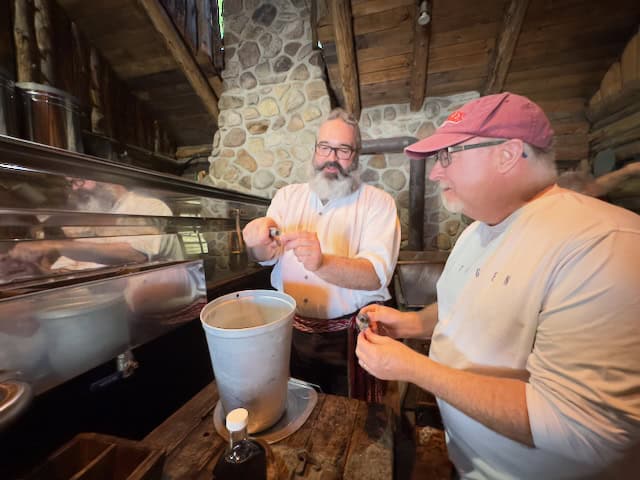
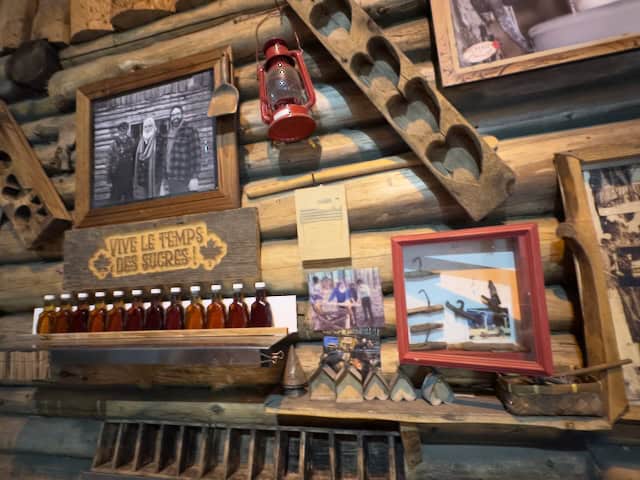
We learned how trees are tapped using a spout and bucket and the “maple water” collected and turned into syrup.  It takes 40 gallons of maple water to make one gallon of light or amber (medium) syrup, and 50 gallons to make a gallon of dark syrup! Amber is the most popular grade of syrup.

We also visited the massive oven, which was purpose-built in 1982 for bread baking and requires two bakers working six days a week to make enough loaves to feed workers and guests during the maple sugar season.

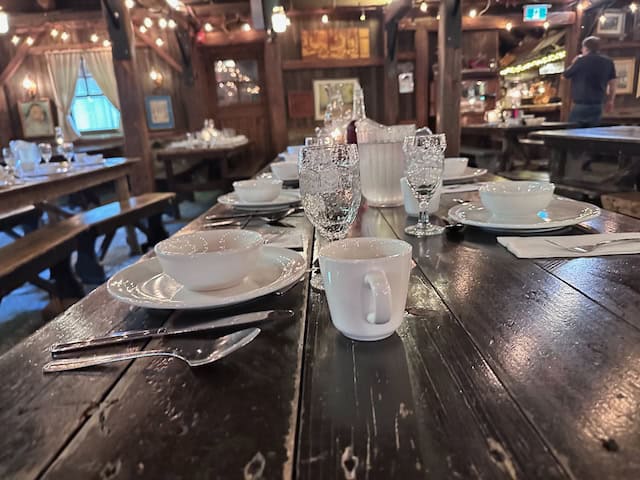
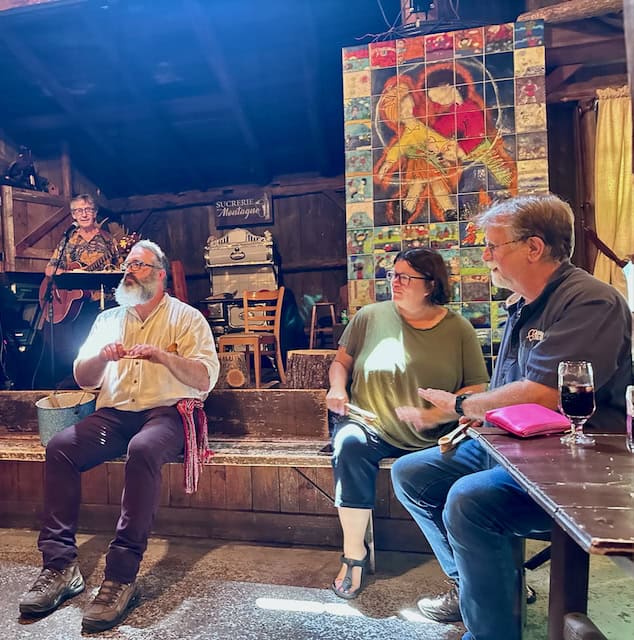
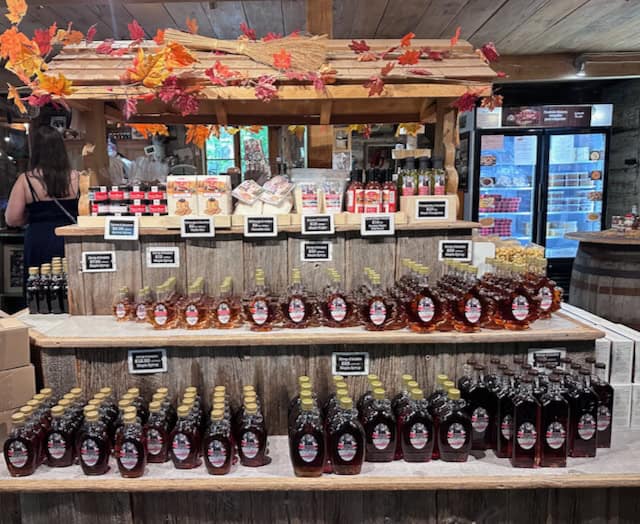
After finishing our tour of the buildings, we settled into their popular restaurant for a hearty meal, served with maple syrup made at Sucrerie de la Montagne, of course. During lunch we were entertained by live traditional Québecois music and afterwards given a lesson in playing the spoons by our jovial and charming host.  Depending on when you visit, you may even see an axe-throwing demonstration near the general store, which has a wide selection of local goods, handicrafts and maple syrup products. Some syrup and tea towels made it into my suitcase!

Our journey through Southern Québec was an unending series of delight and surprise, from the gorgeous countryside to the incredible cuisine.  What will really stay with me is the warmth, generosity, and hospitality of the people I met in Centre-du-Québec, the Eastern Townships and Montérégie. Despite recent political tensions between our countries, the Québecois are wonderfully welcoming. Take them up on their offer to, “Come to the Eastern Townships and hug it out!”

Written and photographed by Jeanne Neylon Decker

Protected by US Copyright Laws.

This post contains affiliate links. If you click and book, I
may earn a commission at no extra cost to you
. I promise not to spend it all on ice cream. Thank you. I appreciate it!

Liguria’s Enduring Allure: The Cinque Terre, Portofino and Camogli

Liguria is the place you imagine when you think of Italy’s spectacularly scenic Mediterranean coastline, stylish Europeans sipping spritzs behind oversized sunglasses, perhaps aboard fabulous yachts bobbing in crystalline waters. I’d traveled to Italy 15 times and when a friend asked why I’d never been to Liguria, I had no answer.  It was time! 

There are many lovely small cities and towns dotting the Ligurian coast, all with their own particular charms.  We settled on Camogli, midway between the bustling seaport city of Genoa to the north and Riomaggiore, the southernmost of the ever- popular Cinque Terre—the Five Towns.  We had a rental car and planned to drive from Ortesei in the Val Gardena, where we’d spent a week at the Adler Dolomiti hiking in the beautiful Italian Alps, to the Ligurian coast.

The freeways were fine, but rain and traffic slowed us down considerably.  We’d been driving for nearly six and half hours for a trip that should have taken just over five, when 90 minutes shy of our destination we entered another of an endless string of tunnels (the Italians call them galleries) and quickly noticed that not only had traffic completely stopped, but everyone around us had turned off their engines. Did I mention I was claustrophobic?  Just as I was beginning to hyperventilate, the people in a car ahead of ours jumped out, skateboard and a soccer ball in hand.

This was the distraction I needed for the next hour until miraculously, engines started, and traffic began to move ever so slowly out of the tunnel.  What a relief to finally arrive at the Cenobio dei Dogi in Camogli.

Camogli- Under the Radar but Not for Long

We chose the Cenobio after reading about it in a Frances Mayes book. It’s a stylish grand dame of a hotel, with a prime location at the end of the esplanade overlooking the sea and the town below. It has a private beach, a pool with plenty of lounge chairs, a well-reviewed restaurant and an outdoor terrace for drinks and lunch, all with amazing sea views. It is steps away from the main pedestrian street, Largo Luigi Simonetti, and a five-minute walk to the train station. 

We had phoned ahead (from the tunnel), and they had a table was waiting for us in Il Doges restaurant.  We tucked into a fresh mushroom salad, spaghetti al vongole (with clams), and a tower of fritto misto del mare with every kind of fish imaginable, before heading upstairs where we were lulled to sleep by the sound of the waves below.

Our room was on the top floor of the bright pink building behind the main hotel. The room was amply sized, and simply but comfortably furnished with a private balcony. I could have spent every waking moment admiring the sea view.

Camogli boasts a bevy of tall pastel- hued buildings, most at least six stories high, looking out to the sea, where historically, many in this community have earned their livelihood.  There are more working boats than pleasure craft in Camogli’s harbor and townspeople go about the business of living among the tourists who descend on the pedestrian main street in search of fresh seafood, focaccia, and beachy souvenirs.

We devoted the next day to exploring Camogli, wandering the harbor area, window shopping, and learning about the Sagra del Pesce. Since 1952, the town has hosted a huge annual fried fish feast, originally served free to all.  The event happens the second weekend in May, and honors the patron saint of fishermen, San Fortunato. 

The early festivals used smaller cookware but in 1954, the first of a series of massive pans was introduced.  That one was four meters in diameter. Two of these immense pans are displayed on a wall on Via Guiseppe Garabaldi near the Largo Luigi Simonetti. This year, three tons of fish, fried in 3,000 liters of olive oil, were served. In all, 30,000 portions were prepared by volunteers. Hungry attendees are asked to contribute 6 Euro each, all of which goes to charity. They even fry up gluten-free portions of fish!

The Largo Luigi Simonetti, an elevated esplanade above the sea, serves as the main thoroughfare and is where you’ll find most of the town’s restaurants and shops.  Families gather and children ride bicycles around the small piazzetta, which is also a perfect place for a sunset aperitivo and dinner.

One of the joys of staying in a seaside town is all the fresh fish. Camogli has so many excellent places to eat it was hard to choose, but Izoa was one of our favorites.

Camogli has its share of tourists who visit, eat, shop, and mostly depart by nightfall. The crowds here do not compare to towns further south, particularly in the Cinque Terre, and we were very grateful for that!

The Abbey at San Fruttuoso

A trip to the Abbey at San Fruttuoso is a highlight of a stay in Camogli. This beautiful Benedictine abbey dates to the 10th century and can only be accessed by foot – an arduous hours-long hike to the end of the peninsula, or a pleasant less than 30 -minute jaunt aboard a boat. You can catch the regularly scheduled boat, which is well signed-posted, on Camogli’s pier near the Basilica di Santa Maria Assunta.

After a quick stop at Punta Chiappa, we landed on the beach below the abbey. Upon arrival, you have options. You can climb the stone stairs up to reach the abbey immediately, take a hike up the hill beside it for the views, or just relax on the beach, as we saw a number of people doing. 

Many beaches in this area are filled with smooth stones rather than sand, so pack your aqua socks. The cobbles are really hard on tender feet!

There are two small restaurants on either side of the beach that we didn’t visit but seemed to be doing a good business. We climbed the steps, past the old rowboats and went inside to explore the maritime art, medieval artifacts, and antiquities housed on several floors of the abbey. We also visited the 10th century chapel and the crypt.

Though the abbey was important in the 11th and 12th centuries, it fell into disrepair and in 1467 was abandoned by the Benedictine monks who founded it. Genoa’s Doria family assumed patronage which lasted until 1885. Many members of the prominent family are buried here in the striking grey and white marble crypt.

We spent a few hours exploring the Abbey and the grounds and were back in Camogli in time for a leisurely late lunch on the hotel’s terrace and a swim.

The Cinque Terre–Beautiful But…

Since we were so close to the Cinque Terre, we planned to take a train early the next morning to Riomaggiore, the southernmost of the five towns, and make our way back up the coast by boat, stopping in each of the towns as we went. We had a car, but parking is almost impossible in these small Ligurian towns. It was a gorgeous, sunny October day — perfect for exploring, or so we thought.  We caught a local train and less than an hour later disembarked along with a shocking number of other visitors. We could not believe how crowded the town was in the so-called off season.

Riomaggiore

We made our way through the heaving throngs down to the pier only to find a sign announcing there would be no boats “due to adverse weather.” Too nice to spend the day at work was our guess!

No boats today! Sunny skies, calm seas–we couldn’t fathom the “adverse weather conditions” noted on the sign.

We waited to climb up the stone steps to enjoy the views out over the water, waited to climb back down, waited to get a cup of coffee, and waited some more. We were not enjoying the highly touted charms of Riomaggiore. We decided to get on a train heading north and pay a visit to Vernazza, reputed to be the most beautiful of the five towns.

Vernazza

If Riomaggiore was crowded, Vernazza was mobbed! Even climbing the stairs to exit the train station was a challenge. There were tour groups galore. We finally made our way down to the water, and after noting the crowds, headed for the 11th century church of Santa Margherita d’Antiocchia for a bit of peace and quiet.

After a walk around the main square, Piazza Marconi, we decided to head back to Camogli.

The ticket machine at the station wouldn’t take our credit cards or our cash. We asked the information person what to do since we didn’t want to get a fine, or worse, for traveling without a valid ticket. He laughed, said the machines had been broken for some time and advised we just get on the train with the tickets we’d used to come south. On we went, back down through the masses to the tracks below and northward to Camogli. We treated ourselves to gelato, headed for the hotel, and spent the rest of the afternoon at their private beach, enjoying the serenity of our beautiful little town.

Picture Perfect Portofino

By now we had explored Camogli, visited the much-vaunted Cinque Terre, had gone swimming in the Ligurian Sea’s crystal-clear waters, enjoyed a spritz or two, but still hadn’t seen any yachts.  One stop on the local train took us to Santa Margherita Ligure and then a short bus ride brought us to picture-perfect Portofino. 

The pretty town boasts upscale boutiques, inviting restaurants and a gorgeous harbor filled with yachts. There were also plenty of tourists, which at this point was not unexpected.  We had a nice wander around town but the sculpture garden, Museo del Parco, we had planned to visit was closed, though we’d checked the website first.

We hiked up the hill to the lovely church of San Giorgio, lit a few candles and enjoyed the views. We realized we could probably see at least some of the art from above and took a winding path back down from the church to the harbor, enjoying the sculpture as we went. 

We decided to take a boat back to Santa Margherita Ligure—an excellent choice as it turned out.  The boat took us on a scenic tour of the harbor where we saw plenty of pleasure craft, and spotted magnificent homes in the hills above the town. 

I’ll always say yes to a boat ride– especially on a day as beautiful as this one.

After our all too brief boat ride, we enjoyed a walk around Santa Margherita Ligure’s waterfront and headed to the train station for the one- stop train ride back to Camogli.

Genoa

Here’s where our well-planned day took a turn. Santa Margherita Ligure’s station was small and didn’t have the large electronic signs with train numbers, expected arrival times and destinations you’ll typically find in Italian train stations. Five minutes before ours was due, a train pulled in and I insisted we get on.  My husband reluctantly climbed aboard and as soon as the doors closed, I sensed I’d made a mistake.  This train was much more luxurious than the locals we’d been taking up and down the coast.  Sure enough, when I asked another passenger if the next stop was Camogli, he shrugged and said, “No lo so, Camogli.” –he didn’t know Camogli.  Not a good sign. A conductor came along and when I showed him our tickets he laughed and announced we were on an express train to Genoa which, by the way, had nine different stations.  He advised we keep our tickets, get off at Piazza Principe, and take the next local train back to Camogli. 

We arrived in Genoa in less than 30 minutes.  The leisurely ride back to Camogli took more than an hour and stopped no fewer than eleven times, but the views over the sea were spectacular.  Lesson learned. Trains in Italy may be delayed, but they do not arrive early.

Though I still struggle with the appeal of the tourist- packed Cinque Terre and our misadventures landed us in Genoa, I loved our time in Liguria. It is a beautiful area with enormous charm, delicious food and wine, and absolutely worth a visit.  I’ll definitely return to Camogli, may explore Genoa, but will give the Cinque Terre a miss next time!

Feel free to share this post!

Written and photographed by Jeanne Neylon Decker

Protected by US Copyright Laws.

This post contains affiliate links. If you click and book, I
may earn a small commission at no extra cost to you. I
promise not to spend it all on gelato. Grazie!

Lisbon’s Beautiful Belem

The Belem district is a fascinating and historic area of Lisbon that ought to be on every traveler’s itinerary—and it appeared that it was on the Sunday we spent there! Packed with monuments, museums and many of Lisbon’s “must see” spots, it’s just about five miles from the downtown area. It’s easy to reach via bus, tram or cab. We took a 10 Euro taxi ride for the 20-minute trip from Lisbon’s city center. The tram costs less but takes nearly an hour and with so much to see, we opted to save time.

There’s plenty to see and do in Lisbon’s busy Belem area.

Belem was the launching point for many sea voyages during Portugal’s Age of Discovery. The Tower of Belem was the last thing sailors would see as they left port and the first site to welcome them home.

The Church of St. Jeronimos and its monastery are beautiful examples of the decorative Manueline architectural style.

Before setting off, many sailors would stop at the stunning Church of St. Jeronimos and its spectacular monastery to pray for a successful journey and a safe return. These gorgeous buildings are wonderful examples of the decorative Manueline architecture popular in Portugal in the late 1400s through 1500s.

St. Jeronimos and it’s spectacular monastery are among Lisbon’s most popular sites.

The entry fee for the monastery is 10 Euro and worth it. It’s stunning and surprisingly peaceful in spite of the crowds. Admission is free for the church. If you plan to attend mass, be punctual. We arrived late and no amount of pleading would make the guards open the church doors for us until services were over.

Visitors to the church can see the tomb of famed Portuguese explorer Vasco da Gama and the memorial to writer Luis de Camoes.

Entry to the Church of St. Jeronimos is free but there is a fee for the monastery.

We were directed to the end of a very, very long line. After standing around for quite some time, we realized there were no lines at the other end of the building and decided to go check it out. That’s when we found the National Archeology Museum.

Avoid the long lines at St. Jeronimos by buying a combo ticket for the Archeology Museum next door for an extra two Euro.

Here’s a tip we wished we’d known–walk right past those long lines in front of the monastery and church and make your first stop in Belem the National Archeology Museum.

The museum is full of ancient treasures and antiquities, some dating back to the Iron Age.

Buy a combo ticket for the museum and the monastery (the monastery is actually in the same building as the museum). For an extra two Euro, or 12 Euro total, you can enjoy the museum’s terrific exhibitions and avoid the crowds. The museum is a treasure trove of Egyptian, Roman, Greek, and Moorish artifacts. After touring the galleries, you’ll go directly into the monastery from the museum without waiting on the ever-present line.

This was the first megalith we saw and it inspired us to seek out the Almendres Cromeleque, home to 95 of these fascinating stones near Evora in the Alentejo area.

The museum has a rich collection of Egyptian, Greek, Roman and Moorish art and antiquities. Be sure to visit the Room of Treasures in the museum. No photography is allowed in that area but the display of coins and jewelry from 1800 to 500 BC is impressive.

After touring the galleries in the National Archeology Museum, you’ll enter the Monastery directly without waiting on any additional lines.

This fascinating time line inside the monastery captures 500 years of world history in words and images.

In spite of the crowds, there are numerous serene spaces within the monastery perfect for quiet contemplation.

You may notice long lines around the bakery just up the street from the monastery. If you’ve been to Portland, Oregon, this may remind you of the lines around Voodoo Doughnuts. I’m always amazed by the patience people seem to have in their quest for particular baked goods, but back to Belem…

Lines for Casa Pasteis de Belem snake around the corner. Worth the wait? You decide.

This is the place that claims to have the original and the best Pasteis de Belem. These are little custard pastries in a flaky filo- like crust. Locals say these are good, but you’ll have to decide if they’re worth waiting for. We didn’t, but we haven’t ever waited for doughnuts either. They sell Pasteis de Belem in the Starbuck’s next door without the wait, though buying them there doesn’t quite have the same cachet. You can find these delicious pastries all over the country though they’re called Pasteis de Nata (nata is cream) or Pastel de Nata, if you’re only having one,  everywhere else except Belem. Try one or two and remember to add a healthy shake of cinnamon and powdered sugar on top!

Time for lunch or dinner? Turn down this little street to find Enoteca de Belem.

If you’re hungry for a meal, we highly recommend the Enoteca de Belem   (+351) 213 631 511 Travessa do Marta Pinto, 12. Located on a little alley off the main street in Belem, this is a terrific choice for lunch or dinner.   It’s very small so book a table or prepare to be disappointed.

We were delighted with our lunch at Enoteca de Belem. Here’s a peak at the menu.

Sitting at the bar gave us a chance to learn about and taste delicious Portuguese wines.

We sat at the bar since we had missed our reservation time—the museum and monastery were so fascinating we spent far longer than we had anticipated. The bar turned out to be perfect for us because in addition to a fabulous lunch, we had a great chat and learned quite a bit about Portuguese wines and history.

The perfectly prepared scallops with cauliflower puree and quail eggs were as delicious as they looked.

The freshly caught grouper was the fish of the day. Served with “clam rice,” it was an incredibly flavorful dish.

Portuguese cuisine often pairs fish and pork. The tender grilled octopus and spicy chorizo was perfection on a plate.

This classic dessert, Papo de Anjo, reminded us of an upgraded rice pudding. Comfort food at its best!

Our lunch was incredible and one of the best meals we had in Lisbon. Try the scallops to start and the grouper or cod if they have it.

When we asked for the wine list, we were handed these vintage binoculars and instructed to look around and choose whatever we were interested in from the shelves above the bar. There was a printed list, as well, but selections change regularly– thus the binoculars.

We opted for wines by the glass so we could sample several. The staff were well- versed in the wide selection available and happy to make suggestions and answer questions.

The knowledgeable staff will be glad to help you match the appropriate wines to your food selections.

Sailboats and other pleasure craft ply the waters off the embarcadero. The Hippotrip looked like Lisbon’s version of the Boston Duck Tours. Could be fun, but we didn’t try it.

Next, take a walk along the water down to the Monument to the Discoveries, which honors Prince Henry the Navigator, and was built in 1960 to commemorate the 500th anniversary of his death. Henry’s mother, Queen Filipa of Lancaster, Vasco da Gama, Magellan, King Manuel I and the poet Camoes are all depicted on the monument.

The busy waterfront is the perfect place to stroll and people watch. It’s possible to go inside the Monument to the Discoveries, which commemorates the 500th anniversary of the death of Henry the Navigator.

The Tower of Belem was the last bit of home Portuguese sailors saw as they set off to sea. It offers beautiful views but be prepared for long lines if you’d like to climb the 120 steps to the top.

Further on, you’ll see the famous Tower of Belem. It’s possible to climb 120 steps to the top of the tower for the views. Lines can be quite long. Let’s face it—there are lines for nearly everything you’ll want to see in this area so just be prepared for that. There’s an Atlas Hotel along the way with a nice terrace, perfect for an apperitivo if you’re ready for a break from touring– and the lines.

There is a lovely park near the waterfront and we happened to catch a good- sized open air market there on our visit.

On our walk back, we came upon an open air market selling everything from hand crafted ceramics, art and jewelry, to tea towels and mass-produced souvenirs. There was also a lively folk dance competition taking place in the park and we simply had to stop and watch for a while. It was delightful!

Troupe after troupe of talented folk dancers took the stage in the park. We joined the crowd to cheer them on.

Near the stage where the dancers competed, we spotted this pavilion. It was a 2012 gift from the Royal Thai Government to Portugal, celebrating 500 years of bilateral relations between the two nations.

We wished we had more time in Belem. We would like to have seen the Maritime Museum, Coaches Museum and the Ajuda Palace. Next time for sure!

Written and photographed by Jeanne Neylon Decker

Protected by US Copyright laws.

Adventures in Fatima and a Day in the Douro Valley

There are two things travelers must bring along on every trip—a sense of humor and resilience, because sometimes, maybe even often, things do not go to plan. That’s where a sense of humor comes in handy. This was the case one Sunday in Portugal on what was to be our longest driving day– from Evora in the Alentejo, to the mountains above the Douro River in the north of Portugal, with a stop at the Shrine of Fatima. I had wanted to visit Fatima for a long time and since it was right off the freeway, we thought this was a perfect plan.

It was time to leave the beautiful Alentejo in Portugal’s southwest and head north to the Douro Valley.

We did not get an early start, which is no surprise to anyone who knows us, but instead enjoyed a delicious, and leisurely, last breakfast at Convento do Espinheiro before setting off for the Douro Valley.

Each year the Shrine of Our Lady of Fatima welcomes more than 4 million pilgrims.

Imagine our surprise when two and half hours hours later we turned off the freeway heading for Fatima and were greeted by plenty of police and even more motorcyclists– thousands of them. Many of the roads leading to the Shrine were closed and everywhere we looked there were motorcyclists—young, old, families, even dogs—all on two wheels.

Apparently everyone in Portugal, with the notable exception of these two visiting Americans, knew there was a special mass for motorcyclists that day at the Shrine of Fatima. After spending about an hour in the traffic jam, we realized there was no possible way we could visit that day. We very sensibly decided to come back on a weekday on our return to Lisbon. I wish I had taken photos of all those motorcyclists but didn’t want to risk offending anyone and there was no possibility of a speedy getaway.  On our return visit, things were decidedly quieter.

 On Oct. 13 each year nearly hundreds of thousands crowd this immense plaza to celebrate the anniversary of the apparition. On the day we visited, a week after our first attempt, there were very few visitors.

Turns out the plaza at Fatima between the basilica and the chapel can accommodate 1 million people– as it did when Pope John Paul II visited in 1987—and we imagined that nearly as many motorcyclists had made the pilgrimage that Sunday morning, too.

The open air Chapel of the Apparition was built on the site where the Virgin Mary appeared to the children.

Each year the Shrine of Our Lady of Fatima welcomes more than 4 million people. When we returned on a Tuesday afternoon a week later, there were no motorcyclists in sight and relatively few visitors.  It could have been the 114 degree heat that kept people away.

Many visitors light candles at the shrine and pray for intentions and interventions.

We visited the beautiful basilica and the Chapel of the Apparition where nuns recited the rosary in numerous languages.  We also took the time to light a few candles, which were available for sale at the shop and ranged in size from standard to enormous. Some were bigger than my arm!
There is a full schedule of masses, reciting the rosary and confessions offered every day.

It was so terribly hot, and since there was no shade on the plaza, we chose not to cross it to see the enormous rosaries and crucifix on the other side. That will have to wait for another visit. But now, back to our journey to the beautiful Douro Valley—

We enjoyed the drive from the Alentejo in the south to the Douro Valley in the north of Portugal. Be sure your rental car comes equipped with the Portuguese version of the Fast Pass.

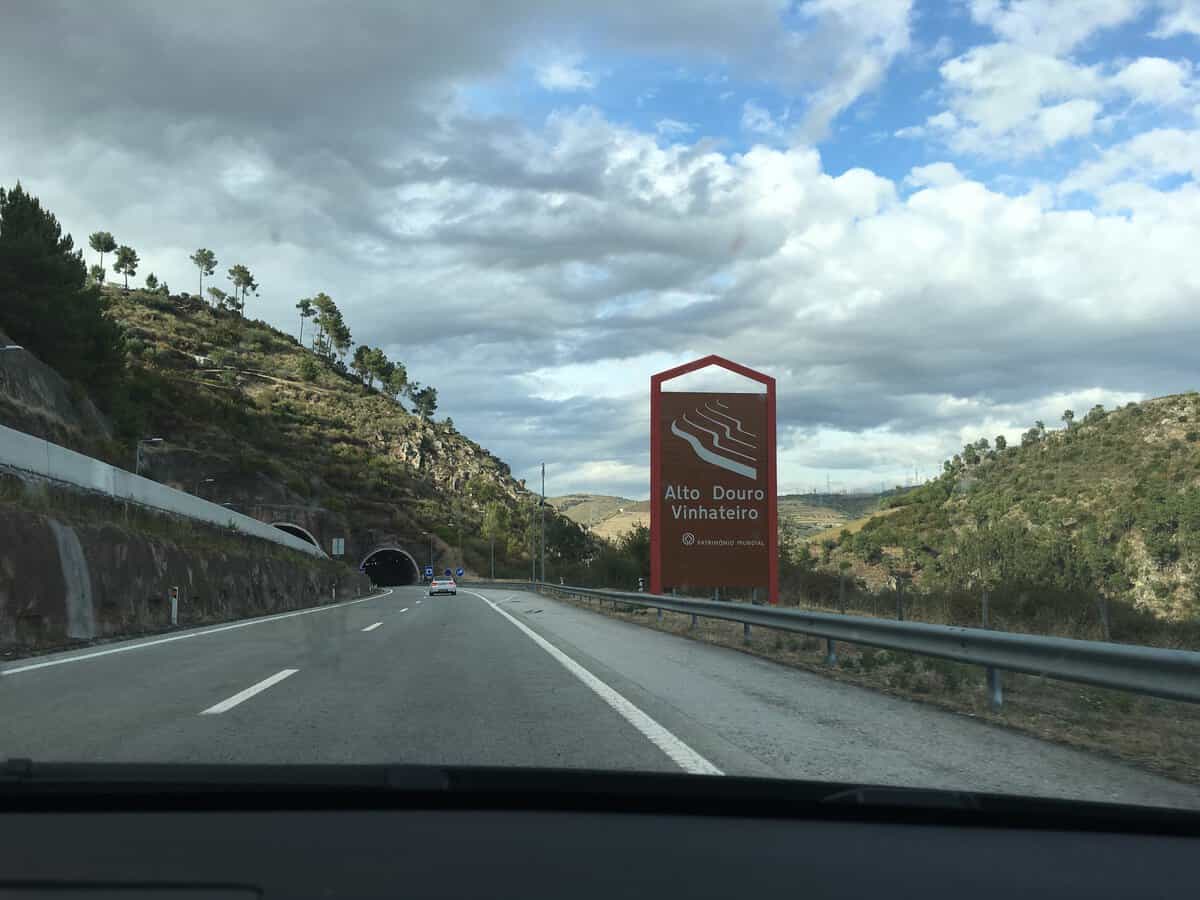
Back to the freeway and on to our pousada we went, over winding mountain roads and bridges, through tunnels, and burned out forested areas. The main roads in Portugal are well- paved and well-marked. Smaller side roads are a little bit trickier, but we never had trouble finding our way even out in the countryside.  We ate our picnic lunch in the car to save time and arrived in Alijo about three and a half hours later. It had been a long day.

Scenic mountain roads took us north to the vineyards of the Douro Valley.

When we finally arrived at the Palacete Alijo, the first thing we noticed was the laundry hanging out to dry on the balconies. Inside, the pousada didn’t come close to living up to the photos we’d seen online. Perhaps someone had carefully cropped out the propane tanks next door and the rust marks surrounding the pool.

Sadly, this pousada in Alijo didn’t live up to expectations and we left without staying.

The website’s images didn’t deliver an accurate portrayal of the property. This was the view from the room we were meant to have.

The website indicated the place was part of the well-respected Pestana Group. The friendly front desk clerk told us that it hadn’t been for nearly five years and offered us a “welcome” drink. He also mentioned that the air conditioner was broken, brought up a few other housekeeping issues and again offered a welcome drink. We had planned to stay for four nights but after seeing the accommodations, we turned down the drink and summoned up Trip Advisor on our phones.

This was the splendid view across the river to Pesa de Regua from our room at the Vila Gale Douro.

Vila Gale (a hotel group popular in Portugal and Spain) had a river view room available for two nights in the town of Peso de Regua, right on the Douro River. Back to the car we went, grateful we hadn’t brought our bags inside—we never do until after we’ve seen the room. After another hour of driving, this time in the dark through the winding mountain roads, and did I mention it was raining?—we arrived at the Vila Gale Douro.

The Vila Gale Douro, part of a popular group of hotels in Portugal and Spain, is well- located across the river from Peso de Regua.

While my husband parked the rental car in the garage, I went to the hotel’s restaurant to secure a table before they closed. It was 10:30 p.m. at this point and we were really hungry. I thought I was imagining things when I my heard my name called out and turned to find two dear friends from home finishing their dinners. Had we not changed our hotel, we would never have had the chance to spend time with them. We agreed to meet for breakfast the next morning.

Our Vila Gale room was large, comfortable and contemporary and had terrific views from the private balcony.

It was lovely to wake up to this beautiful view from our balcony.

Portuguese wine aficionados know that the steep terraced hillsides of the Douro Valley are home to numerous well-regarded producers of table wines and of course, port. Our friends were free in the morning but had to return to Porto in the afternoon. We agreed that a visit to a nearby winery would be the perfect outing.

We spent a fun and informative morning with our friends at Quinta do Vallado.

Grapes grow seemingly everywhere on the Douro Valley’s steep hillsides.

Like the wineries in the Alentejo, you must make reservations to tour and taste in the Douro Valley. My husband had his heart set on a visit to Quinta do Vallado but when he telephoned, was told that the morning’s English- speaking tour was already full. With the help of our front desk clerk, we secured four spots.

Quinta do Vallado is a highly regarded producer of Douro wines and port. They also have a small hotel on property.

The winery is located high up on the terraced hillside across the river from where we were staying, just about a 10- minute drive away. One of the oldest in the Douro Valley, the winery celebrated its 300th anniversary in 2016. Once owned by Dona Antonia Adelaide Ferreira (of the Ferreira Port family), production was geared towards port for the company’s first 200 plus years. In 1993, they decided to restructure and expand into producing Quinta do Vallado label table wines and in 2009 construction on the new winery was completed.

Our tour began in the vineyards where some grapes had already been harvested.

We followed our guide from the vineyards, through the production facilities, and into the cellars, as she explained each stage of wine making to the group in English. Tours are also given in Portuguese several times daily. We always ask if English tours are available, though rather than miss out, we’ve taken some in Italian, French and Portuguese at numerous places.

Our knowledgeable tour guide explained the wine making process in detail– and in English.

We saw everything from the grapes growing, to high tech, temperature controlled stainless steel tanks, to the traditional granite legares in which grapes are crushed by foot, to the cellars where the barrels are stored and wines are aged before they’re bottled.

We saw state of the art temperature controlled stainless steel tanks…

…and traditional granite legares where grapes for port are crushed by foot.

Antique barriques are still in use.

New French oak barrels are also used, depending on the kind of wine they’re aging.

After the very informative tour, we all gathered around a communal table and tasted Quinta do Vallado’s wonderful wines, working our way from crisp whites to delicious ports. Many of us made purchases in the quinta’s well-stocked shop.

After our tour we gathered around for a wonderful wine tasting.

During the tasting, we sampled crisp whites, full-bodied reds and finally, ports.

The well-stocked shop beckoned many of the visitors, including our friends and ourselves.

Though we were not able to tour it, Quinta do Vallado has a small hotel on property with 13 rooms—five in the manor house built in 1733, and eight in the modern wing constructed in 2012.

The roads in the Douro are narrow and winding but exceptionally scenic.

There were two things we planned to do in the Douro—wine taste and take a boat ride. After saying goodbye to our friends at the winery, we headed to Pinhao to check out the river cruise options.

The Douro has been used to transport people, port and other products down river to Porto for centuries.

The Douro River meanders from Spain through the heart of northern Portugal down to Porto where it empties into the sea. For centuries, port wine has been transported by boat down river to the city that shares its name with the wine. Day trippers from Porto, cruise boats from lines like AmaWaterways and Viking, private pleasure craft, and charter boats large and small ply the waters of the Douro River.  Getting out on the river sounded like a perfect plan on that hot day.

Tourism is big business in the small town of Pinhao.

Pinhao is a small town seemingly fully committed to the tourist trade. There are souvenir shops everywhere and numerous choices for boat rides on the river. A one-hour ride was 10 euro from any of the vendors. We chose our boat based on schedule. They all come and go from the same place and follow a similar route.

River boats all leave from the same place and follow similar routes. Schedules differ but pricing does not. 10 Euro is typical for a one-hour boat ride.

Once aboard, you’ll learn all about the port trade and see many well-known names as you pass by the quintas. We had a delightful time and enjoyed chatting with newlyweds from the Netherlands and a Spanish couple. It was a relaxing and informative hour that passed in a heartbeat. We wished we’d opted for a longer ride.

Our convivial group included newlyweds from the Netherlands and a couple from Spain.

Bridges large and small cross the Douro.

Hillsides, which reminded us of California, are dotted with wineries.

You’ll see quintas with familiar names like Croft along with others that have been producing wine for centuries here.

Our journey was so peaceful and enjoyable we wished we’d booked a longer trip. Next time!
After our boat ride, we walked over to the historic Pinhao train station, which has been in service since 1880. The station is notable for its lovely azulejos—the blue and white tiles for which Portugal is famous.

Trains have been transporting travelers to and from the Pinhao station since 1880.

The station is known for its azulejos– the stunning blue and white tiles famous throughout Portugal.

These particular azulejos tell the story of the port trade in 25 large panels that were installed in 1937. There is also a café and shop in the station perfect for a coffee, glass of wine or edible souvenirs.

Pinhao’s 25 panels tell the story of the port trade.

The azulejos were installed in 1937.

The shop inside the station is a pleasant place for a coffee, glass of wine or a snack.

After a leisurely stroll through town and a stop for ice cream and souvenir shopping, we headed back to Pesa de Regua and dinner.

This former industrial building has a new life as home to shops and restaurants.

Just across the bridge from our hotel is a renovated industrial building on R. Jose de Vasques that now houses several restaurants and shops.

Picnic provisions and edible souvenirs are available here.

The contemporary dining room at Castas e Pratos was full on the Monday night we ate here.

We browsed a bit and then headed to Castas e Pratos for our meal. Part wine bar, wine shop, and restaurant, the place was buzzing when we arrived. We were glad we had a reservation upstairs in the airy and modern dining room.

Our starter was a plate of succulent scallops in a rich pea puree.

The tender veal medallions in roquefort sauce was served with a delicious wild mushroom risotto.

Larger parties were sharing dishes like this “Duck Rice”– a local specialty. It looked and smelled divine.

The menu has something for most tastes and includes fish, meat and vegetarian options.

Wines from all over Portugal were featured on the extensive wine list.

We started with a refreshing sparkling rose and ended with a nice tawny port.

Castas e Pratos has an extensive wine list featuring wines from the Douro and as well as all of the other wine producing areas of Portugal. Service was attentive and friendly and we enjoyed every bite of our meal from the scallop starter through desert. Happy and full, we returned to the Vila Gale to plan our next day’s adventure.

Florentine Favorites: Where to Eat in Florence

Many visitors to Florence seem to be on a quest, trying to squeeze in as much culture as they can in a few short days. Don’t overlook the culinary component of travel. Take a deep breath and spend some real time in this glorious city if you can, and take time out for some superb dining while you’re here.

A quick 10- minute walk from our apartment near the Duomo over the Ponte Santa Trinita brought us to Il Santo Bevitore’s welcoming doors. It seemed like everyone inside was having a great time. We did, too, and put it at the top of our list of Florentine favorites.

img_2305

Il Santo Bevitore on the Altro Arno is one of our absolute Florentine favorites.

The comfortable dining rooms (there is a large one, pictured above, and a smaller one just beyond it) are lively and full of happy diners enjoying the excellent cuisine. The atmosphere is casual and warm with just the right amount of buzz.

img_2277

You can request an English menu or practice your language skills with the Italian one.

The food is absolutely delicious and the service is attentive and friendly. Some stand outs were the porcini risotto, the pigeon, rombo, and the veal.

img_2296

This simple pear and pecorino salad was a perfect starter.


img_2279

We always say, “si” to a sformatino– a light, savory custard just right as a first course.


img_2859

Il Santo Bevitore’s veal was perfectly prepared.

You can’t go wrong with the pastas, meat or fish—whatever you choose is going to be good. Save room for dessert though.  The chestnut torte and yogurt mousse were both terrific.

img_2293

The succulent pigeon is a game bird lover’s delight.


img_2292

Fresh fish (rombo in this case), lardons, and potatoes were elegantly plated and beautifully prepared.


img_2883

Save room for dessert. This yogurt mousse was spectacular.

We would’ve eaten at Il Santo Bevitore every night, but felt the need to explore some of Florence’s other delightful dining options. Remember, reservations here are a must. Il Santo Bevitore is open for lunch and dinner.

img_3068Try Cucina Torcicoda for lunch or dinner. They have a restaurant, a casual trattoria, and a pizzeria– all in the same building.  When you book in, and you must reserve, let them know which you prefer. They’ll be very different dining experiences but all delicious.

img_3057

Torcicoda’s elegant and tranquil dining room.


img_3070

Torcicoda’s wine list features fine selections from all over Italy.

We had an excellent dinner in the restaurant. The food was superb and the service attentive.

img_3074

This exquisite pork dish was rich and flavorful. The chestnuts gave it a great contrasting texture and crunch.


img_3448

Memories of this sensational truffle- topped tenderloin make my mouth water.

The casual trattoria has a different menu from the restaurant’s and it looked good, though we didn’t have time to try it.

img_3060

We’ll try the casual trattoria next time.

We ate lunch at Torcicoda’s pizzeria and sampled four different pies. We were especially pleased with the ones topped with fresh buffala mozzarella cheese– gooey and delicious but with a crisp, thin crust–just the way we like our pizza.

img_3059

The pizzeria was packed day and night, so be sure to reserve.


IMG_8298

Fresh buffala mozzarella, available on a number of Torcicoda’s pies, upped the yum factor.


IMG_8297

Pizza bianca with sausage and broccoli rabe was another hit.

The pizzeria also has a good-sized outdoor dining area which is open rain or shine. It’s fun to watch the parade of tourists passing by on their way to the beautiful Santa Croce across the piazza, as you enjoy your meal.

img_3368We walked past Konnubio one afternoon at lunchtime and it looked so inviting we decided to go back for dinner.  It was a good choice. The restaurant is casual and lively but the noise level is not over the top.

img_3357

Diners were just beginning to arrive when we took this photo. Every table was taken in both dining rooms when we left.

The food was beautifully plated and everything we tried was delicious.

img_3366

Seared tuna with fresh asparagus was pleasing to the palate and the eye.


img_3365

Tender lamb with caper berries was outstanding.


img_3373

Konnubio has an extensive wine list and knowledgeable, helpful waitstaff.

You should reserve a table as we saw only one walk- in party seated, while others were turned away. Sit in the main dining room at one of the tables with the big comfy chairs instead of the side dining room, if you can.

img_2020

Cantinetta Antinori is owned and operated by the Antinori wine family and is located in the beautiful Antinori family palazzo right in the center of Florence. We’ve had many delicious lunches here as well as a very good dinner.

img_2003

Enjoy fresh baked bread and Tuscan olive oil from Antinori’s estate while you peruse the extensive wine list.


img_2004

Thinly sliced artichokes with parmesan cheese was a winner.

The food is typical Florentine cuisine and oriented to the seasons.

img_2012

Crispy potatoes topped with filet of white fish, sundried tomatoes, and capers was full of flavor and texture.


img_2013

The hearty stewed beef on a bed of polenta is typical Florentine fare.

They have an extensive wine by the glass (or half glass) program so you can sample many of Antinori’s broad line at reasonable prices. It’s fun to try wines you may not see at home.

img_2002Cantinetta Antinori is very popular with local business people especially at lunch, so book a table.

img_3220

We discovered Trattoria 13 Gobbi, a cute little place tucked away on a small side street, on one of our meandering walks through this beautiful city.

img_3207

The dining room is charming and features plenty of vintage posters, advertisements and more to catch your eye.


img_3211

The flavorful vegetable soup was presented in this lovely copper pot.

We plan to give dinner a try there next time.

img_3209

Trattoria Cibreo is another one of our lunchtime favorites. We go to the trattoria at Via di Macci 122R, instead of Signore Picchi’s very popular but pricier restaurant, Ristorante Cibreo. The food is terrific and the menu seasonal. Be aware that they don’t serve pasta and they take no reservations at the trattoria. They open for lunch at 12:45 pm and you need to be there early to get a table. People will be lined up and waiting for the doors to open. The trattoria is closed Sundays and Mondays. There’s a tripe truck parked nearby that the always has a line. Snack while you wait?

img_7869

While not to my taste, this tripe truck does a great business.

Here are a few other Florentine restaurants we’ve enjoyed over the years: Omero is a wonderful classic Florentine restaurant way up above the town with great views. The food is delicious, the service is attentive and this well-known eatery is extremely popular. Be sure to book in for lunch or dinner.

Il Latini is the place for multi- course and enormous meals. There wasn’t a menu when we went for lunch–they just kept bringing food to the table. It was all good and there was plenty, served family style. The key word here is “basta”! Enough! Tell them how many courses you want before they start bringing it—especially if you don’t want the meat courses.

Del Fagioli means the beans, literally. This is a good, casual family place close to the Uffizi. The owner seemed to know at least half the patrons when we had dinner there some time ago. Corso Tintori 47r telephone for a reservation—they were turning people away. 055244285

There are so many wonderful restaurants, trattorias and pizzerias in Florence you’re bound to find some to fit your taste and budget. Check out the Mercato Centrale for some great casual options and share your favorites with us! Buon appetito!

Note: Always check a restaurant’s website for updated hours and reservations. Things change, but the need to make a booking does not!

Written and photographed by Jeanne Neylon Decker

Protected by US Copyright Laws

Want a Quick Bite? Try Florence’s Mercato Centrale

Craving a cappucino and a cornetto? Need a bouquet of fresh flowers or picnic provisions? How about fresh pasta to enjoy at home? Or maybe you’re just in the mood for pizza and a beer? Florence’s Central Market or Mercato Centrale Firenze is Florence’s answer to foodie heaven.  Housed in a historic building originally erected in 1847, and open from 10 a.m. to midnight, this is the place to go.

mercato caentrale nov 2015 - 8

Pick up picnic provisions like salami, cheeses, prosciutto and more at Florence’s Mercato Centrale.

mercato caentrale nov 2015 - 6

Fresh pastas and delicious sauces to go with them make a tasty and quick meal that’s easy to prepare in your vacation rental.

The market on the ground floor is fun to explore with every kind of seasonal produce, pastas, sauces, meats, cheeses, and flowers. Anything you could want that’s fresh and in season is right here.

mercato caentrale nov 2015 - 3

The Mercato Centrale has a bounty of seasonal produce, herbs and fresh flowers.

Upstairs at the Mercato Centrale is one of our favorite stops for for lunch, though you can also have breakfast, snacks, sweets, drinks and dinner here.

mercato caentrale nov 2015 - 16

Neapolitan-style pizza is done right at La Pizzeria Sud.

Go get some terrific Neapolitan style pizza at Pizzeria Sud. You can take your slices to one of the communal tables or go upstairs for table service. We opted for the former and enjoyed the hustle and bustle of the place.

mercato caentrale nov 2015 - 14

Lunch is ready!

There are lots of tasty options– pasta, panini, cheese and meat platters, fish, pizza, even burgers and fried chicken to choose from. There is also a coffee bar, wine, beer, pastries, gelato and delicious desserts–something to please most any palate.

mercato caentrale nov 2015 - 17

Choose your favorite foods from the array of vendors upstairs at the market and grab a seat at the communal tables. Mangia!

Everything on offer here from the hamburgers made from Chianina beef at La Toraia di Enrico Lagorio, the pasta from Raimondo Mendolia, Maurizio e Poala Rosellini’s fresh fish, the bufala mozzarella, beautiful baked goods, chocolates and gelato are all of the highest quality.

mercato caentrale nov 2015 - 20

A great selection of fresh or aged cheeses to eat now or enjoy later are readily available.

mercato caentrale nov 2015 - 11

If you’re looking to really splash out, try these fragrant truffles.

mercato caentrale nov 2015 - 12

If your tastes run more to fried foods, you’re in luck.

We even sampled the trippa fritta—fried tripe, a Florentine favorite, though not to my taste.

mercato caentrale nov 2015 - 15

Trippa fritta is a Florentine favorite.

After lunch (or dinner), you’ll probably want coffee and something sweet. Please remember that no self-respecting Italian would even consider ordering a cappuccino, latte or similar milky coffee drink after breakfast hours. Stick to the espresso. Ask for a caffe lungo if you miss your American coffee. Desserts are in abundance here and include gelato, pastries, cookies, and cannoli, which are stuffed while you wait—as they should be. Crushed pistachios on the ends are optional.

mercato caentrale nov 2015 - 19

These confections look almost too good to eat. Almost…

Upstairs is also where you’ll find Eataly, which features Italian grocery items, household goods, personal care items and my favorite Florentine soaps from Nesti Dante. You’ll also find a wine shop specializing in Chianti Classico selections, a cooking school, a bancomat (ATM)  and public restrooms which are in short supply in many cities like Florence.

mercato caentrale nov 2015 - 18

If you’re looking for Italian wines, particularly those from the Chianti Classico region, you’ve come to the right place.

mercato caentrale nov 2015 - 13

Students pay rapt attention at the Lorenzo de Medici Cooking School upstairs at the Mercato Centrale.

If you feel the need for yet more shopping, there are also stalls outside the building on the surrounding streets with scarfs, leather items, and souvenirs—all the typical Florentine goods you’d expect to find.

mercato caentrale nov 2015 - 10

Shoppers can find everything from dry pasta to Pinocchio at the market and stalls outside.

Buon apetito and happy shopping!

Written and photographed by Jeanne Neylon Decker

Protected by US Copyright Laws.

Day Tripping– Lovely Lucca

The lively and lovely small city of Lucca is the birthplace of Giacomo Puccini and a wonderful place to spend one day or several. We’ve had a few day trips from our home base in Panzano in Chianti (www.stayitalia.com more on that in another post) and keep promising ourselves to spend more time here.

IMG_7826

Lucca is a popular destination for visitors to Tuscany and easy to reach by car or train from Florence.

You cannot drive inside the walled city. You must park in one of the lots outside. Be sure to look for the pay station if you park in any area with blue lines. White lines mean free parking, but blue lines require payment. We were so excited to get a spot near the Porta Santa Maria that we didn’t even notice we were in a pay zone and came back to find a parking ticket on our windshield. Note—if you get a parking ticket, pay it while you are still in Italy at any Post Office. You can do so with cash or credit card and you’ll avoid paying your car rental company the fee they charge to provide the Italian government with your information plus you’ll avoid the hassle of paying via wire transfer/foreign currency once you return home.

IMG_7836

Bicycling is a popular means of getting around in Lucca– inside the city walls and on top of them.

Once you get inside the walls, Porte San Pietro is the main gate–find an Info Point—Porta Santa Maria or Porta San Donato both have them. Pick up a tourism map which has several itineraries for exploring the town. Itineraries are in Italian, English and German and include opening times, closing days, and other important information for the major sites such as museums and churches.

IMG_7875

Visitors and locals alike stroll or bicycle around Lucca’s famous medieval walls. Bicycle rentals are readily available.

Lots of people go to Lucca to “walk the wall” or ride bicycles around the city on the top of its ancient fortifications—Passaggiata delle Mura. The medieval walls built in 1544 replaced earlier Roman ones and extend 4,195 meters around the perimeter of Lucca. There are plenty of bicycle rental places just inside the walls, particularly near the Porta Santa Maria. It was a blustery, rainy day when we were there a few weeks ago, so we put this on our list for next time.

IMG_7878

Now a place for picnics and soccer practice, the grassy area around the walls was once a moat.

IMG_7788

If you have time for a delicious and leisurely lunch (or dinner), go to la Buca di Sant’Antonio, Via della Cervia 3, 55100 Lucca +39058355881 www.bucadisantantonio.com. The restaurant specializes in traditional cuisine of the area and the food is delicious.We’ve had several memorable meals here.You must reserve a table because the restaurant is quite popular.

IMG_7776

Put Buca di Sant’ Antonio on your list of delightful restaurants in Lucca.

IMG_7779

Maccheroni lucchesi al sugo di coniglio– housemade pasta with rabbit sauce– as delicious as it looks.

IMG_7782

Puntarella alla Romana– a crisp, bitter salad topped with anchovies widely regarded as a Roman specialty.

IMG_7781

Petto di faraona all’ uva moscato– guinea fowl in a wonderful moscato wine sauce with crispy pancetta. Yum!
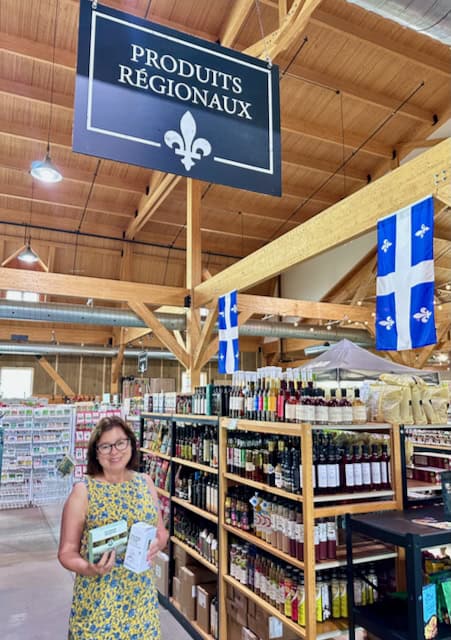
The Church of St. Michele in Foro is one of Lucca’s “must visit” sites. It was built on the site of the Roman forum in the 11th and 12th centuries and is still the center of city life. The church has works by Luca della Robbia and Fillipino Lippi, among others.

IMG_7792

This beautiful church is worth seeing both for its architecture and the wonderful art inside.

IMG_7811

San Michele in Forno.

Piazza San Martino is home to Lucca’s duomo of the same name. Built in the Gothic Romanesque style, this beautiful church contains some important artworks by Ghirlandaio, Tintoretto and Fra Bartolomeo as well as the Holy Face of Lucca, a wooden Christ on a crucifix attributed to Nicodemus, as legend has it.

IMG_7808

The anfiteatro is another of Lucca’s attractions. Built in the second century AD, the amphitheater’s former arena is now home to many shops and restaurants built into the ancient Roman walls, which are interesting to see from both inside and outside.

IMG_7828

IMG_7832

This Roman amphitheater once hosted games and gladiators. Now it’s a popular dining and shopping destination.

The Torre delle Ore, or clock tower, dates back to 1390. It is the tallest tower in town and has 207 wooden steps that ambitious visitors are welcome to climb.  In its early days, the time was announced by bells alone but a clock face was added in 1752.

IMG_7818

Hardy souls who climb the tower can see the hand-wound clock mechanism from the 18th century. It’s still working!
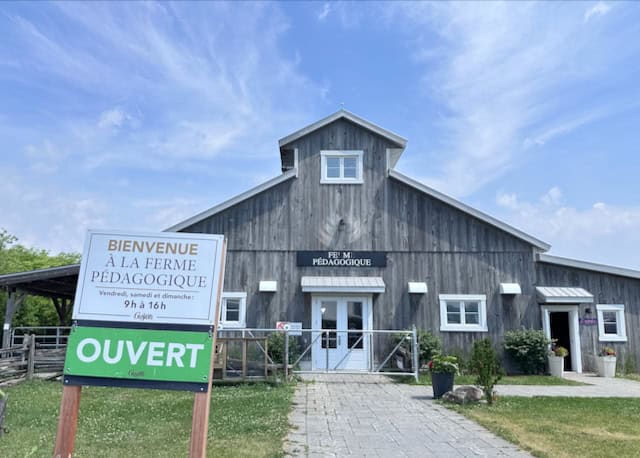
Lucca has a Puccini Museum, of course, which is at Corte San Lorenzo 9 (near the Piazza Citadella)– the composer’s birthplace. The museum features furnishings, artworks, pianos, musical scores and other personal belongings including letters and notes from and to Puccini.

Shopping seems to be a popular past time in Lucca and there is no shortage of brand names from which to choose.

IMG_7821

Lucca has plenty of stores to keep shoppers happy.

IMG_7822

This giant sewing machine is a clever advertisement for the Milanese menswear maker.

Lucca is perfectly suited to those who like to wander, and we do, but after awhile we needed a break and stopped in for a gelato at De’Coltelli, 10 Via San Paolina, www.decoltelli.it . Definitely seek this one out for their terrific artisanal gelato offered with complimentary panna (thick, sweetened whipped cream), which just adds to the deliciousness!

IMG_7815

Panna is offered free as a thank you to gelato lovers here.

If it’s a drink or coffee you crave, pop in to The Dark Side—a cool little bar at 24 Via San Frediano at the corner of Via Angillara near the Church of San Frediano.

IMG_7870

Come over to the Dark Side. You’ll be glad you did.

IMG_7839

Step inside San Frediano for the beautiful baptismal font and works by Sienese sculptor Jacapo della Quercia, Matteo Civitali, and Amico Aspertini. The stunning facade features a golden mosiac depicting the Ascension.

Although we had come in for a quick coffee, we stayed for more than a half hour. The bartender was really friendly and he gave us tastes of some popular aperitivos along with descriptions of everything we sampled.

IMG_7868

Our knowledgable and friendly bartender at the Dark Side.

The Dark Side’s complementary snacks, served with drinks, looked abundant and delicious, but we were off to Pisa.


Picture Perfect Panzano in Chianti

Panzano in Chianti is right in the heart of Chianti’s wine growing region and has been one of our favorite Tuscan getaways for many years. The small town is located midway between Florence and Siena, on the Chiantigiana/Highway 222, making it the perfect location from which to embark on day trips to these beautiful Tuscan cities.  Other popular destinations like San Gimignano, Volterra and Pisa are also within easy driving distance, as are lovely nearby towns like Radda, Greve and Castellina in Chianti.

IMG_8645

Steps lead down to reception at Villa Pecille in Panzano.

We have always rented from Sammie Daniels, founder of Stay Italia.   In Panzano, we’ve stayed at Casa La Rota and Villa Pecille numerous times. Both are located on vineyard property owned by the family behind Fontodi Winery and are situated on the Conca del Ora, some of the most gorgeous countryside in Tuscany. Casa La Rota is surrounded by vineyards and is a five-minute drive into town. Villa Pecille overlooks the Conca del Ora and is a short walk into the village of Panzano.

IMG_8254

La Rota is surrounded by Fontodi’s beautiful vineyards.

IMG_7339

Casa La Rota.

All the apartments at La Rota and Villa Pecille are fully furnished and equipped with just about everything anyone could need to feel at home. Some have fireplaces. The two properties offer a range of accommodations suitable for two to eight people and both have swimming pools, ample outdoor areas for relaxing, and laundry facilities.

IMG_8720

One of the terraces at Villa Pecille.

IMG_8627

The pool at Villa Pecille.

IMG_8652

Both La Rota and Villa Pecille have lots of lovely outdoor spaces to enjoy.

Sammie, who is American, is an expert on the area and has been here since 1985 when she opened a B & B in nearby Greve. She went on to remodel and manage the Vignamaggio Hotel, which was the setting for Much Ado About Nothing starring Kenneth Branaugh and Emma Thompson in 1993. In 1995, Sammie moved to Fontodi and opened Casa La Rota and has been there ever since. Sammie can assist guests with restaurant recommendations, wine tastings, even organizing dinners prepared in your villa.

IMG_8792

Our spacious, fully equipped kitchen at Villa Pecille’s La Loggia.

IMG_8798

La Loggia’s beautiful dining room is perfect for entertaining.

Sammie also has other properties in the area and several apartments in Florence.

IMG_8591

The Piazza Bucciarelli is at the center of village life in Panzano in Chianti.

While not a large town, Panzano has its own market every Sunday morning in the main square— Piazza Bucciarelli—until about 1 p.m. The market is a great place to pick up fresh produce, fabulous cheeses, hot roast chicken, pasta and sauces, clothing, and household goods.

IMG_7298

You can purchase Mr. Moreno’s superb selection of cheeses at Greve’s Saturday Market or in Panzano on Sunday mornings.

IMG_7302

Clothing, accessories, shoes and more are available at Panzano’s Sunday Market.

The stores in town including the Coop (supermarket), pharmacy, and smaller shops near the main square and on Via Giovanni de Verrazzano, the road that leads up the hill to Santa Maria Assunta, are also open on Sundays but only until 1 p.m. There is also a much bigger weekly market in nearby Greve on Saturday mornings.

IMG_7297

Fresh seasonal produce is at the heart of the market.

The town of Panzano is home to perhaps the most famous butcher in the world—the colorful, Dante- reciting Dario Cecchini.  His Antica Macelleria Cecchini is technically a butcher shop but really so much more. Walk into his macelleria on a Sunday morning and it’s like there’s a party going on. He has a great spread of complimentary appetizers including his famous “Tuscan butter” (lardo), salamis, cheeses, olive oil, bread and wine.

IMG_7321

Dario Cecchini may be the best known butcher in the world.

In addition to superb meats ready for your grill or oven, it is possible to purchase prepared dishes like porchetta—a delicious roast pork dish, polpetti—giant meatballs, and other local specialties for a picnic or easy meal at home. Service is friendly and English is spoken—Dario’s wife is a Californian. The ever-accommodating Dario is often willing to pose for photographs for international visitors who make the pilgrimage to Panzano to see him.

B8863793-AD55-44B6-9B1F-0EFD31CD4886

The very personable Dario Cecchini with our son this summer (top), and many years ago during one of our first holidays in Panzano.

Dario also has several restaurants: Solociccia, which is Tuscan slang for “only meat” and features cuts of beef from top to tail; Solociccino is a mini version of Solociccia and open for lunch only; Officina della Bistecca showcases sensational steaks including the famous Bistecca Fiorentina; and Dario DOC—which serves lunch from Monday through Saturday and is the only Dario restaurant where reservations are not required. All of the restaurants serve family style, multi course, prix fix meals, and while famous for top quality meat, vegetarian options are offered.

IMG_7320

Complimentary meats, cheeses, bread, wine and Dario’s famous “Tuscan butter” are a tasty treat for visitors to the macelleria.

The butcher shop and restaurants draw people from around the globe-a lot of people. Dario’s Sunday lunches are especially popular so book in advance if you’d like to partake in these multi course extravaganzas. In the warm weather diners are served outside on long communal tables. We’ve met interesting people from all over the world at these delicious, leisurely meals. Dario also offers classes/workshops in butchery, which must be reserved in advance. All the details for the shop, restaurants and classes are here.

IMG_8100

This sculpture welcomes visitors to Il Molino di Grace’s tasting room outside Panzano.

Wine tasting is a popular Tuscan past time and Panzano is a marvelous place to indulge in this pleasure. There are three wine bars or enoteca on or across from the main piazza—Enoteca Baldi at 25 Piazza Bucciarelli, Misticoteca at 13 Piazza Bucciarelli, and the newest, Il Cardo at 50 Piazza Bucciarelli. These are all about a three-minute walk (or less) from one another.

IMG_8601

Enoteca Baldi is popular with locals and visitors alike. Bring your beverage outside and enjoy it on the Piazza if you like.

Enoteca Baldi and Il Cardo offer a selection of light foods to accompany your wine.  Misticoteca, whose delightful owner Misty always has a warm welcome for visitors, has olive oils, specialty foods and gift items available for purchase. There almost always seems to be a crowd there.

IMG_8760

Misticoteca was a popular place to watch the Giro d’Italia but this enoteca always draws a crowd.

We were fortunate to have our recent visit coincide with the Giro d’Italia—a major bicycle race—and its attendant 15 Giorni di Rosa or 15 Days of Pink—an exhaustive calendar of public events ranging from bicycle themed films, musical concerts, theatrical performances, free lectures, and of course, wine tastings.

IMG_7968

The Bar Dante Alighieri in Radda is perfect for a coffee, light meal or a drink.

IMG_8121

Shopkeepers in Radda were thinking pink for the Giro d’Italia.

The events were held in Radda, where the race would begin; Castellina in Chianti, San Donato, Panzano, through which the race passed; and Greve, where the race would end.

IMG_8701

Greve welcomed racers and bicycling enthusiasts for the Giro d’Italia.

The day before the race, Unione Viticoltori de Panzano in Chianti presented Vino al Vino Miniatura, a smaller version of the wine tasting event the group hosts every September. All members of the organization had their wines available for tasting.

IMG_8587

Panzano’s vintners presented Vino al Vino in Minaturo the day before the big race.

Wineries represented at that festive Saturday afternoon event included Fontodi, Il Molino di Grace, Casaloste, La Massa, Cennatoio, Fattoria la Quercia, Tenuta degli Dei and Castello dei Rampolla, among other local producers, 20 in total by my count. A souvenir glass and the opportunity to taste all of the delicious wines on offer cost just 10 Euro. There was live music in the Piazza Bucciarelli as well as local art on display to keep participants entertained while they sipped.

IMG_8590

Great wines, music and a beautiful day brought people to Panzano’s Piazza Bucciarelli.

We visited Fontodi and Il Molino di Grace for wine tastings on this visit, and have toured and tasted at many others over the years. Here’s a list of local wineries, touring/tasting/direct sales availability, and other information.

IMG_7996

A visit to Fontodi– one of the region’s premier wine producers.

IMG_8049

The delightful and knowledgable Rina Lapini prepares to pour Fontodi’s flagship Flaccianello for visitors.

Contact wineries directly to make arrangements for private tours and wine tastings prior to arriving in Tuscany. Some are open to the public and some are not. Some offer complimentary tastings and some charge a fee.

IMG_7384

Doors on Via Giovanni de Verrazzano, the main street off Piazza Bucciarelli leading up the hill to Santa Maria Assunta.

Panzano is also a fine place to have custom shoes, belts and hand bags made by local leather artisan Carlo Fagiani; visit a gallery that specializes in local artists’ work (we enjoyed a photography exhibition by Jeferson Silva Castellari and purchased one of his photographs on canvas); pick up antique or modern hardware; stop into a beautiful church– Santa Maria Assunta, which has a painting of the Annunciation attributed to Ghirlandaio and a 14th century Madonna from Botticini; or just relax with a coffee at our favorite bar, Caffe la Curva (it’s called Bar of the Curve because that’s where it is), or stop by for gelato and apperitivi later in the day.

IMG_7373

Order custom made shoes, belts and handbags at Carlo Fagiani in Panzano.

IMG_8731

Caffe la Curva is a great place to start the day with a cappuccino and cornetto or end it with an apperitivo.

IMG_8804

Panzano’s bucolic beauty beckons us back again and again.

However you chose to spend your time in this beautiful place, enjoy la dolce vita in Italia and perhaps you’ll understand why we’ve returned to Panzano in Chianti again and again.