Browsing Tag

spring break

Why Spring is a Great Time to Visit Amalfi

By mid-March, most of us in the Northern Hemisphere are tired of winter. Our thoughts turn to cloudless blue skies, tourmaline waters, and sun-dappled landscapes. Italy’s Amalfi Coast with its breathtaking views, pristine beaches, and lemons as big as your head, comes immediately to mind.  Mild temperatures, a relaxed pace, and relative lack of crowds make Spring the perfect time to travel to what is considered a dream destination by many. Here’s what I discovered on my Springtime trip to Amalfi, Positano, and Ravello.

Beat the Crowds

Visit Amalfi before Easter and enjoy this dream destination without the crowds.

Easter marks the beginning of the season in Amalfi and elsewhere in Campania. We decided to visit right before the holiday, hoping to beat the crowds as we had the previous week in the seaside village of Castellabate di Santa Maria. About two hours drive south of Amalfi on the Cilento Coast, there were few tourists and many shops and restaurants remained closed during our stay. Our hotel, the Palazzo Belmonte, was in its “soft opening” period and the restaurant, pool, and beach club hadn’t opened yet but we had great fun exploring this less discovered area. After a five-night stay, Amalfi beckoned so we packed up the rental car and headed north.

We had barely turned on to the coastal road that winds its way across the Sorrento Peninsula, when we came nose-to-nose with an enormous city bus. I was terrified. I couldn’t even take a photo as my husband slowly backed up the narrow roadway into a spot wide enough to let the bus pass. This, I thought, is why people hire professional drivers to get around the Amalfi Coast. It was not the last time I would have this realization.

We soldiered on towards Amalfi, holding our collective breath as we inched by buses and other cars on narrow, hairpin turns. With a sigh of relief, we arrived at DieciSedici.

An Albergo Diffuso

After checking in at the reception desk, we were directed to the building next door. Though billed as a boutique hotel, DieciSedici was more of an albergo diffuso.  We had unwittingly booked a room in a residential building, not a proper hotel. This kind of lodging, where “hotel” rooms can be in different buildings, or diffused, is not uncommon in Italy and is fine if you don’t need 24/7 on-site assistance.

Beware the Stairs

When the receptionist mentioned there were stairs and no lift, we asked for help with the bags. Even though we travel with only carry-on bags, we were glad we did. Leo assisted us up the 64 stone steps leading to our room. As we climbed, we learned that breakfast, included with the stay, was served at the Bistro F. Illi Pansa where he worked. It was about a 10-minute walk away in the historic center.

While we settled in, the receptionist had someone from a nearby garage come and spirit our rental car away. She instructed us to call 45 minutes before we needed the car again, but discouraged us from driving in the area at all.

Our room was large, clean, and comfortable. It had a spacious bathroom with a heated towel rack, a small refrigerator, and an electric tea kettle. We could even see a sliver of the sea from our Juliette balcony.  After catching our breath, we headed back down the steep steps to explore Amalfi.

The Heart of Amalfi

people gathered by an ancient fountain having a drink and filling waer bottles
The beautiful Baroque Fountain of St. Andrew, across from Amalfi’s cathedral on the Piazza del Duomo, is a popular spot to get a drink or fill a water bottle.

We walked along the sparkling sea front, past many restaurants not yet open for the season, and a few busily preparing for the evening’s guests. There were some pedestrians and bicyclists on the promenade but nothing like I’d seen in summertime photos.

After passing the transportation hub where boats to Capri and Positano, and buses to Ravello, Sorrento and other points on the peninsula arrive and depart, we entered a pedestrian tunnel. Minutes later we found ourselves on the Piazza del Duomo in the heart of Amalfi’s historic old town staring in awe at the spectacular cathedral that is the city’s centerpiece.

The Duomo

Cathedral of St. Andrew's Byzantine facade with golden mosaics
The Cathedral of St. Andrew the Apostle’s facade is spectacular day or night.

Built between the 9th and 12th centuries, the Cathedral of St. Andrew the Apostle is a masterwork in golden mosaics that gleam in the Mediterranean sunshine. We watched as the elegant façade with its bronze Byzantine doors drew wedding couples and their photographers, and Instagrammers galore. The restaurant where we would enjoy breakfast each morning was directly across from the cathedral, providing us with endless people-watching opportunities with our morning cappuccino.

After queuing for a much-needed gelato at Cioccolato Andrea Pansa, we bought tickets to visit the cathedral. It features Gothic, Romanesque, Byzantine and Arab-Norman architectural styles and is one of the most popular sites in Amalfi. Architect Enrico Alvino designed the ornately decorated facade after an 1861 collapse damaged the front and atrium of the church.

The opulent interior of Amalfi’s duomo, dedicated to St. Andrew the Apostle.

Our 3 Euro visit included the Cathedral and adjoining Basilica of the Crucifix and its crypt. St. Andrews’ relics are there.  There is also a small Diocesan museum with frescoes, sculpture and religious art inside the Basilica. Outside, we toured the peaceful Cloister of Paradise, once a burial ground for nobility.

Famous Fruit

On our walk around town, we saw plenty of evidence of Amalfi’s number one citrus crop. Lemons, limoncello, lemon soap, lemon candles, lemon ice, lemon-embellished clothing, lemon everything was for sale everywhere.  At dinner at Pizzeria Donna Stella, we had a table on the upstairs terrace. Lemons were growing overhead.

People in front of the Bottega di Limone, a shop selling lemon-based products and lemon-embellished clothes.
Lemon everything is sold in towns across the Sorrento Peninsula. Upstairs is one of my favorite restaurants, Da Gemma.

Mistakes Were Made or How Not to Get to Pompeii

On our first full day in Amalfi, we planned to visit Pompeii. Earlier in the trip, we spent five days in Naples. From there, we took day trips by train to explore the nearby ruins in Herculaneum and spectacular palace and gardens at Reggia Caserta.  We could have easily taken the Circumvesuviana train to Pompeii from Naples, but thought it would be better to drive from Amalfi. It was not.

frescoes on the walls of an ancient villa in Pompeii
We were richly rewarded with the chance to see ancient frescoes in Pompeii’s intact villas, though the drive there was harrowing.

No one was available to bring us our car, so we made our way up the steep streets to the garage, passing sure-footed donkeys on the way. Back in our car, we drove down the narrow main street, ever so slowly, past startled shoppers, stand after stand of lemon-themed merchandise, cafes, and coffee shops until we reached the road out of town.

For what seemed like an eternity, we drove up harrowing, hairpin turns around the mountain and down the other side. I was exhausted by the time we reached Pompeii, and I wasn’t even behind the wheel. It was well worth the nerve-wracking journey to explore the extensive and fascinating archeological site and we spent the entire day there. I’ll share about that experience in another article, but we should have taken the train from Naples. Or hired a driver in Amalfi.

Ravello

bronze statue of Bacchus with child holding grapes on his shoulders
Villa Cimbrone’s gardens, my main reason for coming to Ravello, are filled with sculpture, fountains and spectacular views.

I was not ready to get back in the car after our Pompeii outing, but had always wanted to visit the gardens at the Villa Cimbrone in Ravello. Buses runs every half hour from Amalfi and cost 1.50 Euro each way, cash only. The decision was an easy one.

Up, up, up we went on those now familiar hairpin turns, the ride accompanied by the sounds of squealing bus tires and a blaring horn warning other drivers that we were coming. Buses takes up both lanes of the narrow road so alerting others is a matter of safety.  

About a half an hour later, we arrived in Ravello. We hiked through the ancient town and climbed the winding 100 steps to the celebrated Villa Cimbrone. The Villa dates to the 12th century and has long attracted literary luminaries including members of the Bloomsbury Group like Virginia Woolf and E.M.Forster, celebrities, and bold face names such as Greta Garbo, Winston Churchill, Tennessee Williams and Jackie Kennedy Onassis.

Someday I’d love to stay at the five- star hotel, but I’d set my sights on the botanical gardens for this visit. For 10 Euro, visitors can explore the property’s expansive English-Italo style gardens, redesigned in the early 20th century by Lord Grimthorpe (Ernest William Beckett) with advice from celebrated English garden designer Vita Sackville-West. In March, the gardens were not in full bloom, but it was still a wonderful experience to stroll the sprawling grounds, admire the superb sculpture, and enjoy sensational views from the Terrace of Infinity high above the sea.

terrace overlooking the sea with marble statues
Standing on the Terrace of Infinity, you’ll quickly understand how it got its name.

There were few other visitors in Villa Cimbrone’s gardens that sunny March day, but the restaurants and cafes we passed on our way back to Ravello’s historic city center were buzzing.  

The Villa Rufolo and the Ravello Festival

a view from above of gardens at Villa Rufolo
A view of Villa Rufolo’s gardens, home to the Ravello Festival.

Another highlight of our day in Ravello was a visit to the Villa Rufolo. It’s right off the Piazza Vescavado, the main square, and home to the acclaimed Ravello Festival that takes place every summer. The festival features world-renowned symphony orchestras, soloists, and ensembles, and will celebrate its 74th season in 2026. The festival runs from July 4 to September 5 and is the reason Ravello refers to itself as the “City of Music”.

Our self-guided tour included the upper rooms, Knight’s Hall, chapel, theater, cloisters, magnificent gardens and belvedere overlooking the sparkling Tyrrhenian Sea. We could only imagine what a memorable experience it would be to attend a performance on these spectacular grounds with the gardens and sea as a backdrop.

At the bus stop, we were surprised by the size of the crowd that had gathered. Apparently, it had been an hour or more since the last bus had appeared. One finally came 30 minutes later. Even with the wait, the crowded bus was better than driving.

Amalfi’s Maritime Museum

overview of Maritime Museum with vaulted arches and displays in glass cases
The Compass and Maritime Duchy Museum, located in Amalfi’s Arsenal, holds 1,000 years of nautical, scientific, and cultural history.

There’s more to see in Amalfi than the Cathedral and shops. Amalfi was once one of the most important maritime centers and trading hubs on the Mediterranean. Nearly 1,000 years of the city’s nautical, scientific, and cultural history are stored in the Arsenal, home to the Compass and Maritime Duchy Museum.

The museum showcases the evolution of nautical navigation equipment including the compass. The compass is a Chinese invention but Amalfitano Flavio Gioia was once credited with its creation. It was later acknowledged to have been brought to Amalfi by sailors who had traveled to China.

The museum’s collections include Roman and medieval treasures, coins, and manuscripts like the Tabula de Amalpha. This important document of maritime law, written in Latin, was used until the 16th century. Maritime equipment, art, religious artifacts, and period costumes are also on exhibit. Additional exhibitions are on display in the Salone Morelli in the Town Hall. 

Amalfi also has a Paper Museum, the Museo della Carta. I would have loved to visit but ran out of time.

Positano

large boat in the harbor in Positano in front of moutains with buildings
Take a relaxing boat ride to Positano from Amalfi. It’s the best way to get there.

After too much touring and driving, we hopped on a boat for the less than 30- minute ride to Positano. With the sun shining and wind in our hair, we were finally beginning to relax and enjoy the Amalfi Coast.

There were plenty of seats on the boat to and from Positano, not likely the case once tourist season begins.

Positano was exactly as I imagined; soaring cliffs dotted with citrus and olive groves, vineyards, and homes perched precariously high above the sea. Our plan was to have a wander, visit a church, see the shops, and have lunch by the beach. That seemed be the itinerary for most visitors. 

Just like in Amalfi, not everything in Positano was open yet, but would be soon. Workers were very busy preparing for the Easter weekend ahead, which officially kicks off the busy season. Shops and restaurants that had been closed all winter were being swept and windows washed. From our seaside table at Chez Black, we watched as workers erected umbrellas and set up chairs on the beach. They were even busily planting palm trees in the sand.

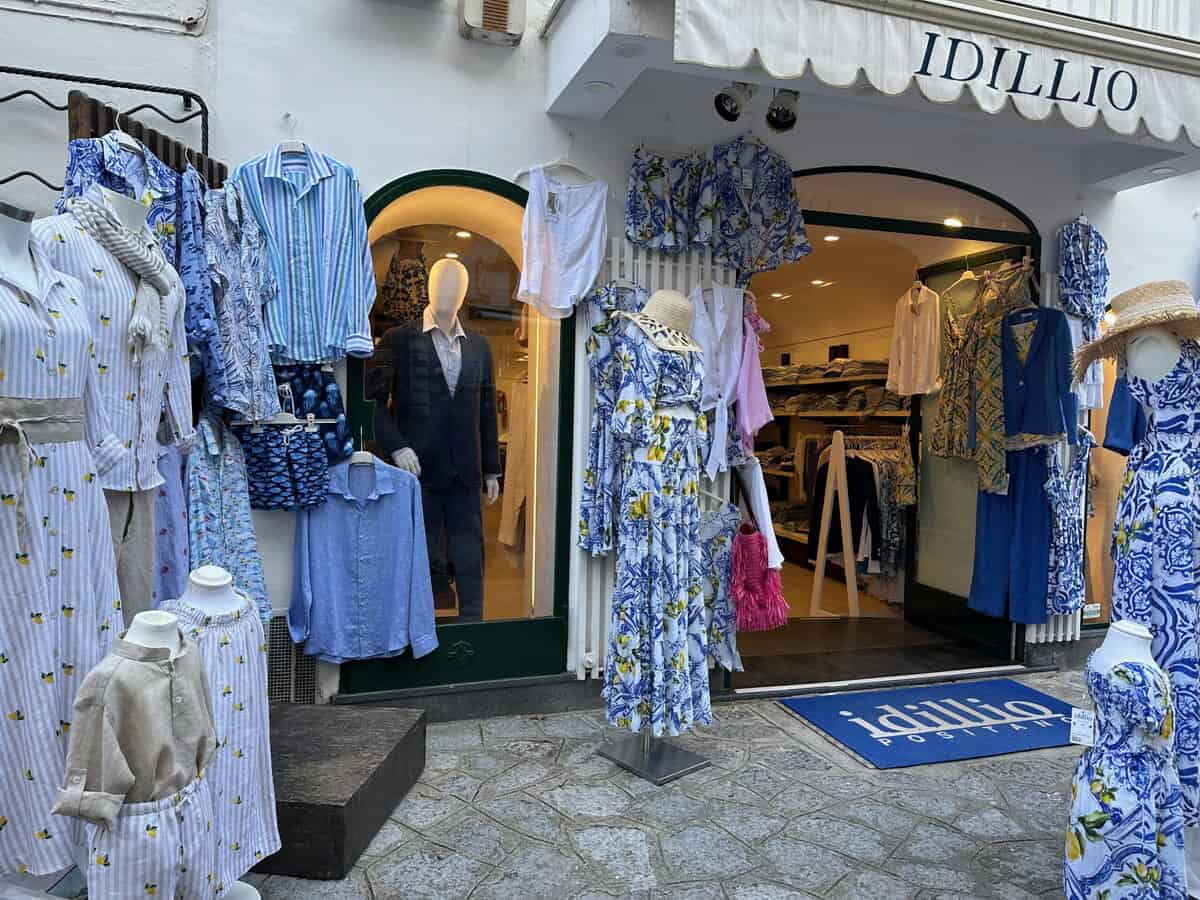
As we wandered the unexpectedly crowded streets, we saw racks of summer clothes outside in the sunshine, surrounded by shoppers. I have never seen so many lemon-embellished clothes, hats, shoes, and home décor as I did that one afternoon in Positano. After eating and drinking, shopping is a very popular pastime in Positano.

Before leaving Positano, we stopped at the beautiful Chiesa di Santa Maria Assunta. We walked the small labyrinth outside the church and took some time in the church’s serene interior to reflect on our good fortune.

On the boat back to Amalfi, I spied a gentleman sporting a straw hat with lemon trimmed band, lemon-embroidered shirt, shorts, and espadrilles. His companion was similarly attired. He told me he was from Milwaukee and on the trip of a lifetime. He certainly had the souvenirs to show for it.

If You Go:

The sun sets on the Tree of Life on Amalfi’s blissfully quiet esplanade before the “season” begins.

Don’t wait for summer to travel when the number of tourists and temperatures soar.

Consider hiring a driver or using buses and boats to get around the Amalfi Coast. Driving is treacherous and not for the faint of heart. Boats and buses leave from the harbor (Porto di Amalfi) on a regular schedule or you can hire a private boat. Taxis are also readily available.

Tourism is the main industry in Amalfi, Positano, Ravello and most towns on the Sorrento Peninsula. Be prepared to pay accordingly and extravagantly for almost everything.

If you struggle with mobility issues, be aware that streets are narrow, often cobbled, and hilly. There are stairs nearly everywhere you go, inside and outside.

Practicalities: Where to Eat, Where to Stay

We enjoyed our daily gelato stop at Ciocolatta Andrea Pansa, breakfast at Bistro F. Illi Pansa (included with our room rate), and dinners at Da Gemma, Ristorante L’Abside, and Pizzeria Donna Stella in Amalfi. Antica Trattoria Barracca also came highly recommended and it was good, but we liked the others more.

We chose Amalfi as our base to explore the Sorrento Peninsula with the exception of two nights in Sorrento. We stayed at the Hilton Sorrento Palace before returning to Naples for a flight to Sicily. If you don’t mind climbing many steep stairs and don’t need a front desk with 24-hour assistance, DieciSedici is well-located. There are hotels at varying price points and levels of service, including some luxury properties like La Sirenuse, Il San Pietro di Positano, and Hotel Eden Roc all in Positano, plus Air BnBs, to choose from throughout the peninsula. Make your reservations far in advance, no matter when you plan to visit this popular destination.

Written and photographed by Jeanne Neylon Decker

This post contains affiliate links. If you click and book, I may receive a small commission at no cost to you. Thank you for your support. I promise not to spend it all on gelato or lemons.

This article, photographs and all materials published by TravelTawk.com are protected by US Copyright Law and may not be reproduced or used without permission from the publisher.

Greece: Discover the Magic of Springtime on the Peloponnese Peninsula

Skip the sweltering summer heat and crazy crowds. Sunny skies, warm weather, wild flowers amidst the ancient ruins, and best of all, far fewer tourists competing to see Greece’s extraordinary sights make Spring the best time to visit. Our original plan was an April trip to the Greek islands, but we were a month too early.  Most island hotels weren’t even open yet so we chose a road trip around the Peloponnese Peninsula instead.  

We saw only pleasure craft in Nafplio’s beautiful harbor–several from as far away as Sweden and Wales.

The Beautiful Seaside CIty You Probably Never Heard Of

Nafplio, Greece’s first capital city, is less than a two-hour drive from Athens. Though this charming seaside city is unfamiliar to many Americans, it’s a favorite weekend getaway for Athenians. A rich history, Venetian fort and castle, wonderful museums, and important archeological sites nearby, made it an easy choice to begin our Peloponnese adventure here.

Sunday afternoons are perfect for a stroll and a leisurely lunch across from the Nafplio harbor.

We chose a boutique hotel in a former sea captain’s home as our base– 3Sixty Hotel & Suites. The busy harbor, lined not with working boats, but luxury yachts and other pleasure craft, enticing shops, and open-air restaurants with fresh fish on offer, was a five-minute walk in one direction.  Syntagma Square, the center of the historic old town with museums, beautiful churches and more restaurants and shops was five minutes the opposite way.

Historic Syntagma Square

Syntagma Square is still the heart of the city. The Archeological Museum forms the Western wall of the square.

Syntagma or Constitution Square, remains the center of public and political life in Nafplio and it was here that the citizenry rose up and demanded independence from the Ottoman Empire. There are monuments, plaques and a War Museum proudly proclaiming the important role Nafplio’s citizens played in Greece’s War of Independence throughout the city.

You’ll find monuments to Greece’s War for Independence all around Nafplio. The Palamidi Castle looms high above this one.

Archeological Museum

Standing in the center of the square you are surrounded by several of modern Greece’s most important buildings. There is a former mosque used as the country’s first Parliament. The homes of Greece’s first Governor, Ionnis Kapodisrias, and War of Independence hero Theodoros Koloktronis are here, too. So is Nafplio’s Archeological Museum. The must- see museum is housed in a 1713 Venetian building that forms the Western side of the Square. It boasts exhibits that date back to the Paleolithic era. 

These figurines were discovered at the archeological site at Tiryns and date to 6th-5th century BC. They are part of the permanent collection at Nafplio’s Archeological Museum.

Priceless antiquities, some more than 5,000 years old, including pottery, clay and bronze seals, and marble figurines, await in this impressive building. It was originally meant as a warehouse for the Venetian fleet.

This cache of 92 golden staters dates back to the early 3rd century BC.

Clay hearths from 3,200-2,100 BC, stone and bone tools, jewelry, anthropomorphic clay figures, and some of the earliest handmade Neolithic clay vases are displayed, giving us a glimpse into what life was like back then.

Ouch! You’ll find these iron reinforcements for sandals at the Nafplio Archeological Museum.

While you’re in the historic center, enjoy a leisurely stroll through the pedestrian-only shopping streets. There are shops, restaurants, bakeries, and cafes to suit most tastes and budgets.

<img loading=
After a nice wander around town and some shopping, I always want ice cream. Here’s my favorite!

A Murder in Church

Visit one of the beautiful Greek Orthodox churches here, like St. George’s Cathedral with both Byzantine and Venetian 16th century architecture. Another noteworthy church is St. Spyridon on Odos Kapodisriou. The street was named for the first governor. Mr. Kapodisriou was murdered by political rivals on the threshold of the small church.

Greece’s first governor met his untimely end at the hands of political rivals here at St. Spyradon.

The Conquerors: What They Left Behind

Today the Bourtzi is a tourist attraction. It was built by the Venetians to protect the city from the Ottomans. The Turks captured Nafplio in 1540, were ousted by the Venetians in 1685, and retook the city in 1715.

Over the centuries the city was captured and ruled by Byzantines, Franks, Venetians and Turks before Greece won independence in 1830.  These conquerors have all left their mark on Nafplio’s culture, architecture and cuisine.

The Venetians

Responsible for two of Nafplio’s best known and most visible landmarks, the Venetians built the Bourtzi and Palamidi Castle. Both are open to the public. On arrival, you’ll see a small, fortified island in Nafplio’s harbor. Bourtzi means island fortress in Turkish, but it was originally named Castello dello Soglio by the Venetians who built it on the islet of St. Theodoroi in 1471 to protect the city and harbor from invading Ottomans. Take a 10-minute boat ride from the harbor to visit the Bourtzi. Extremely windy weather on the day we planned to visit kept us away. 

Built by the Venetians and conquered by the Ottomans a year later in 1715, the Palamidi Castle is visible from nearly everywhere in Nafplio, including the public beach.

The Palamidi Castle, one of the best-preserved in Greece, looms 709 feet above the city. It was captured by the Turks only one year after it was built, ending the Venetians’ second occupation of Nafplio in 1715. The castle has spectacular views over the city and the sea, whether you choose to climb the 847 steps to reach it (some locals claim 999 steps), or drive, as we did. Wander the rooms, cells, and secret passageways and stop at St. Andrew’s Chapel to light a candle.

<img loading=
There are hundreds of years of history to explore at the Palamidi Castle.

Bring a picnic and soak up the sea air, sunshine and panoramic views. Look for the rocky beach far below.  Even though the water was cold, swimmers were enjoying a dip while sunbathers took advantage of the lovely Spring weather. Like most of the archeological sites we visited, the Castle is not accessible to mobility challenged visitors.  

If you plan to spend several days in Nafplio and explore nearby archeological sites, buy the 20 Euro three-day combination ticket at Palamidi Castle or the Archeological Museum. It includes Mycenae Archeological Site and Museum, Byzantine Museum at Argolis (Argos), Tiryns Archeological Site, Nafplio Archeological Museum, Palamidi Castle and Asini Archeological site. We managed to see all except Asini.

Why Worry (Beads)?

Greek worry beads, or komboloi, have been popular since the Ottomans ruled Nafplio.

It’s common to see Greek men toying with a rhythmically clacking string of beads while they’re walking down the street, chatting with friends, dining, pretty much anytime.  These are komboloi or worry beads. Nafplio has a unique and interesting museum dedicated to them.

Komboloi became popular during the Turkish occupation but the use of beads for prayer, mediation, and to ward off evil can be traced to the 8th century BC. Always strung in odd numbers, the beads are traditionally barrel shaped and made from amber, carnelian, horn, bone (buffalo and camel are popular) semi-precious stones, ivory or olive wood. Along with komboloi, the museum has a spectacular collection of beads dating from 1550 to 1950 including Muslim prayer beads brought back by the crusaders and converted to rosary beads, and Hindu and Buddhist meditation beads. No photos were allowed in the Museum.

<img loading=
Komboloi made from natural materials can cost from several hundred to more than 1,500 euro.

Because Nafplio is so closely associated with komboloi, there are shops selling beads of varying quality everywhere. I liked Amber House at 12 Vos. Konstantinou, which carries locally crafted komboloi.  Natural materials make the most satisfying sounds and are meant to sooth, owner Angelika told me. She had me hold several komboloi to find the most comfortable string and listen to the sounds the beads made before purchasing.

Tiryns and Hercules

Wildflowers were blooming amidst the ruins everywhere we visited in the Peloponnesian Peninsula, like here at Tiryns.

In 468 BC the ancient city of Tiryns was sacked by neighboring Argos. Today, wildflowers, poppies and chamomile bloom among the remaining stone foundations of the once thriving kingdom. Climb the stone steps to the upper ramparts and use your imagination to see where the palace once stood, as well as homes and shops in this community of 15,000. Fun fact: Hercules’ mother (Greeks call him Heracles), Alcmene, was the Queen of Tiryns. You’ll likely have this peaceful place all to yourself, as we did.

Mighty Mycenae and a Scandal

<img loading=
Mycenae’s extensive archeological site covers about 79 acres or 32 hectares.

One of the most important archeological sites in the world is perched high between two hills 30 minutes from Nafplio. Home to the once mighty Mycenean civilization, this area has been inhabited since the 7th millennium BC. The extensive ruins here date from the late Bronze Age (1,350 to 1,200 BC). Excavation of the vast site began in 1876, funded by a German businessman with a penchant for Homerian heroes. He was on a quest to find the burial site of King Agamemnon and he succeeded. 

These enormous stones at Mycenea are a hallmark of Cyclopsean architecture. It was thought that only creatures as great as the cyclops could have built with stones this size, not mortal men.

Legend has it that the conquering hero returned home from war (Agamemnon, not the German businessman) to find his wife Clytemnestra had taken up with Aegisthus, his cousin. Together they stabbed him to death in the bath, partly in revenge for sacrificing Clytemnestra’s daughter to ensure favorable winds for the Greeks as their warships sailed to Troy. The lovers are buried in giant beehive tombs, side by side, in the fields below the citadel. You’ll have to drive up the road and hike a bit to find Agamemnon’s larger, but solitary resting place. Don’t miss these ancient architectural wonders with their spectacular domes!

Walk inside Agamemnon’s phenomenal tholos, or beehive, tomb- an architectural wonder. Pieces of the sculpted facade are on display at the British Museum in London and the National Archeological Museum in Athens. Grave robbers make it impossible to know what treasures he may have been interred with.

Mycenae is on the tourist route and there were busloads the morning we visited. The often-photographed Lions Gate is at the entrance and selfie-seekers can create a bottleneck.  Be prepared to be awed as you follow the pathway up through the Cyclopean walls where you’ll find the ruined palaces, temples, royal burial circles, cistern, treasury and fortifications.

Royal burial circles at Mycenae are just inside the gates. The dead were placed in vaults vertically.

There are some paved paths at Mycenae, particularly in the beginning of the complex through the Lion’s Gate and past the royal burial circles. Further along, the path is mostly rocks and dirt with sharp pieces of marble protruding from the ground and then it becomes paved again. Much of this site is not accessible for people with mobility challenges, nor are the fields below the citadel where the beehive tombs are located.

The famous Lions Gate is a highlight at ancient Mycenae and one of the few areas accessible for those with mobility challenges.

Whether you visit the Mycenae Museum before or after the archeological site is personal preference, as long as you see it.  More than 2,500 amazing treasures including fine gold works like Agamemnon’s exquisite death mask, everyday items like pottery, weapons, figurines, jewelry, and frescoes from the archeological site showcase the life and afterlife of the ancient Myceneans from the Bronze Age to the Hellenistic Era. 

Agamemnon”s death mask is just a splendid example example of the fine gold work the Mycenaens were known for. You’ll find it in the Mycenae Museum.

An Ancient Healing Place

It’s a long climb to the top of the ancient theater at Epidaurus. Known for its outstanding acoutics, it still hosts performances today. And yes, you can hear every word spoken at the bottom!

In the ancient world, Epidaurus and the Sanctuary of Asclepius was known as a curative place. Asclepius was the most important healing god in antiquity. Today the site draws visitors primarily for its theater, a UNESCO World Heritage Site, known for its perfect acoustics. Built around 340 BC, the Greek theater, which was expanded by the Romans to seat up to 14,000, is one of the best preserved in the world and still used for performances. Climb up the steep stone steps to the top and listen to the “orators” below.

Take time to wander through the Sanctuary of Asclepius, one of the most important healing places of the ancient world.

After, head out to the sanctuary where you can visit temples, the gymnasium and the enkoimeteria- a large hall where visitors would sleep and wait for the gods to come to them in their dreams with health advice. There is also a small museum on the site with sculptures and other excavated artifacts.

Byzantium

The road leading to the ancient Argos Theater, built in 320 BC, still has some of its marble pavers. Just beyond are Roman baths and the Greek Agora is across the road.

Snakes were the only thing on my mind as we followed the groundskeeper who, armed with a weedwhacker, cleared the tall grass between placards in the ancient agora, or marketplace, at Argos. Located in the modern town, the ruins of Roman baths and the theater complex are across a busy street. They’re worth seeing, though there is little signage.

Detail on a stela near the Argos Theater.

The Byzantine Museum, housed in the historic Kapodistria Barracks, focuses on private, public and religious life here, from 324 AD until 1453 AD.  Everyday objects, pottery, sculpture, weapons, and religious artifacts that belonged to residents of the one of the oldest continuously inhabited cities in the world gave us a fascinating peek into the past.

This 13th century bowl is among the everyday objects on display at the Byzantine Museum in Argos.

Nafplio and the amazing archeological sites nearby filled us with wonder and sparked our interest in returning to this spectacular region for a deeper exploration of these ancient civilizations. Our road trip continued to Kalamata, Patras, Galaxidi, Delphi and finally, Athens—a city we could have spent a month exploring. Those who choose the Peloponnese Peninsula as their destination, as we did, will be generously rewarded.  We’ll visit the islands another time!

PracticalitiesDriving and More

Driving on Greece’s main roads is easy. Mountainous, country roads are bit of a challenge but getting to explore the Peloponnese countryside is worth the effort.

Nafplio is an easy drive from Athens, but country roads can be winding and narrow, especially in the mountains, and people drive fast. Most signage is in Greek and English but not all, so prepare by jotting down the Greek spelling for your destination, especially if it is off the main road, and bring paper maps. Most Greeks speak English, but they were tickled when we could say good morning, hello, goodbye, and thank you in their native tongue. Very few of the archeological sites we visited were accessible for people with mobility challenges.

Nafplio was a great place to begin our exploration of the Peloponnese Peninsula. We will definitely return!

If You Go

We stayed at 3Sixty Hotel & Suites in Nafplio. Some of our favorite restaurants were I Folio, Taverna Pidalio, Mevta, and 3Sixty Grill, all in Nafplio.  Here are links to the sites we visited mentioned in this article:   Archeological Museum of Nafplio, Palamidi Castle, Archeological Site and Museum at Mycenae, Archeological Site at Tiryns, Archeological Site at Argos, Byzantine Museum in Argos, Epidaurus, the Bourtzi.

Written and photographed by Jeanne Neylon Decker

This article, photographs, and all materials published by TravelTawk.com are protected by US Copyright Law and may not be reproduced or used without permission from the publisher.

This post contains affiliate links. If you click and book, I
may earn a commission at no extra cost to you
. Thank you. I appreciate it!