Browsing Tag

Sculpture

Puppets in Palermo—A Stopover in Sicily’s Biggest City


Welcome to Palermo.

We took a drive right up the center of Sicily on SS624 to reach Palermo. The ride is scenic, beautiful and pretty straightforward. As you approach, you’ll be greeted with breathtaking views of the city sprawl and the bay—bellissimo!

Palermo is Sicily’s capital city and it’s most populous. Its Romanesque, Gothic and Baroque architecture, cultural attractions, and incredible cuisine draw visitors from around the world.

Palermo is the largest and busiest city in Sicily and has plenty to offer the visitor looking for a bustling urban experience. We had less than two full days in Palermo and there is far more to see and do than we had time for.

The simple facade of Monreale Cathedral gives no indication of the superb golden mosaics inside this “must see” church.

Let your first stop in Palermo be a visit to Monreale Cathedral. This stunning cathedral has golden mosaics that rival, and some say surpass, those at Venice’s Basilica San Marco (St. Mark’s). This is truly a spectacular church, considered to be the finest example of Norman architecture in Sicily, and should not be missed. The somewhat plain façade belies the beauty that awaits inside.

The breathtaking golden mosaics inside Monreale Cathedral rival those at St. Mark’s (San Marco) Basilica in Venice.

Narrow, busy streets and overcrowding make parking a challenge in Palermo and the area surrounding the cathedral is no exception. There is a well-marked, supervised pay parking garage just down the road from the cathedral. Walk carefully along the alley- like street back up to the church.

The clear message here is: Do not park in front of this garage. Parking is always tricky in Palermo. When in doubt, find a pay lot.

After enjoying the splendor of the cathedral, we had a terrific lunch at Bricco e Bacco Brasserie, just kitty corner from the cathedral. It was a lovely place with good, local specialties and friendly service. Since we arrived after the lunch crowd, it was also quiet. You’ll find the restaurant at Via B. D’Aquisto, 13, Monreale, Phone for a reservation +39 091 641 7773. It’s a popular spot.

Driving in Palermo can be a harrowing experience and is not for the faint hearted.

Wind your way down into the city proper, navigating traffic carefully. All bets are off in Palermo and traffic can be heavy. Stop signs seem to be a mere suggestion and traffic signals are also sometimes ignored.

Farm fresh fruits and vegetables are sold at stands throughout the city. Be aware that in Sicily, what we call broccoli is cauliflower here.

Street markets like this one, selling clothing, dry goods, kitchen wares and other necessities can be found throughout Palermo. Ask for a “piccolo sconto”– a discount. Bargaining is part of the fun.

We really enjoyed walking all around the city to get the flavor of it and to get our bearings on our first visit.  We covered a lot of ground, including the Corso Vittorio Emmanuel, which is Palermo’s “high street.” Here you’ll find upscale shops and stylish boutiques, cafes and bars. Palermo also has numerous street markets with household necessities, clothing and dry goods, fruit stands, and food stalls, including the well known Vucciria and Ballaro markets.

Hands down, our favorite cultural institution in Palermo was the Museo Internazionale delle Marrionette. Yes, it is a puppet museum and far more compelling than you might expect. Sicily has a strong tradition of puppetry used for both entertainment and political commentary dating back centuries.

In addition to providing entertainment, puppet shows were often used to express political and social view points, particularly when the literacy rate was low.

Plan to spend at least a few hours enjoying the expansive collection and exhibits at the International Museum of Puppetry.

The museum’s collection includes more than 3,000 puppets of all kinds from around the world.

Marionette soldiers in full armament along with their battle- ready horses are on display in this large gallery.

The attention to detail and historical accuracy of the costumes is impressive.

They have puppets and marionettes from around the world, from the simplest paper puppets to the most elaborate marionettes. You’ll see everything from fairy princesses and dragons to entire armies dressed in armament from throughout the ages, all with remarkable attention to detail.

Even Laurel and Hardy make an appearance here.

You’ll find examples of puppets from the primitive to the extraordinarily elaborate.

Puppets from around the world including Africa, Indonesia and Japan are represented.

There are also a variety of settings and backdrops on view. We found our visit to the marionette museum to be an absolutely enchanting experience. The museum hosts puppet shows, too, of course.

Enjoy these fine examples of Japanese Bunraku puppets.

The museum often hosts puppet shows and has videos of productions on view.

For more information and show times, please visit www.museomarionettepalermo.it The museum is at the end of Via Butera on the Piazzetta Antonio Pasqualina, 5.

Known for its medieval art collection, the Galleria Regionale della Sicilia at Palazza Abatellis is a former palatial residence dating back to the 1490s, which went on to become a convent and then a monastery. It is now a regional gallery and museum.

Built for the Kingdom of Sicily’s Port Master, this fine former residence now houses an impressive collection of Medieval art and other treasures.

Here you will find sculptures, frescoes and paintings by Italian artists, as well as Flemish and other European masters, sacred art, weaponry and more.

Sculpture, paintings, religious art and more await visitors at the Palazzo Abatellis.

Though the building suffered terrible damage during Allied bombing raids in WWII, frescoes such as these from the 1400s survived.

Unfortunately the website has not been updated for some time so it is best to call the museum at +39 091 623 0011. It is located at Via Allora, 4.

To see how the upper class lived centuries ago, visit the Palazzo Mirto www.casemuseoitalia.it/en.   The Palazzo Mirto is part of a network of “house museums” found throughout Italy. It was originally built for the Filangeri family in the mid 17th century and falls into the ancestry category of homes.

The Palazzo Mirto provides a glimpse at the opulence the upper classes enjoyed during the time of the Kingdom of Sicily.

The palazzo is filled with beautifully appointed rooms featuring elaborate furnishings, ceramics, antique musical instruments, and art. One of the most spectacular is the Chinese Room, likely decorated in 1876 when the house was renovated.

The Chinese Room was the height of fashion when it was designed in the mid 1800s.

There are also classic carriages on display along with other historic treasures that paint a picture of Sicilian life for the upper class in the days before the Risorgimento when Sicily was still a kingdom.

Splendid furnishings and elegant porcelain are among the items on display at Palazzo Mirto.

The museum is located at Via Merlo, 2 and telephone is +39 091 616 4751 for updated information.

Enjoy a performance or take a guided tour– these are the only ways to get inside the magnificent Teatro Massimo.

If there is a performance at the Teatro Massimo, get a ticket and go. Regularly scheduled dance, opera, and classical music are all performed here. If you’re feeling flush, you, too, can rent the royal box —you just have to purchase all 27 seats in it.

The Teatro Massimo is known for its excellent acoustics and grand stage.

If time does not permit you to attend a performance, take a guided tour, which is the only other way to see the inside of this magnificent and historic building.

This beautiful and historic theater is among the largest in Europe.

A model of the theater is displayed in the lobby.

The theater boasts one of the largest stages in Europe and is worth seeing. Built in 1897, it is known for its outstanding acoustics and is still the largest theater in Italy with 1,300 seats. It is appropriately located on the Piazza Verdi. +39 091 6053580 www.teatromassimo.it.

The Politeama Garabaldi Theater hosts regular performances in Palermo’s historic city center.

We wanted to visit the highly regarded National Archeological Museum but it was closed for renovations during our visit. Please go to www.regione.sicilia.it/beniculturali/salinas for current information.

A stroll through Sicily’s capital city yields surprises.

We did not visit the Catacombe dei Cappuccine, the home of about 8,000 dead bodies, amassed over the course of several hundred years, all dressed up and on display. We find the entire enterprise rather ghoulish and having seen the Capuccine Chapel in Rome, which features skeletons of dead monks, felt no obligation to see this seemingly far more ambitious enterprise. Apparently it is a popular place on many tourist itineraries and so we mention it here.

Flags fly outside the Porta Felice Hotel on the small but busy Via Butera.

There are lodgings at all price points and with all levels of service, as you would expect in a large city like Palermo. We stayed at Hotel Porta Felice www.hotelportafelice.it/en at Via Butera, 45. Tele. 091 6175678. This is in the old section of town near the port.

Pleasure craft and fishing boats crowd the marina at the end of Via Butera.

Even though the hotel is on what appears to be a small side street, it is pretty busy. We were upgraded to a nice suite, even though we’d booked through www.venere.com. The location was very convenient and we walked everywhere we wanted to go, after turning in our rental car.

Friendly service and excellent Sicilian specialties await diners at L’Ottava Nota.

We only had two nights in Palermo and wound up having dinner both evenings just down the street from our hotel at L’Ottava Nota Ristorante, via Butera 55 091 6168601 www.ristoranteottavanota.it.   The restaurant was small and lovely with fantastic food and great service. The fish dishes were all spectacular. Everything was fresh, artfully prepared and delicious.

Perfectly prepared pasta makes a delicious first course.

White fish in a light curry broth was a favorite.


Seafood dishes were the star attraction for us, but L’Ottova Nota has superb meat and vegetable dishes, too.

A fish in a light curry broth with vegetables was so good I still think about it, though it is no longer on the menu. We mentioned we were staying at the Porta Felice and were happily surprised to learn we’d get a 20 percent discount on our meal because we were guests there. We cannot confirm that the special pricing is still available but it never hurts to ask, should you dine here. The restaurant is just a few doors down from Porte Felice on Via Butera, 55. The telephone is +39 091 616 8601.

We had an excellent lunch at Trattoria Piccolo Napoli, www.trattoriapiccolonapoli.it. Piccolo Napoli had been recommended by an Italian friend in the wine business but apparently Anthony Bourdain had once dined here and the owner told us that lots of Americans had been showing up ever since. Our welcome was much more cordial when we told him (in Italian) that his friend Sasha had sent us! Try the panisse (chick pea fritters) to start and have any seafood you like—it is all super fresh and simply, but deliciously, prepared.

Snack on some panisse as you peruse the menu.

Simply but perfectly prepared pastas and seafood dishes shine at Piccolo Napoli.

Through a small window into the kitchen, we watched the chef toss a whole octopus into a pot, plate it and serve it to a young girl who devoured every bit. We had pasta with shellfish and then I had a beautiful swordfish dish. For dessert, they brought us the ubiquitous “winter melon.” The melon is sweet and refreshing and so called winter melon because it can be picked in the summer and stored throughout the winter.  We saw it on menus throughout Sicily. The restaurant is on the Piazzetta Mulino a Vento, 4. Telephone is +39 091 320431.

Palermo is a fascinating and vibrant city and certainly worth a visit. We’ll be back.

Our final meal in Palermo was an extremely casual, but excellent pizza lunch at the airport, which we enjoyed out on the observation deck with a view of planes coming and going, and of course, the beautiful sea!


Treasures of Berlin’s Museum Island

Take a stroll through the Brandenburg Gate, down Unter den Linden, to the banks of the River Spree. There you’ll find some of the world’s most intriguing and important cultural treasures—the Ishtar Gate, the bust of Nefertiti and so many extraordinary antiquities, classical sculpture and masterworks, it is impossible to imagine they could all be in one place—but they are—Berlin’s Museum Island.

IMG_0852

Museumsinsel http://www.smb.museum is home to five separate historical museum buildings, each designed by a well-regarded architect of the time and now part of a UNESCO world heritage site. Here you will find the Pergamonmuseum, Altes (Old) Museum, Alte Nationalgalerie, the Bode-Museum, and the Neues (New) Museum.

IMG_0626

The museums on Berlin’s Museumsinsel are a treasure trove of important paintings, sculpture, and antiquities from around the globe.

According to Visit Berlin, more than 3 million people come each year to view the collections that range from prehistory to 20th century art. Savvy travelers will want to purchase a Museum Pass, which provides entry to 50 major and lesser-known museums, including the five on Museum Island, over three consecutive days for one low fee. The price was 24 Euro when we visited in November. Passes are available at Berlin Tourist Info points, in the museums, and online at Shop.visitberlin.com.

IMG_0859

The magnificent Ishtar Gate, believed to date from 170 AD, was dedicated to Zeus and Athena. It was brought to Berlin from Western Turkey in 1903.

The long lines and crowded galleries attest to the fact that the Pergamon Museum is on nearly every visitor’s short list of places to visit in Germany’s capitol city.   It should be. The magnificent Pergamon Altar, Ishtar Gate, and marvelous sculpture and other works from ancient Sumeria, Babylon, Assyria, and modern day Iraq, Turkey and Syria are all on display here.  Restoration is underway on the Ishtar Gate, but it remains open for viewing. The Pergamon Altar was closed for restoration during our recent visit and will reopen in 2019. We were fortunate to see it several years ago.

IMG_0866

Detail from the Processional Way, which leads to the Ishtar Gate, at the Pergamon.

IMG_0869

Stunning Roman mosaics cover the floor in the gallery that contains the Market Gate of Miletus, built in the 2nd century AD in Turkey and excavated and brought to Berlin in the early 1900s.

IMG_0901

The stunning Aleppo Room at the Pergamon, seen through protective glass walls.

IMG_0907

Facade of the Caliph Palace Mshatta from Amman/Jordan from the 8th century. The 33 meter long, 5 meter high facade was brought to Berlin in 1903 to the Bode Museum. In 1932 it was reconstructed in the Pergamon.

We practically had the galleries to ourselves when we visited the Bode-Museum in November. This beautiful museum boasts art from the Byzantine and Roman Empires, a spectacular sculpture collection spanning from the early Middle Ages to the late 18th century, and one of the most extensive numismatic collections in the world. We could not understand why the Bode wasn’t full of people enjoying these art treasures.

IMG_0842

Pedro Roldan’s Our Lady of Sorrows (Mater Delorosa) at the Bode-Museum.

IMG_0784

The Bode-Museum is known for it’s sculpture collection. Friezes, sacred art and other cultural treasures are also on display.

IMG_0838

Don’t miss the extensive numismatic collection at the Bode. It’s one of the most comprehensive in the world.

The Bode also has a lovely café where we enjoyed a delicious and very reasonably priced lunch along with views over the Spree. The cafe balcony overlooks the museum’s grand entrance below.

IMG_0815

IMG_0814

The comfortable cafe at the Bode was perfect for a light lunch.

IMG_0817

Save room for dessert!

If Impressionist works are more to your liking, visit the Alte Nationalgalerie, home to 19th century works by Renoir, Manet, Monet, and Cezanne, Adolph von Menzel and other well regarded artists of that time period. The Alte Nationalgalerie was the third museum to open on Museum Island.

IMG_0617

The Alte Nationalgalerie is home to a fine collection of 19th century paintings– part of Berlin’s State Art Collection.

Housed in one of Berlin’s most impressive neoclassical buildings, the Altes Museum was dedicated in 1828 by Friedrich Wilhelm III for “the study all antiquities and the free arts”. The museum’s permanent collection centers on classic antiquities covering Etruscan, Roman and Greek art and includes urns, vases, sarcophagi, friezes, pottery and sculpture.

IMG_0769

The Altes Museum is a popular destination for student and tour groups.

The 3300 year-old bust of Nefertiti is among the highlights at the Neues Museum, or New Museum. After sustaining significant damage during World War II, the building, which was designed by Friedrich August Stuler and constructed between 1843 and 1855, was abandoned. In 2003, extensive restoration began and the museum opened in 2009 with three main collections—Egyptian art from the Egyptian Museum and Papyrus Collection, prehistoric objects from the Museum for Prehistory and Early History, and classical antiquities. Visitors will find works from around the globe including the Middle East, North Africa, and Northern Europe at the Neues Museum.

For updated information on each of the museums on Berlin’s Museum Island and details on permanent collections, temporary exhibitions, admission, hours and directions, please visit http://www.smb.museum.

Note: The banner image is the Cathedral of Berlin known also as Berlin Dom, located on Museum Island.  In addition to church services, the Berlin Dom is open for tours. Numerous concerts and other events are also held there throughout the year. To the right is the Berlin TV Tower, constructed by the Soviets during the Cold War and now a popular tourist destination.

Napa Valley Winery Visits and our First Stop- B Cellars

Gone are the days when it was possible to drive up and down Route 29 or the Silverado Trail and pop into wineries for complimentary tastings. Though there are plenty of wineries that are open to all during posted hours, many are open for tours and tastings by appointment only.  Most now require reservations due to the Covid-19 crisis. It is also rare to find a winery that offers complimentary tastings. Buses, and even limos, are discouraged at most wineries these days, too. We think these are all positive changes and if you’ve ever seen large, loud groups who’ve clearly been doing more drinking than “tasting” you’ll probably agree.

IMG_8194

B Cellar’s owners preserved many of the older oak trees on the property when they built the new winery facility.

The Napa Valley has nearly 500 wineries with tasting rooms so to make the most of your trip, it’s important to do some homework. Look at a map of the Napa Valley and find where your favorite wineries’ tasting rooms are located because sometimes they are not where the wine is actually made. You won’t want to waste time driving up and down the Valley backtracking, so plan your itinerary with location in mind. Our rule of thumb is no more than three winery visits a day and only two if the tours and tastings are very extensive. Do some research and contact your favorite wineries to see what they offer and reserve accordingly. Many offer a range of “experiences.”

When walk-in visits were allowed and most people just turned up, by booking a visit you’d frequently get to taste special bottles and have the chance to really learn about a particular winery and its wine maker. You’d also avoid the crowded tasting room experience, though the current public health crisis limits the number of people allowed at wineries.

IMG_8193

B Cellars open demonstration kitchen.

On our last visit to Napa Valley we began with a trip to B Cellars in Oakville. We had first visited them back in 2014, when the winery was being built and our tasting took place in a construction trailer. The wines were spectacular then too, but now the setting befits the wine! The  Hospitality House, with several tasting areas inside and out, is situated on gorgeous, expansive grounds and includes a demonstration kitchen, a culinary garden, chicken coop, wine production facilities, wine cave and event space.

IMG_8201

The grounds are populated by Seward Johnson’s lifelike sculptures of people involved in daily tasks like shopping, gardening and just relaxing.

The winery, which was founded in 2003 by Duffy Keys and Jim Borsack, with the highly respected Kirk Venge as winemaker, offers several tasting experiences. Most take about 90 minutes. Since we would be coming right after lunch, we chose the Sojourn, which included B Cellars Flagship wines and several delicious local cheeses.

We were greeted with a taste of the 2013 Juliana Vineyard Sauvignon Blanc, which we enjoyed on the expansive terrace. We moved over to an umbrella- shaded table and began our tasting in earnest with a 2012 Dutton Ranch Chardonnay.

IMG_8184

The Hospitality House has tasting areas inside and out.

Red wines we tasted included the 2013 Manzana Vineyard Pinot Noir, a 2009 Blend 24, and 2012 Ehrlich Cabernet Sauvignon. Our delightful and knowledgeable wine host Alex also poured us several wines not typically included on the Sojourn tasting including a 2012 Blend 26.

IMG_8191

Our knowledgeable wine host Alex.

IMG_8196

The wine cellar has plenty of private event space.

After our tasting we elected to tour the grounds and wine cave with Alex—a lovely and memorable afternoon at B Cellars and a great place to begin our Napa Valley wine adventure.

Note– I have updated this post to reflect the need for reservations during the current coronavirus crisis.  Please check with individual wineries for details and requirements.

Art Oasis- Faye Sarkowsky Sculpture Garden

Art and nature lovers share a common destination– the Faye Sarkowsky Sculpture Garden in Palm Desert.  The stunning sculpture garden is located within the Eric Johnson Memorial Gardens and is part of the Palm Springs Art Museum in Palm Desert. Contemporary sculptures are installed among the four beautifully landscaped acres that surround The Galen, the museum’s LEED-certified building.

IMG_6395

Felipe Casteneda’s Seated Thinking Woman

IMG_6396

Walks Among Stars by Dave McGary

This welcoming garden, which is open to visitors all year long, includes soothing water features, winding walkways, beautiful native plants and plenty of quiet nooks for contemplation. As you stroll along the pathways it’s easy to forget that this lovely oasis of art and nature is located off a busy street between sprawling shopping malls.

IMG_6399

Blue glass in the pavement paths through the garden replicate a winding river. The pavilion is used for concerts and events.

The contemporary sculptures on display include works by international artists such as Felipe Casteneda, Gio Pomodoro, Betty Gold, Dan Namingha, Donald Judd, Yehiel Shemi and Dave McGary. Downloadable self-guided tour information is available on the museum’s website. Admission to the garden is free.

IMG_6405

Barry Flanagan’s Acrobats

IMG_6398

Peter Reginato’s Midnight and Morning Rain…Waiting for Miro

The Faye Sarkowsky Sculpture Garden is also used for concerts and events. For complete and updated event information contact the Palm Springs Art Museum.


Hats Off to Degas–Lucas Shakes Things Up at SF’s Legion of Honor

San Francisco’s venerable Palace of Legion of Honor, part of the city’s Fine Arts Museums, is currently hosting the very popular Degas, Impressionism and the Paris Millinery Trade.

The extensive exhibition focuses on the impact of the millinery trade in Paris during the Belle Epoch era on the work of Degas and his contemporaries.  Paintings and pastels by Degas, Renoir, Edouard Manet, Mary Cassatt, Toulouse- Lautrec and others, some never before shown in the U.S., are featured. In addition to the splendid impressionist paintings, included in the exhibition are 40 marvelous examples of millinery from that time period—in other words—hats!

Hats featuring flowers were popular in the 19th and 20th centuries. Silk, cotton, velvet and paper were all used to construct artificial flowers like those shown here.

Some patrons were definitely in the spirit of things.

These hats range in size and complexity from the sublime to over the top. One chapeau is topped with an entire owl, which had been preserved specifically for that purpose. There are plumes, beads, metallic wire, ribbons and flowers adorning these mostly enchanting toppers.

Plumage from domestic and exotic birds, including ostrich and owls, often were used to embellish luxury ladies’ hats.

These hats all sport fashionable feathers. The hat on the left features a complete owl while the one on the right has an African starling above its brim.

A visitor admires Manet’s “At the Milliner’s”–one of about 40 paintings and pastels in the exhibition.

Men’s hats are included in the exhibit too. There are fine examples including boater and bowler hats, along with a sketch of Degas himself in a top hat.

Bowlers and top hats, along with carrying cases, are part of the exhibit.

The 42 year-old Edgar Degas is shown here wearing a top hat.

The exhibition was quite crowded, mostly with ladies of a certain age, oohing and ahhing over the millinery creations. There were a few patrons sporting hats and we spotted several of the museum’s docents in the spirit of things– wearing lovely fascinators.

Feathered finery got a lot of attention from visitors.

We didn’t take a docent-guided tour but shared our table at lunch with a group of ladies from the San Jose area who had and raved about it. It is necessary to reserve a spot for a guided tour in connection with this exhibit.

This docent wears a fine fascinator for her presentation. Reservations for the free tours are essential for this exhibition.

Some of the Impressionist paintings in this exhibition have not been shown in the U.S. before.

Special exhibition tickets are required for the Degas exhibit, in addition to the general admission fee for the museum. This doesn’t seem to be keeping the crowds away at all downstairs. There were numerous tour groups vying to get close to the works during our midweek trip to the Legion of Honor.

Special exhibition tickets are required, in addition to general admission. The galleries became quite crowded at times.

Upstairs in the galleries featuring Rodin’s classic sculpture, visitors can enjoy near solitude—at least during our visit. Displayed with the August Rodin: The Centenary Installation, which honors the 100th anniversary of the artist’s death, you’ll find the provocative work of Sarah Lucas. Sarah Lucas:Good Muse is the first major exhibition of the UK artist’s work in the U.S.

The museum is best known for its ancient and classical European collections which includes paintings, sculpture, furnishings and porcelain.

Sarah Lucas’ work brings contemporary art and controversy to the Legion of Honor.

Sarah Lucas:Good Muse would probably be much more comfortable at the SFMOMA (SF Museum of Modern Art) than at the classically- focused Legion of Honor. The docent who provided a tour of the exhibition shared that many patrons and members of the museum were more than a little unhappy with Lucas’ work.

Giant plaster cast boots, soft sculptures and a series of Lucas’ yellow urinal sculptures are on display among the 50 bronze, plaster and marble works by Rodin.

Lucas’ sculptures, made from plaster, panty hose, florescent lights, a bedspring and mattress, cigarettes and other materials, allude to sexual interactions, availability, empowerment, and domestic responsibilities, according to the docent. She also pointed out examples where Rodin’s work related to the themes of Lucas’ pieces.

“Washing Machine Fried Eggs” invites discussion of women’s sexual and domestic roles.

Apparently the artist wanted to “bring color” to the galleries and chose to include a series of yellow urinal sculptures displayed atop small refrigerators, placed among Rodin’s classic sculpture. We found the juxtaposition interesting but could easily understand the contretemps. At the entrance to the galleries where Lucas’ work is displayed, there are signs warning that the art may not be appropriate for all viewers. We have chosen not to include photos of the most controversial work for that reason.

Electricity in this piece “keeps the energy up” according to the artist.

Degas, Impressionism and the Paris Millinery Trade closes September 24 and Sarah Lucas: Good Muse closes September 17. Go see these very different exhibitions for yourself and let us know what you think. A day at the Palace of Legion of Honor is always a day well spent.

MoMA’s Must See Picasso Sculpture Closes Soon

In just over a month’s time, one of the most extensive and engaging exhibitions of Pablo Picasso’s sculpture ever presented in the United States will close. If you haven’t already visited the Museum of Modern Art’s marvelous retrospective of the painter’s rarely seen works, get your tickets and go see it before it closes on Feb. 7, 2016. http://www.moma.org

IMG_0797

A visitor examines Picasso’s Man With A Lamb (1943).

For the first time since 1967, New York’s MoMA presents one of the largest exhibitions of the painter’s three-dimensional work. The exhibit includes more than 100 sculptures plus photographs and works on paper, many never before displayed in North America. I was fortunate to see the exhibition during the Member Preview before it opened to the public in September.

IMG_0746

Left foreground, Woman with Child (1961), center rear, Head of a Woman (1957), right, Chair (1961). All three of these sculptures are painted sheet metal.

While Picasso was a formally trained painter, he was a self-taught sculptor and his work reflects the exuberance and personal relationship he had with the art form. He kept most of his sculptures in his personal possession rarely allowing these works to be displayed. One of the first and only times some of these pieces were presented publicly was in 1966 at a major retrospective at the Petit Palais in Paris when the artist was 85 years old. The following year, the MoMA staged Sculpture of Picasso in New York featuring many of the same works. Picasso’s sculptures have not been on public view on such a grand scale since.

IMG_0775

Insect (1951) was created from fired white clay and painted.

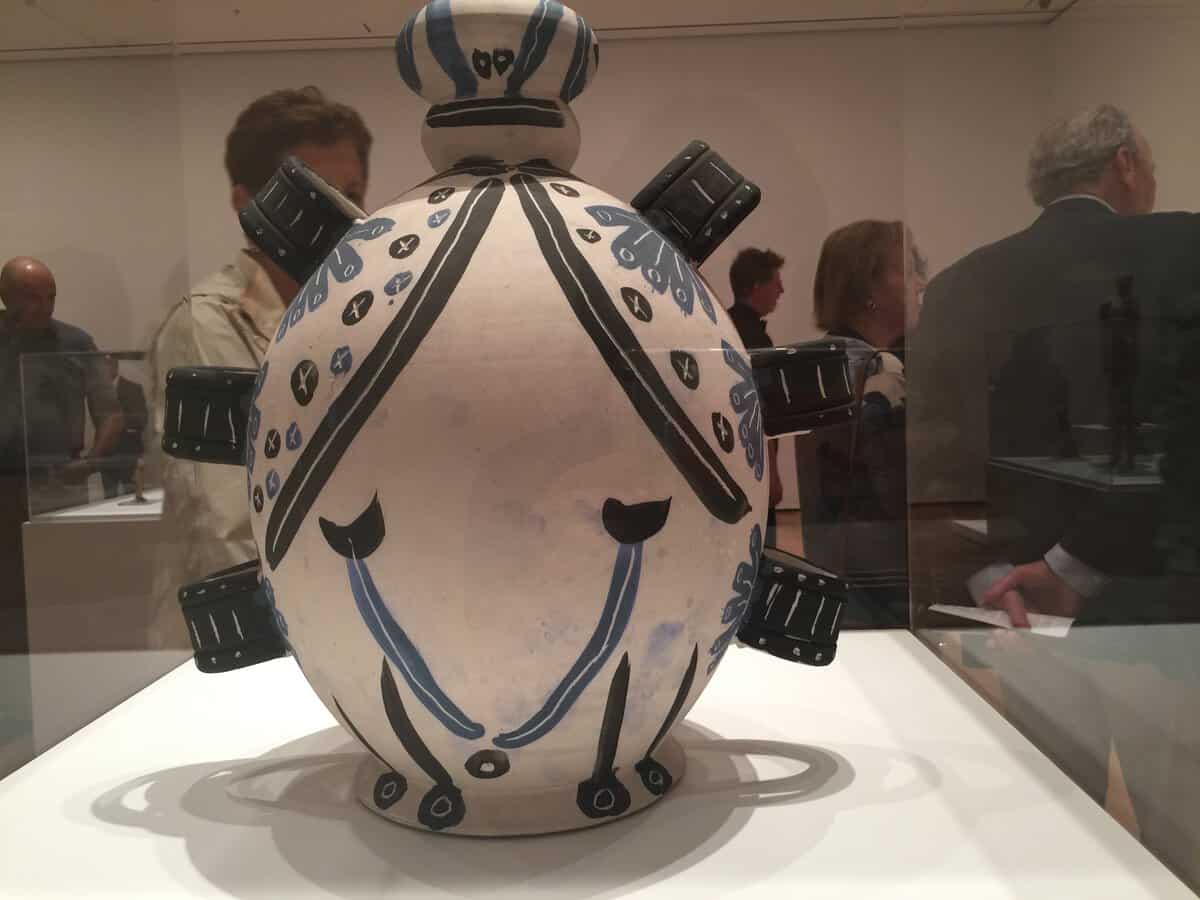
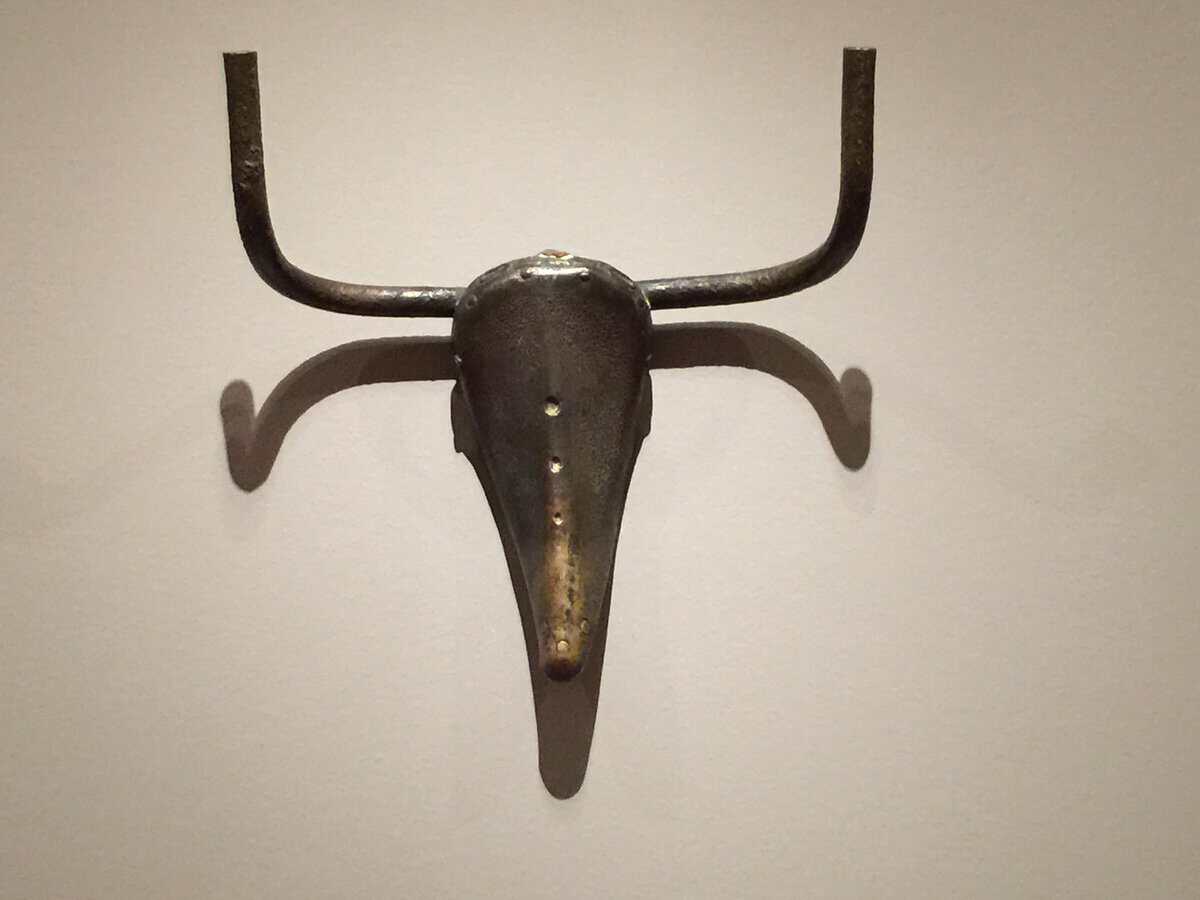
Picasso was fond of unconventional techniques and materials and frequently used found objects and materials including scrap wood, wire, metal and cardboard in his sculpture. Wicker baskets, pie tins, palm fronds, toy cars and many other scavenged items found their way into Picasso’s work. He used a bicycle seat and handlebars to create Bull’s Head, which was on loan from a private collection, for example.

IMG_0799

Bull’s Head, (Spring 1942) is a repurposed bicycle seat and handlebars.

IMG_0811

Left, bronze Pregnant Woman (1949). Right, Flowery Watering Can (1951-52) incorporates a watering can, plaster, nails and wood.

Museumgoers will learn that Picasso’s forays into sculpture were influenced by many sources including ceramics and woodcarvings by Paul Gaugin and Edgar Degas as well as by Oceanic and African sculpture. His themes run the gamut from political expression to family life. Just as in his paintings, women are frequent subjects in Picasso’s sculpture.

IMG_0768

Left, Bather (1931) bronze. Right, Head of a Woman (1932) plaster.


IMG_0771

Left, Woman with Vase (1933) bronze. Center, Head of a Warrior (1933) plaster, metal and wood.

He enjoyed reinventing and reimagining many of the same themes as the exhibition demonstrates. His Glass of Absinthe – six different polychromed bronze pieces each including an actual absinthe spoon, is a good example of this.

IMG_0807

Seated Woman (1947), Standing Woman (1945), Seated Musician (1950), and Seated Faun (1950) are among the small earthenware, terracotta and clay pieces in this display case.

Visitors to Museum of Modern Art http://www.moma.org will need timed tickets to see the Picasso Sculpture exhibition. Only members, corporate members and guests accompanied by members are exempt from this. Each day a limited number of tickets will be available for same day viewing but we strongly suggest that you get your tickets in advance to ensure you don’t miss this wonderful exhibition.

IMG_0783

Woman with Outstretched Arms (1961) painted iron and sheet metal.

Published in conjunction with the exhibition and available in the MoMA’s book and gift shops, the Picasso Sculpture catalog makes a beautiful souvenir that will allow you to revisit your favorite works again and again.