

Can you resist looking up when the Goodyear blimp passes overhead? Imagine being among the first to spot a zeppelin as the strange looking aircraft floated by 125 years ago. Learn about the iconic airship that once captured the world’s imagination and transformed travel, commerce, and military strategy at a visit to Friedrichshafen’s fascinating Zeppelin Museum.
This engaging, family-friendly museum is perfect for fans of flight, military history, engineering, and adventure. The museum is a must for those fascinated by the Hindenburg disaster.

On the Shores of Lake Constance

Housed in an enormous structure on the shores of Lake Constance, or the Bodensee in German, the Zeppelin Museum tells the story of the airship developed by Count Ferdinand von Zeppelin. A retired German General and an inventor with a penchant for engineering, he foresaw a future where these large, lighter than air, rigid airships would play an important role in transporting goods and people, with both commercial and military applications. For decades, they did just that.


Visitors to the museum learn the science, technology, development and fascinating 125 year history of the airships. Compelling interactive and static exhibits tell the story. The first zeppelins, LZ 1 and LZ 2, were experimental aircraft and used to survey large swaths of Europe from their base in Friedrichshafen.
As von Zeppelin correctly surmised, the German military quickly saw their potential for surveillance and transportation. Consumer applications came soon after when zeppelins were used to transport goods over long distances.
First in Transatlantic Flight
Zeppelins were first flown to destinations within Germany and then across Europe. The fast, economical airships became the first aircraft to carry passengers across the Atlantic Ocean.
By 1936, the Hindenburg carried passengers and up to eight tons of perishable goods like flowers, food, and medicine in its cargo hold for the relatively speedy two-day transAtlantic journey. Zeppelins were also used for polar expeditions including Roald Amundsen’s last fateful trip to rescue Italian explorers at the North Pole.
During Wartime

The museum has fascinating exhibitions about the zeppelin’s role in WWI and the subsequent shut down of production demanded by the Allies after Germany’s loss in the conflict. Two of the already-built zeppelins were given as reparations to Italy and France. A third was sent to the USA. German engineers also came to the United States to work with the military to develop an American dirigible program.
Let Your Imagination Soar Aboard the Hindenburg
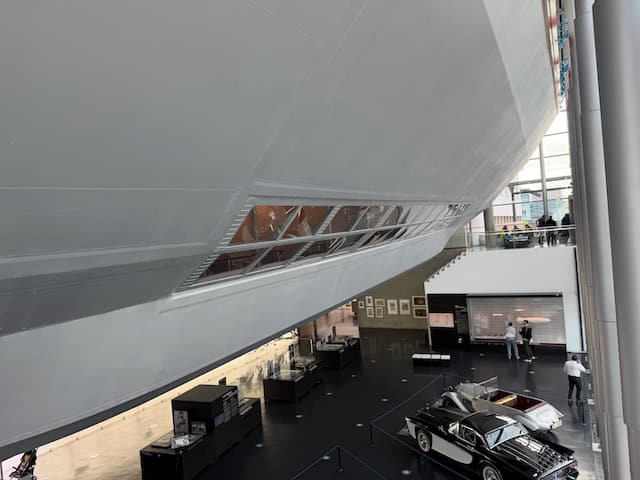
One of the highlights at the Zeppelin Museum is exploring a partial reconstruction of the Hindenburg. It was one of the largest passenger-carrying zeppelins ever built. The reconstruction was faithfully built adhering to the airship’s original plans.
Enjoy the 1930s Bauhaus design of the surprisingly spacious lounges and public spaces and relax where passengers would have. Peek into the restrooms and down the halls where the passenger cabins are located aboard the luxury airship. It’s clear that traveling by zeppelin was for strictly for those with means.


During the zeppelin’s heyday, 50 to 70 passengers could comfortably travel across the Atlantic to Lakehurst, New Jersey just outside of New York City, or to Brazil’s then capital, Rio de Janeiro. In 1928, the journey to New Jersey aboard the LZ 127 Graf Zeppelin took more than four days, while less than a decade later the Hindenburg could make the crossing in about 50 hours.
The Hindenburg Disaster

After a transatlantic journey on May 6, 1937, the Hindenburg crashed and burned while landing in Lakehurst, New Jersey. The zeppelin was carrying half its normal passenger load on that flight. Incredibly, of the 97 people aboard, which included 61 crewmen and 36 passengers; 65 lived through the catastrophe while 32 souls perished. The museum contains photos, newsreels and news clips of one of the world’s most infamous air disasters.
An aviation failure of epic proportions, the fiery Hindenburg crash has been studied in minute detail since then. Spoiler alert: While a number of factors (highly combustible hydrogen gas, weather conditions, the flammable coating of the rigid aircraft) may all have played a role, the exact cause of the crash is still a mystery. Many of the most sensational photographs of the burning Hindenburg in the exhibition were taken by Richard Fleischhut, who became known for his photographic portraits of stars like Marlene Dietrich.

With the development of faster aircraft and public confidence dwindling after the Hindenburg disaster, the era of passenger travel aboard zeppelins came to a close. This was not the end of the zeppelin, however. The museum explores how Hitler’s National Socialist Party leveraged the airships for propaganda purposes and used slave and forced labor brought to Friedrichshafen from across Europe to build zeppelins before and during WWII, even though they knew the airships had limited military usefulness.
A Family Connection
We have a family connection to that dark period of history. We spotted signage in the museum that noted after Allied bombers attacked Friedrichshafen on March 18, 1944, Hitler ordered all military production, including the Zeppelin factory, to move to hastily constructed underground bunkers. It was on that March 18th bombing run that my father-in-law and his B-24 crew mates, who had taken off from Wendling Air Base in the UK, were shot down over Friedrichshafen. They managed to fly their crippled aircraft across Lake Constance and landed in Switzerland, barely avoiding Nazi capture.

The men were interned in Adelboden, Switzerland for the remainder of the war. The 392nd bombing group had one of its deadliest days of the war on that mission. Only 10 of the 24 planes that flew to Friedrichshafen that day returned to England.
Models, Statistics, and A Flight Simulator

The museum has an entire gallery dedicated to the Hindenburg. In addition to models, photographs, and plenty of fascinating facts, the largest surviving pieces of Hindenburg wreckage are on display here; the rudder bearing arm and part of the tail unit.
In Zeppelin Hall, aviation fans can geek out over routes, statistics, comparisons, and models of various aircraft. There is a lot to see here. In addition to aircraft models, visitors can admire the luxurious Mercedes-Maybach custom-built for Herr Zeppelin, as well as other classic cars on exhibit.

Ever wonder what makes a gas balloon rise or how airship gears and engines work? Visitors can learn the basics of flight technology and the science behind airships, and use the museum’s NT Zeppelin flight simulator to embark on a scientific research mission. The interactive stations bring the technology of zeppelins to life and are a hit with visitors of all ages.
The Wunderkammer: A Cabinet of Wonders
The zeppelin’s soaring popularity in the 1930s created a huge market for all things airship-related including clocks, coins, toys, and tableware. Based on 16th century collector’s cabinets, the Wunderkammer is a treasure trove of 350 zeppelin-inspired items that can be further explored using the tablets near the displays. I could have spent hours in the Wunderkammer admiring everything from the carousel to miniature zeppelins.


Image and Power
After viewing the extensive exhibitions on the zeppelin’s history, development, role in two world wars, and the merchandise the zeppelin craze spawned; head upstairs to see the photography gallery. Image and Power: Photography in Focus contains fascinating photographs from the museum’s archives and explores the role photographs of the zeppelin played in promoting political agendas and national identity, among other things. The photographs will be on view until April 12, 2026.


Art and Restitution
Obligation of Ownership focuses on the provenance of the 40 works of art displayed here from the Bodensee Museum and the ongoing difficulties of reuniting art confiscated or stolen from victims of the Third Reich. The museum scrutinizes its own collection regarding Nazi looting and relocation of cultural treasures, along with a look at art dealers who played a role. Even 80 years after the end of the war, restitution work continues.

Take a Walk
After your visit to the Zeppelin Museum, take some time to explore Friedrichshafen. More than half of the city was destroyed by bombing during WWII, but today there are beautiful public gardens to stroll in, lovely churches to visit, and plenty of coffee shops, bars, and restaurants to relax in while you take in the views across Lake Constance to Switzerland’s magnificent mountains.


As you stroll along the Lake Constance shoreline take a moment to enjoy the public art including Helmut Lutz’s Sound Ship (above left), a carved wooden toad who appears to be watching the sunset over Switzerland (center), and a memorial to Herr von Zeppelin (right) in the park across from the water. There’s also a pedestrian shopping zone nearby if you’re looking for some retail therapy.
Practicalities: Plan Your Trip
We stayed at the charming Hotel Villino, a Relais & Chateau property in Bodolz, a 30-minute drive from Friedrichshafen. The Villino is a delightful, family-owned property with 21 beautifully decorated, comfortable rooms and suites. It is surrounded by gardens in a peaceful countryside setting and has a spa on the property. The hotel was the ideal base for exploring the Bodensee region and a pleasure to return to after day trips throughout the area.


The Villino boasts a Michelin-starred dining room with two elegant multi-course pre-fix menus with an Italian-Asian flair. We enjoyed the restaurant very much, both at breakfast and dinner. Reservations are essential for dinner.
Eat Like a Local
We also enjoyed dining in nearby Lindau at Hotel Restaurant Alte Post, known for traditional Styrian and Swabian cuisine like schnitzel, roasts, spaetzle, and fish dishes. It was the perfect place for dinner before catching a performance of Swan Lake at the Lindau Marionettenoper a few streets away. (Get tickets to see a show if you can; it’s a delightful experience.) In the warmer weather Alte Post’s beer garden is open, serving beverages and hearty fare. Be sure to reserve as the restaurant is very popular with residents and visitors.


For a very local experience, head to Bodolzer Dorfstubel in Bodolz. This casual eatery offers German dishes like schnitzel, spaetzle, wurstsalat, steaks, and stews. Our waiter, who didn’t speak English comfortably (I relied on Google translate) pulled up the restaurant’s Instagram account and showed us photos of the food to help us choose. It was a tasty meal that left us too full for dessert.
The Bodensee
The Bodensee region encompasses Germany, Austria, Switzerland, and Lichtenstein, and offers travelers a world of cultural activities and culinary opportunities, along with boating, hiking, and other outdoor pursuits. The Zeppelin Museum is just one of the highlights in area filled with them. Be sure to get a Bodensee PLUS card for free admission to the Zeppelin Museum and 160 other attractions in the Lake Constance region. Visit traveltawk.com again soon for more stories on the fascinating cross-cultural Bodensee.
Written and photographed by Jeanne Neylon Decker
This article, photographs, and all materials published by TravelTawk.com are protected by US Copyright Laws and may not be reproduced without permission from the publisher.
This post may contain affiliate links. If you click and book, I may earn a commission at no cost to you. Thank you for your support. I promise not to spend it all on ice cream!