Browsing Tag

Art

Art and More at Seattle’s Free Frye Museum

IMG_8920

Welcome to the Charles and Emma Frye Art Museum.

Charles and Emma Frye began collecting art in 1893 focusing primarily on French and German artists from the 19th and early 20th centuries. The couple built an impressive Founding Collection of 230 paintings, now on permanent display at their namesake museum in Seattle’s Capitol Hill area. The museum is open to the public at no charge, as the Fryes intended when they established the Charles and Emma Frye Free Public Art Museum in 1952.

IMG_8925

The museum has expanded and been updated since it opened at its current location in 1952.

The Fryes had a particular interest in German painters of the mid-19th Century Munich School including Wilhelm Leibl, Franz von Lenbach and Max Slevogt whose works, along with other prominent painters of the period, are part of the Founding Collection.

IMG_8897

Henry Raschen’s 1913 portraits of Emma and Charles Frye hang in the Frye Salon.

The Frye’s Permanent Collection includes not only those works collected by Charles and Emma, but also later acquisitions made by the Frye Foundation. These later aquisitions expanded the collection to include American artists as well as European painters other than the French and German artists the couple built their original collection upon.

IMG_8896

Acquisitions by the Frye Foundation expanded the collection to include American artists.

Gilbert Stuart and John Singleton Copley’s Colonial Period paintings hang alongside the American Realism works of Winslow Homer and Thomas Eakins. Mary Cassatt, James McNeil Whistler, and John Singer Sargent are among the ex-pat painters whose Impressionist works are displayed.

IMG_8888

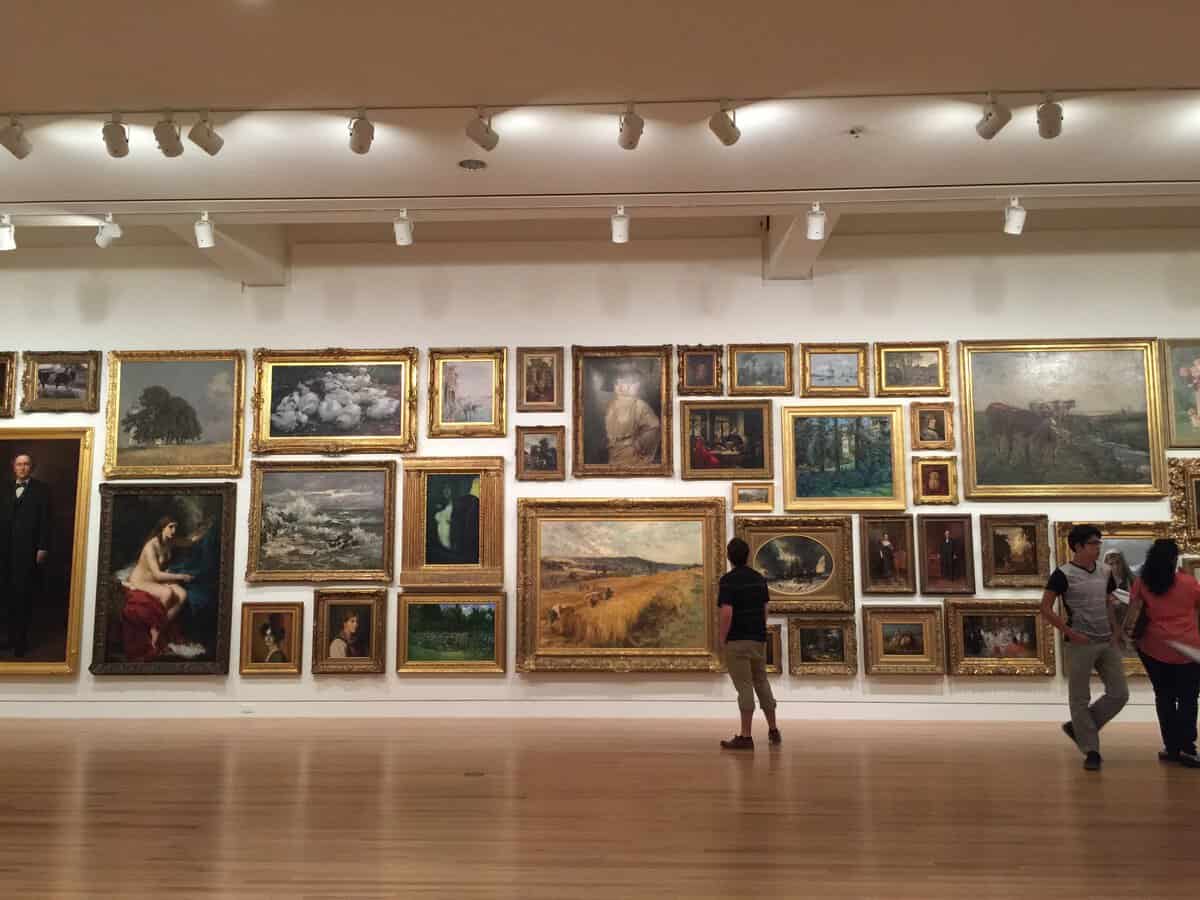
Paintings are hung as they once were in the Frye home gallery.

IMG_8891

Portrait of Chief Seattle by Henry Raschen, 1916.

The vast collection of paintings covers every wall in the Frye Salon with the works hung as they once were in the Frye’s home gallery. The Frye Salon is reminiscent of Boston’s Isabella Gardener Stewart Museum. In other words, there is not much space between the works and they are not hung in any apparent order— historical, religious and allegorical paintings hang beside portraits, landscapes and seascapes. There are several copies of a hardcover guide available to visitors in the gallery that identifies and describes each work and artist.

IMG_8902

Visitors reference gallery guide to identify paintings and artists.

IMG_8903

The helpful guide is available only in the gallery. There are several other books about the museum and its collection for sale in the shop, but not the gallery guide.

In addition to the Permanent Collection, there are several changing contemporary exhibitions.

IMG_8877

The Frye features contemporary art as well as European and American paintings from the 19th and 20th centuries.

We enjoyed the two Andy Warhol exhibitions on view during our visit. During the 1970s, Warhol recorded a reported 40,000 Polaroids documenting his personal and professional endeavors. Warhol’s Little Red Book #178 is a collection of 19 Polaroid pictures of his friends and other celebrities taken in 1970 while he made his film L’Amour.

IMG_8883

Little Red Book #178 has 19 of the reported 40,000 Polaroid photos Warhol took in the 1970s.

From 1964-1966, Warhol recorded hundreds of visitors to his studio, called The Factory, using a Bolex camera. Warhol’s 12 Screen Tests features artists and celebrities who were instructed to sit still for the length of a 16 mm film—about three minutes. Subjects featured in 12 Screen Tests include Dennis Hopper, Edie Sedgwick, Susan Sontag, Lou Reed, Bob Dylan, Marcel Duchamp and Brooke Hayward. Not everyone was capable of the task assigned. Bob Dylan’s Screen Test shows him smoking a cigarette and fidgeting throughout.

IMG_8906

Hundreds of Warhol’s Factory visitors were filmed for his series of “Screen Tests.”

IMG_8905

Subjects were meant to be still for the three minute films, but Bob Dylan fidgeted and smoked throughout his “Screen Test.”

Also on view was Structure and Ornament, a multi media exhibition of Leo Saul Berk’s work based on the iconic Chicago-area Ford House, his childhood home.

IMG_8868

Berk’s dream about sleeping on the floor at Ford House was the inspiration for “Heat Signature.”

The artist refers to his work as “a riff on the house,” which has historical significance and was designed by architect Bruce Goff. The exhibition includes the history of the home, photographs and films, along with Berk’s sculptures and other works, based upon the unique structure and the artist’s memories of living there.

IMG_8861

Leo Saul Berk’s childhood residence, the iconic Ford House, was the basis for the “Structure and Ornament” exhibition.

IMG_8876

“Cone Twelve,” Berk’s aluminum composite and stainless steel sculpture.

IMG_8865

“Mortar and Marbles” is a to-scale representation of a section of the Ford House’s curved coal walls.

We also saw American Portraits: 1880-1915– a selection of portraiture by artists whose works are included in the Founding Collection.

IMG_8907

Museum visitors relax and enjoy the “American Portraits: 1880-1915” exhibition.

The Museum has a nice little café with an outdoor garden. Sandwiches, soups, sweets and other simple but satisfying offerings are available at very reasonable prices.

IMG_8927

The Frye’s cafe has a lovely garden area and is a nice option for lunch or coffee.

On our first visit to the Frye Museum, we were told that one of the galleries was closed for yoga, but would soon reopen. While yoga is no longer offered at the museum, the Museum hosts art classes for everyone from pre-schoolers to life-long learners, Mindful Mediation on the first and third Wednesday of the month, art history lectures, jazz concerts, activities for those with memory loss and their families, film presentations and more.  Find the complete schedule here.

Charles and Emma Frye would no doubt be pleased to see their wish– that the public enjoy free access to art, that ‘perfection of good-nature,’ continues to be a reality today, thanks to their free art museum.

Written and photographed by Jeanne Neylon Decker

Protected by US Copyright Laws.

MoMA’s Must See Picasso Sculpture Closes Soon

Note: This exhibition is now closed!

In just over a month’s time, one of the most extensive and engaging exhibitions of Pablo Picasso’s sculpture ever presented in the United States will close. If you haven’t already visited the Museum of Modern Art’s marvelous retrospective of the painter’s rarely seen works, get your tickets and go see it before it closes on Feb. 7, 2016. http://www.moma.org

IMG_0797

A visitor examines Picasso’s Man With A Lamb (1943).

For the first time since 1967, New York’s MoMA presents one of the largest exhibitions of the painter’s three-dimensional work. The exhibit includes more than 100 sculptures plus photographs and works on paper, many never before displayed in North America. I was fortunate to see the exhibition during the Member Preview before it opened to the public in September.

IMG_0746

Left foreground, Woman with Child (1961), center rear, Head of a Woman (1957), right, Chair (1961). All three of these sculptures are painted sheet metal.

While Picasso was a formally trained painter, he was a self-taught sculptor and his work reflects the exuberance and personal relationship he had with the art form. He kept most of his sculptures in his personal possession rarely allowing these works to be displayed. One of the first and only times some of these pieces were presented publicly was in 1966 at a major retrospective at the Petit Palais in Paris when the artist was 85 years old. The following year, the MoMA staged Sculpture of Picasso in New York featuring many of the same works. Picasso’s sculptures have not been on public view on such a grand scale since.

IMG_0775

Insect (1951) was created from fired white clay and painted.

Picasso was fond of unconventional techniques and materials and frequently used found objects and materials including scrap wood, wire, metal and cardboard in his sculpture. Wicker baskets, pie tins, palm fronds, toy cars and many other scavenged items found their way into Picasso’s work. He used a bicycle seat and handlebars to create Bull’s Head, which was on loan from a private collection, for example.

IMG_0799

Bull’s Head, (Spring 1942) is a repurposed bicycle seat and handlebars.

IMG_0811

Left, bronze Pregnant Woman (1949). Right, Flowery Watering Can (1951-52) incorporates a watering can, plaster, nails and wood.

Museumgoers will learn that Picasso’s forays into sculpture were influenced by many sources including ceramics and woodcarvings by Paul Gaugin and Edgar Degas as well as by Oceanic and African sculpture. His themes run the gamut from political expression to family life. Just as in his paintings, women are frequent subjects in Picasso’s sculpture.

IMG_0768

Left, Bather (1931) bronze. Right, Head of a Woman (1932) plaster.


IMG_0771

Left, Woman with Vase (1933) bronze. Center, Head of a Warrior (1933) plaster, metal and wood.

He enjoyed reinventing and reimagining many of the same themes as the exhibition demonstrates. His Glass of Absinthe – six different polychromed bronze pieces each including an actual absinthe spoon, is a good example of this.

IMG_0807

Seated Woman (1947), Standing Woman (1945), Seated Musician (1950), and Seated Faun (1950) are among the small earthenware, terracotta and clay pieces in this display case.

Visitors to Museum of Modern Art http://www.moma.org will need timed tickets to see the Picasso Sculpture exhibition. Only members, corporate members and guests accompanied by members are exempt from this. Each day a limited number of tickets will be available for same day viewing but we strongly suggest that you get your tickets in advance to ensure you don’t miss this wonderful exhibition.

IMG_0783

Woman with Outstretched Arms (1961) painted iron and sheet metal.

Published in conjunction with the exhibition and available in the MoMA’s book and gift shops, the Picasso Sculpture catalog makes a beautiful souvenir that will allow you to revisit your favorite works again and again.


Art Oasis- Faye Sarkowsky Sculpture Garden

Art and nature lovers share a common destination– the Faye Sarkowsky Sculpture Garden in Palm Desert.  The stunning sculpture garden is located within the Eric Johnson Memorial Gardens and is part of the Palm Springs Art Museum in Palm Desert. Contemporary sculptures are installed among the four beautifully landscaped acres that surround The Galen, the museum’s LEED-certified building.

IMG_6395

Felipe Casteneda’s Seated Thinking Woman

IMG_6396

Walks Among Stars by Dave McGary

This welcoming garden, which is open to visitors all year long, includes soothing water features, winding walkways, beautiful native plants and plenty of quiet nooks for contemplation. As you stroll along the pathways it’s easy to forget that this lovely oasis of art and nature is located off a busy street between sprawling shopping malls.

IMG_6399

Blue glass in the pavement paths through the garden replicate a winding river. The pavilion is used for concerts and events.

The contemporary sculptures on display include works by international artists such as Felipe Casteneda, Gio Pomodoro, Betty Gold, Dan Namingha, Donald Judd, Yehiel Shemi and Dave McGary. Downloadable self-guided tour information is available on the museum’s website. Admission to the garden is free.

IMG_6405

Barry Flanagan’s Acrobats

IMG_6398

Peter Reginato’s Midnight and Morning Rain…Waiting for Miro

The Faye Sarkowsky Sculpture Garden is also used for concerts and events. For complete and updated event information contact the Palm Springs Art Museum.


Motorcycle Mania—Moto Talbott Collection

Note: The Moto Talbott Collection closed permanently on September 30, 2024.

I’m not much of a motorcycle aficionado myself, but I have been married to one for enough years to recognize the distinctive sound of a Ducati from a distance. On our recent trip to California’s Monterey Peninsula, we drove up to Carmel Valley to indulge in some wine tasting and discovered the Moto Talbott Collection. My husband’s delight quickly faded when he saw the motorcycle museum was closed, but fate smiled once again when founder Robb Talbott appeared in the courtyard.

Moto Talbott is a “must see” for motorcycle aficionados.

We had a nice chat, but Mr. Talbott was off to an appointment so no chance for a sneak peek behind the gates that day. We left with the promise to return later that week; my husband clutching the newly printed brochure Robb had kindly given him.

Rare, vintage, award- winning and beautifully restored motorcycles, all with stories to tell, await visitors to Moto Talbott.

Bright and early that Friday morning, we returned to Moto Talbott. In the courtyard were the museum’s newest acquisitions—two BMW Isetta 300s. Originally produced in Italy in the 1950s, Issetas are known as micro cars or “cabin scooters.” These two had been languishing in a hayloft in a Northern California barn for more than 40 years. Robb had picked them up just the night before.

These Isseta micro cars had just arrived after languishing in a hayloft for 40 years.

The Moto Talbott Collection opened in November 2016 and has been  attracting motorcycle fans from all over the world ever since. The collection is mostly motorcycles (more than 170 of them) but also features scooters, vintage transportation- themed toys, motorcycle memorabilia and more. The bikes are artfully displayed in a 6,000 square foot building with walls of snow barrier board trucked in from Wyoming and constructed by hand. Every detail has been carefully thought through.

This BMW is handsomely displayed against a handcrafted wall of Wyoming snow barrier board.

There are some real gems in the collection, including the Ducati Marianna that won the very last Motogira D’Italia in 1956 and is credited with saving the Ducati Company from possible closure. There’s a terrific photo of the wining rider, Guiliano Maoggi, with a cigarette clenched in his teeth on the wall above the bike, along with the fascinating story of his victory.

Visitors can learn about the last Motogiro d’Italia and the winning Ducati’s intriguing victory tale.

Steve McQueen’s 1931 VL Harley is there, as is a demonstration bike from WWII with the gas tank and engine covering cut away so soldiers training on it could learn what went where. This particular bike, which is quite a rare find, came to the collection complete with troop movement maps, gloves and a fully- functioning Thompson sub-machine gun, which has since been rendered inoperable.

Every bike has a fascinating story and a great deal of history behind it, including this rare WWII demo bike.

There’s a Vespa specially designed to promote Coach’s leather goods, a motorcycle that was buried in the backyard to protect it from certain destruction in a fire, race and award winners, beautiful restorations, trial bikes, rare and vintage motorcycles—they’re all here.

Each Coach logo was carefully hand painted on this promotional Vespa.

What really makes a trip to Moto Talbott special is the opportunity to learn the history and stories behind these bikes from the engaging and knowledgeable docents. We were fortunate to spend the morning with Rich Watson, former Economics professor at UC Santa Barbara and a lifelong lover of motorcycles. Rich could not have been more informative and entertaining. We were captivated by the intriguing tales he told, from his description of riders being impaled by enormous splinters during the American board racing days of the early 1900s to stories of unbeatable BSAs.
Engaging docents like Rich Watson enrich the visitor’s experience by sharing the stories and history behind the bikes.

These Indians from the early 1900s were used for American board racing– an extremely dangerous form of motorcycle racing not permitted for decades.

The impressive collection currently features road bikes and dirt bikes from 16 countries, from the Czech Republic to Mexico. MV Agusta, BSA, Bultaco, BMW, Indian, Harley Davidson, Kawaski, Maico, Gilera, Triumph, Honda—nearly every notable motorcycle company is represented here.

Road bikes and dirt bikes from around the globe are part of the collection at Moto Talbott.

The “Riders for Health” motorcycle under the orange vest traveled more than 80,000 kms bringing health care and aid to those in need in Zimbabwe.

The former proprietor of the highly regarded Talbott Vineyards and chairman of the board of the eponymous clothing company his family founded, Robb Talbott’s commitment to excellence and quality is as apparent in the Moto Talbott Collection as it was in his previous endeavors. The museum was at least three years in the making and was created so that he could “…share his passion for bikes and beauty… And mostly to share the stories of these bikes and their history.” The museum’s mission statement rings especially true after talking with Robb—”preservation, restoration and education…all driven by passion.”

Some of founder Robb Talbott’s vintage toys are displayed here.

We also had the chance to meet Bobby Weindorf, the museum’s curator and chief restorer.   Motorcycles have been part of Bobby’s life since he was 12 years old. His career was built on his passion: five years with American Honda’s factory road race and Supercross/Motocross teams; a dealership in Santa Barbara for 10 years, and several years in Italy working with motorcycle race teams. When asked about his three favorite bikes in the collection, he chose the 1977 MV Agusta 850SS because, “It’s big, powerful and makes a bold Italian statement,” a 1977 Hodaka Super Combat Wombat, “…cute dirt bike with an awesome name,” and a 1965 BMW R 69S in Granada Red, for it’s “pure elegance in a rare color…”

Moto Talbott is dedicated to preservation, restoration and education–and doing a spectacular job in all three area.

Bobby noted that Moto Talbott will continue to evolve: expanding and changing the collection, offering events, and continuing to educate visitors, preserve the “survivors,” and restore the classic motorcycles that he and the others involved in this marvelous museum have worked so tirelessly to make accessible to motorcycle lovers from around the world.

Update–The museum has been temporarily closed due to Covid-19.  For more information click here.

Go to The Galen-The Palm Springs Art Museum in Palm Desert

UPDATE: THE GALEN IS PERMANENTLY CLOSED!

Go ahead. Put down your golf clubs, get up from that poolside chaise and go to The Galen. Open since 2012, The Palm Springs Art Museum in Palm Desert is housed in an 8,400 sq. ft., LEED- certified building called The Galen and features photography, sculpture, painting and new media exhibitions, at no charge.

Bob Hope, Frank Sinatra and Gerald Ford may have streets named after them in this affluent desert community, but it’s Lucille Ball who’ll welcome you to the marvelous Personalities: Fantasy and Identity in Photography and New Media exhibition now on display through May 3, 2015 at The Galen.

IMG_6385

Morning by Yehiel Shemi is part of the museum’s Faye Sarkowsky Sculpture Garden.

A gorgeous, nearly life- sized photograph of America’s favorite red head, “Lucille Ball, Lover Come Back” by Ray Jones, leads the way into a fascinating exploration of the photographic portrait from early daguerreotypes, circa 1851 and 1860, to a 2013 video portrait by Brian Bress created during the artist’s residency at the MACRO in Rome.  Bress’s work, titled “The White and the Yellow Hunter,” is revealed, and then just as quickly, hidden, from the viewer.

Unfortunately, no photography was permitted in the galleries so I will have to tell, instead of show, what I saw.

In addition to Lucille Ball, notables whose images grace the galleries include: Marilyn Monroe, Marlene Dietrich, Bette Davis, Steve McQueen, Francis Bacon and Salvador Dali. Works by Diane Arbus, Richard Avedon, Harry Callahan, Weegee (Arthur Fellig), Robert Mapplethorpe and other photographers, some better known than others, are included in the exhibition.

LWS-105-2, LWS 95-4 and LWS 237-7 are part of a series of photos taken over a 30-year time period by Milton Rogovin, a retired optometrist. Dr. Rogovin began photographing people and places, some year after year, in Buffalo’s down and out Lower West Side, when he was 62 years old. He completed the project when he was 92.

Among the images I found most striking was one of a hyena handler (that there were such people was a bit of a revelation) called, “Abudullah Mohammed with Mainasara.” The photo was taken in Ogre Remo, Nigeria by Pieter Hugo and is part of his series The Hyena and Other Men. Ike Ude’s “Sartorial Anarchy #5,” Andrew Bush’s “Deerheadman,” and Jono Rotman’s image of the tattooed countenance, “Denimz Rogue,” from his Mongrel Mob series, were other standouts.

Several videos are also on display, including one by Marina Abramovic titled “The Kitchen V- Carrying the Milk.” It’s a 12 minute and 43 second video of the performance artist holding a bowl of said beverage. Tony Oursler’s doll in a suitcase featuring a video- recorded face, with sound, called “Passage,” also drew quite a bit of attention.

The exhibition also provides the opportunity to walk on water, or at least walk on five underwater images of the artist, Wang Wei, in “1/30th of a Second.” I enjoyed watching a school group gingerly step on the images, one by one, as the docent explained what they were seeing.

After you’ve enjoyed The Galen, step outside. The stunning four-acre Faye Sarkowsky Scupture Garden, also at no admittance charge, surrounds the museum. More on that later—with photos!