Browsing Tag

Art

Art Oasis- Faye Sarkowsky Sculpture Garden

Art and nature lovers share a common destination– the Faye Sarkowsky Sculpture Garden in Palm Desert.  The stunning sculpture garden is located within the Eric Johnson Memorial Gardens and is part of the Palm Springs Art Museum in Palm Desert. Contemporary sculptures are installed among the four beautifully landscaped acres that surround The Galen, the museum’s LEED-certified building.

IMG_6395

Felipe Casteneda’s Seated Thinking Woman

IMG_6396

Walks Among Stars by Dave McGary

This welcoming garden, which is open to visitors all year long, includes soothing water features, winding walkways, beautiful native plants and plenty of quiet nooks for contemplation. As you stroll along the pathways it’s easy to forget that this lovely oasis of art and nature is located off a busy street between sprawling shopping malls.

IMG_6399

Blue glass in the pavement paths through the garden replicate a winding river. The pavilion is used for concerts and events.

The contemporary sculptures on display include works by international artists such as Felipe Casteneda, Gio Pomodoro, Betty Gold, Dan Namingha, Donald Judd, Yehiel Shemi and Dave McGary. Downloadable self-guided tour information is available on the museum’s website. Admission to the garden is free.

IMG_6405

Barry Flanagan’s Acrobats

IMG_6398

Peter Reginato’s Midnight and Morning Rain…Waiting for Miro

The Faye Sarkowsky Sculpture Garden is also used for concerts and events. For complete and updated event information contact the Palm Springs Art Museum.


Hats Off to Degas–Lucas Shakes Things Up at SF’s Legion of Honor

San Francisco’s venerable Palace of Legion of Honor, part of the city’s Fine Arts Museums, is currently hosting the very popular Degas, Impressionism and the Paris Millinery Trade.

The extensive exhibition focuses on the impact of the millinery trade in Paris during the Belle Epoch era on the work of Degas and his contemporaries.  Paintings and pastels by Degas, Renoir, Edouard Manet, Mary Cassatt, Toulouse- Lautrec and others, some never before shown in the U.S., are featured. In addition to the splendid impressionist paintings, included in the exhibition are 40 marvelous examples of millinery from that time period—in other words—hats!

Hats featuring flowers were popular in the 19th and 20th centuries. Silk, cotton, velvet and paper were all used to construct artificial flowers like those shown here.

Some patrons were definitely in the spirit of things.

These hats range in size and complexity from the sublime to over the top. One chapeau is topped with an entire owl, which had been preserved specifically for that purpose. There are plumes, beads, metallic wire, ribbons and flowers adorning these mostly enchanting toppers.

Plumage from domestic and exotic birds, including ostrich and owls, often were used to embellish luxury ladies’ hats.

These hats all sport fashionable feathers. The hat on the left features a complete owl while the one on the right has an African starling above its brim.

A visitor admires Manet’s “At the Milliner’s”–one of about 40 paintings and pastels in the exhibition.

Men’s hats are included in the exhibit too. There are fine examples including boater and bowler hats, along with a sketch of Degas himself in a top hat.

Bowlers and top hats, along with carrying cases, are part of the exhibit.

The 42 year-old Edgar Degas is shown here wearing a top hat.

The exhibition was quite crowded, mostly with ladies of a certain age, oohing and ahhing over the millinery creations. There were a few patrons sporting hats and we spotted several of the museum’s docents in the spirit of things– wearing lovely fascinators.

Feathered finery got a lot of attention from visitors.

We didn’t take a docent-guided tour but shared our table at lunch with a group of ladies from the San Jose area who had and raved about it. It is necessary to reserve a spot for a guided tour in connection with this exhibit.

This docent wears a fine fascinator for her presentation. Reservations for the free tours are essential for this exhibition.

Some of the Impressionist paintings in this exhibition have not been shown in the U.S. before.

Special exhibition tickets are required for the Degas exhibit, in addition to the general admission fee for the museum. This doesn’t seem to be keeping the crowds away at all downstairs. There were numerous tour groups vying to get close to the works during our midweek trip to the Legion of Honor.

Special exhibition tickets are required, in addition to general admission. The galleries became quite crowded at times.

Upstairs in the galleries featuring Rodin’s classic sculpture, visitors can enjoy near solitude—at least during our visit. Displayed with the August Rodin: The Centenary Installation, which honors the 100th anniversary of the artist’s death, you’ll find the provocative work of Sarah Lucas. Sarah Lucas:Good Muse is the first major exhibition of the UK artist’s work in the U.S.

The museum is best known for its ancient and classical European collections which includes paintings, sculpture, furnishings and porcelain.

Sarah Lucas’ work brings contemporary art and controversy to the Legion of Honor.

Sarah Lucas:Good Muse would probably be much more comfortable at the SFMOMA (SF Museum of Modern Art) than at the classically- focused Legion of Honor. The docent who provided a tour of the exhibition shared that many patrons and members of the museum were more than a little unhappy with Lucas’ work.

Giant plaster cast boots, soft sculptures and a series of Lucas’ yellow urinal sculptures are on display among the 50 bronze, plaster and marble works by Rodin.

Lucas’ sculptures, made from plaster, panty hose, florescent lights, a bedspring and mattress, cigarettes and other materials, allude to sexual interactions, availability, empowerment, and domestic responsibilities, according to the docent. She also pointed out examples where Rodin’s work related to the themes of Lucas’ pieces.

“Washing Machine Fried Eggs” invites discussion of women’s sexual and domestic roles.

Apparently the artist wanted to “bring color” to the galleries and chose to include a series of yellow urinal sculptures displayed atop small refrigerators, placed among Rodin’s classic sculpture. We found the juxtaposition interesting but could easily understand the contretemps. At the entrance to the galleries where Lucas’ work is displayed, there are signs warning that the art may not be appropriate for all viewers. We have chosen not to include photos of the most controversial work for that reason.

Electricity in this piece “keeps the energy up” according to the artist.

Degas, Impressionism and the Paris Millinery Trade closes September 24 and Sarah Lucas: Good Muse closes September 17. Go see these very different exhibitions for yourself and let us know what you think. A day at the Palace of Legion of Honor is always a day well spent.

MoMA’s Must See Picasso Sculpture Closes Soon

In just over a month’s time, one of the most extensive and engaging exhibitions of Pablo Picasso’s sculpture ever presented in the United States will close. If you haven’t already visited the Museum of Modern Art’s marvelous retrospective of the painter’s rarely seen works, get your tickets and go see it before it closes on Feb. 7, 2016. http://www.moma.org

IMG_0797

A visitor examines Picasso’s Man With A Lamb (1943).

For the first time since 1967, New York’s MoMA presents one of the largest exhibitions of the painter’s three-dimensional work. The exhibit includes more than 100 sculptures plus photographs and works on paper, many never before displayed in North America. I was fortunate to see the exhibition during the Member Preview before it opened to the public in September.

IMG_0746

Left foreground, Woman with Child (1961), center rear, Head of a Woman (1957), right, Chair (1961). All three of these sculptures are painted sheet metal.

While Picasso was a formally trained painter, he was a self-taught sculptor and his work reflects the exuberance and personal relationship he had with the art form. He kept most of his sculptures in his personal possession rarely allowing these works to be displayed. One of the first and only times some of these pieces were presented publicly was in 1966 at a major retrospective at the Petit Palais in Paris when the artist was 85 years old. The following year, the MoMA staged Sculpture of Picasso in New York featuring many of the same works. Picasso’s sculptures have not been on public view on such a grand scale since.

IMG_0775

Insect (1951) was created from fired white clay and painted.

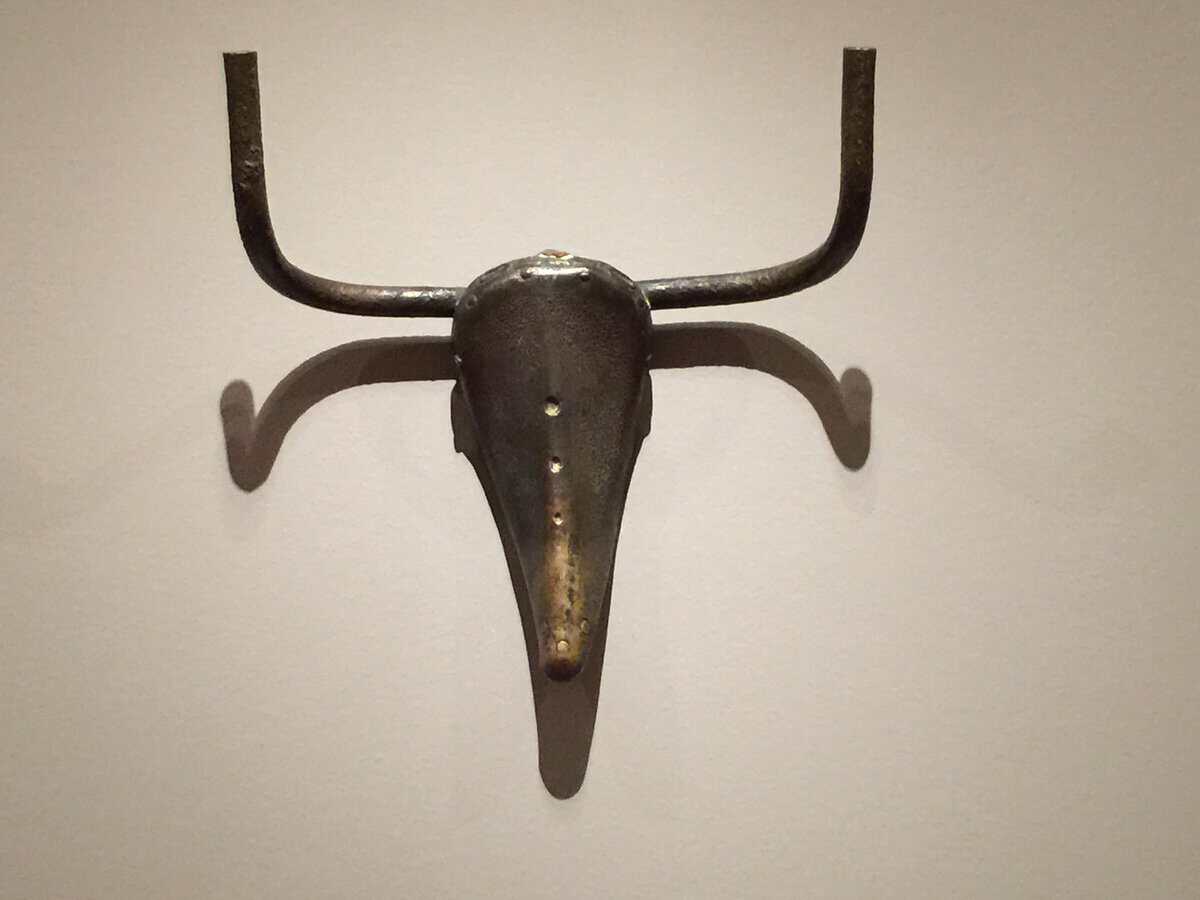
Picasso was fond of unconventional techniques and materials and frequently used found objects and materials including scrap wood, wire, metal and cardboard in his sculpture. Wicker baskets, pie tins, palm fronds, toy cars and many other scavenged items found their way into Picasso’s work. He used a bicycle seat and handlebars to create Bull’s Head, which was on loan from a private collection, for example.

IMG_0799

Bull’s Head, (Spring 1942) is a repurposed bicycle seat and handlebars.

IMG_0811

Left, bronze Pregnant Woman (1949). Right, Flowery Watering Can (1951-52) incorporates a watering can, plaster, nails and wood.

Museumgoers will learn that Picasso’s forays into sculpture were influenced by many sources including ceramics and woodcarvings by Paul Gaugin and Edgar Degas as well as by Oceanic and African sculpture. His themes run the gamut from political expression to family life. Just as in his paintings, women are frequent subjects in Picasso’s sculpture.

IMG_0768

Left, Bather (1931) bronze. Right, Head of a Woman (1932) plaster.


IMG_0771

Left, Woman with Vase (1933) bronze. Center, Head of a Warrior (1933) plaster, metal and wood.

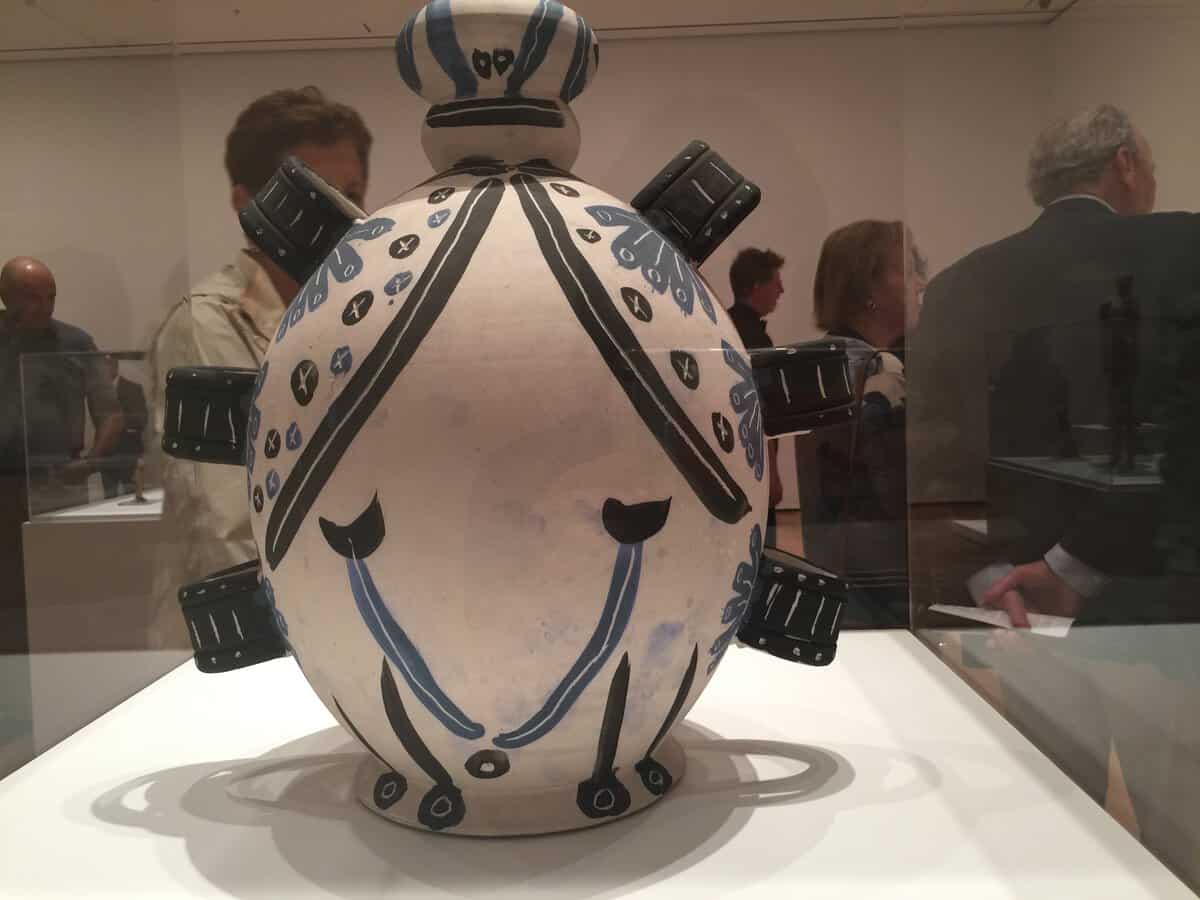
He enjoyed reinventing and reimagining many of the same themes as the exhibition demonstrates. His Glass of Absinthe – six different polychromed bronze pieces each including an actual absinthe spoon, is a good example of this.

IMG_0807

Seated Woman (1947), Standing Woman (1945), Seated Musician (1950), and Seated Faun (1950) are among the small earthenware, terracotta and clay pieces in this display case.

Visitors to Museum of Modern Art http://www.moma.org will need timed tickets to see the Picasso Sculpture exhibition. Only members, corporate members and guests accompanied by members are exempt from this. Each day a limited number of tickets will be available for same day viewing but we strongly suggest that you get your tickets in advance to ensure you don’t miss this wonderful exhibition.

IMG_0783

Woman with Outstretched Arms (1961) painted iron and sheet metal.

Published in conjunction with the exhibition and available in the MoMA’s book and gift shops, the Picasso Sculpture catalog makes a beautiful souvenir that will allow you to revisit your favorite works again and again.


Go to The Galen-The Palm Springs Art Museum in Palm Desert

UPDATE: THE GALEN IS PERMANENTLY CLOSED!

Go ahead. Put down your golf clubs, get up from that poolside chaise and go to The Galen. Open since 2012, The Palm Springs Art Museum in Palm Desert is housed in an 8,400 sq. ft., LEED- certified building called The Galen and features photography, sculpture, painting and new media exhibitions, at no charge.

Bob Hope, Frank Sinatra and Gerald Ford may have streets named after them in this affluent desert community, but it’s Lucille Ball who’ll welcome you to the marvelous Personalities: Fantasy and Identity in Photography and New Media exhibition now on display through May 3, 2015 at The Galen.

IMG_6385

Morning by Yehiel Shemi is part of the museum’s Faye Sarkowsky Sculpture Garden.

A gorgeous, nearly life- sized photograph of America’s favorite red head, “Lucille Ball, Lover Come Back” by Ray Jones, leads the way into a fascinating exploration of the photographic portrait from early daguerreotypes, circa 1851 and 1860, to a 2013 video portrait by Brian Bress created during the artist’s residency at the MACRO in Rome.  Bress’s work, titled “The White and the Yellow Hunter,” is revealed, and then just as quickly, hidden, from the viewer.

Unfortunately, no photography was permitted in the galleries so I will have to tell, instead of show, what I saw.

In addition to Lucille Ball, notables whose images grace the galleries include: Marilyn Monroe, Marlene Dietrich, Bette Davis, Steve McQueen, Francis Bacon and Salvador Dali. Works by Diane Arbus, Richard Avedon, Harry Callahan, Weegee (Arthur Fellig), Robert Mapplethorpe and other photographers, some better known than others, are included in the exhibition.

LWS-105-2, LWS 95-4 and LWS 237-7 are part of a series of photos taken over a 30-year time period by Milton Rogovin, a retired optometrist. Dr. Rogovin began photographing people and places, some year after year, in Buffalo’s down and out Lower West Side, when he was 62 years old. He completed the project when he was 92.

Among the images I found most striking was one of a hyena handler (that there were such people was a bit of a revelation) called, “Abudullah Mohammed with Mainasara.” The photo was taken in Ogre Remo, Nigeria by Pieter Hugo and is part of his series The Hyena and Other Men. Ike Ude’s “Sartorial Anarchy #5,” Andrew Bush’s “Deerheadman,” and Jono Rotman’s image of the tattooed countenance, “Denimz Rogue,” from his Mongrel Mob series, were other standouts.

Several videos are also on display, including one by Marina Abramovic titled “The Kitchen V- Carrying the Milk.” It’s a 12 minute and 43 second video of the performance artist holding a bowl of said beverage. Tony Oursler’s doll in a suitcase featuring a video- recorded face, with sound, called “Passage,” also drew quite a bit of attention.

The exhibition also provides the opportunity to walk on water, or at least walk on five underwater images of the artist, Wang Wei, in “1/30th of a Second.” I enjoyed watching a school group gingerly step on the images, one by one, as the docent explained what they were seeing.

After you’ve enjoyed The Galen, step outside. The stunning four-acre Faye Sarkowsky Scupture Garden, also at no admittance charge, surrounds the museum. More on that later—with photos!