Browsing Category

Germany

How to Have a Wellness Weekend in the Black Forest

fall foliage surrounds a pond with ducks

The charming German town of Badenweiler in the foothills of the Black Forest has been drawing wellness seekers for millennia. They come for the healing, mineral-rich waters to relax and find relief for everything from stress to rheumatism. A tradition since the Romans were here, we devoted our weekend in Badenweiler to bathing, both ancient and modern.

In addition to lovely, wooded scenery, hiking trails, and the thermal waters that flow from under the Black Forest, Badenweiler boasts some of the most expansive and best-preserved Roman baths north of the Alps. We were excited to visit them. We followed a small group of people down a leafy walkway into a public park. There we found the glass pavilion that protects this archeological wonder.  We paid 3 euro each to pass through the turnstile and travel back in time, way back.

Roman Rituals

The extraordinary 2,000-year-old ruins include the caldarium, tepidarium, and frigidarium.  Our guide, Dominick, explained the hot, tepid, and cold baths were visited in that order. Cold plunges, popular today, are nothing new. Thousands of years ago the ancient Romans were well-versed in the therapeutic benefits of thermal waters of varying temperatures.

Community baths played an important role in Roman life. They were used not just to bathe, but also to socialize and keep up on politics and local news. Their baths also often included steam rooms and relaxing areas for this reason.

Ruins of a Roman bath complex
The extensive bathing complex is one of the best preserved north of the Alps.

Roman sculpture, grooming aids, and even a replica of typical Roman wooden bathing shoes are among the exhibits inside the pavilion.  These platform sandals protected bathers’ feet from the hot floors inside the caldarium. Dominick was brimming with historical and entertaining facts about the Romans who settled in this part of Germany and built this elaborate bathing complex.

Roman soldiers were often paid in land and encouraged to settle permanently in the areas they had been sent to conquer. This was the case in Badenweiler. Settler soldiers built these baths to enjoy the same rituals and amenities they would have enjoyed at home. Badenweiler’s healing thermal waters likely made these even more appealing.

Take the Tour

man in front of informational panels
Our guide helped bring the ancient ruins to life. He gave the tour and answered questions in German and English.

Visitors walk through and over the remarkable ruins on accessible walkways and have a bird’s eye view of all areas of the baths. Our guide explained the significance of each area in both German and English. Everyone in our small group spoke one or the other language. After a very informative hour-long walk through the Roman complex, Dominick led us out into the park surrounding the baths.

walkway over ancient ruins in the glass pavilion
Walkways over and through the ruins make the complex accessible to all.

Using our mobile phones to light the way we ducked through a small doorway, one by one.  Dark and dank, we had entered a recreated ancient Roman drainage channel which had originally served the baths in this very spot. It was constructed in 1998. What a relief it was to return to sunlight after a short time inside the channel.

people exiting a tunnel
The reconstructed subterranean drainage channel shows what masters of architecture the Romans were.

It is possible to enter the ruins without a guide, but self-guided visits do not include the drainage channel, well worth seeing, or the wonderful stories Dominick shared that sparked our imagination and brought the distant past to life.

Modern Baths

After exiting the drainage tunnel, we looked up and saw people relaxing on chaise lounges on a broad terrace overlooking the park. They were enjoying the popular Cassiopeia Therme. Next door to the ancient Roman ruins, the Cassiopeia Thermal Baths draw visitors and locals alike to the healing waters within. The modern baths are housed in an impressive classical-style building. 

Classical -style building with signage for Cassiopeia Therme
The Cassiopeia Therme is a popular attraction in Badenweiler and can get crowded on weekends and holidays.

Guests at these public baths enjoy the same thermal waters the Romans did, in a series of pools of varying temperatures and sizes indoors and out.  Temperatures range from 30 to 36 degrees Celsius and are seasonally adjusted. Families, couples young and old, and this pair of American wanderers settled in for a relaxing afternoon in the healing waters. 

Don’t Forget Your Towel

people waiting inside a large rotunda building
People waited patiently to check in for an afternoon at the Cassiopeia Thermal Baths.

This was our first experience in a public bath house. As we queued for entry, we realized we had already made a mistake not bringing towels from our hotel. Everyone else, we noticed, came equipped for the day with shower shoes, robes and towels. We had brought flip flops and swimsuits, but had to rent towels. We must not have been the only ones unprepared. Bathrobes, shower towels and sauna towels were available to rent at registration.

long hallway inside the Cassiopeia Therme
A long hallway led to the gender-specific locker rooms. The rest of the facility is co-ed.

Off to the changing rooms we went, locker keys in hand.  The changing rooms had large lockers, restrooms, and showers. The faint sulfurous aroma of thermal waters wafted through the humid air as we approached the bathing areas.

No Lazy River

Though the day was overcast and a little cool, we headed to the large heated outdoor pool. People of all ages were clearly enjoying themselves. We saw couples floating hand-in-hand, kids leaping from their parents’ arms, and teenagers racing one another around the pool.

overview of large outdoor pool
The giant whirlpool was a lot of fun and one of our favorite activities. Photo courtesy of Schwarzwald Tourismus GmbH.

There was a vast, oversized whirlpool at one end of the outdoor pool complex. We jumped in and let the water carry us, trying not to bump the other bathers as we circled, laughing as we moved through the swirling current. This was no lazy-river experience. We quickly figured out we would need an exit strategy to escape the strong current, but it was so much fun, we stayed in the fast-moving water for about a half an hour.

Take a Dip

There were many other pools to sample, so we held hands and made for one of the handles on the side of the pool.  It took a few attempts, but we finally grabbed hold and swam out. After a dip at the other end of the huge outdoor pool, we headed indoors. There were a series of smaller pools inside on the ground level. Each had different depths and temperatures that were clearly posted.  The smaller and shallower pools were popular (and populated) with young children. We avoided those. After exploring the options, we made a circuit from hottest to coolest pool and repeated it several times.

There were chairs and lounges around all the pools, indoors and out. Just like at home, people had “reserved” their chairs with towels and personal property. We took a short break on the comfortable lounges and enjoyed the view of the park outside.

Sauna Time

signage for thermal baths
Signs outside the Cassiopeia thermal baths let guests know what to expect inside, including a wellness oasis.

After enjoying almost all the pools on the ground level, we walked past the busy café and headed upstairs to the sauna area.  We had become aufguss enthusiasts during our recent stay at the Adler Balance in Italy’s Dolomites and were looking forward to experiencing Cassiopeia’s saunas. 

As we climbed the stairs, we noticed we were heading for an adults-only zone as well as a “textile free” area.  This was a relatively new term to us and means simply, no swimsuits (or any other garments) allowed. The policy was evident in the large co-ed pool adjacent to the saunas, where naked bathers swam and floated, blissfully unencumbered by swimwear or self-consciousness. 

Textile Free Zone

Another patron, perhaps sensing my foreignness, or hesitation, tapped me on the shoulder and pointed to the sign above the sauna, in German and English, when I failed to disrobe quickly enough.  She may have thought I planned to enter the sauna in a swimsuit, which I knew was just not done.

signs inside the baths indicate different services
These signs advertise the thermal baths and Roman-Irish bath, also in the textile free zone.

Leaving our inhibitions and our swimsuits at the sauna door, we stepped out of our pool shoes and into the least hot (coolest would be a misnomer) of the units first. Cassiopeia has a range of saunas from 55 to 90 degrees Celsius. They include aroma, herbal, Finnish, crystal and infusion saunas.

There is also a Roman-Irish bath in the textile-free zone. That would have been a new experience for us but it was not available during our visit. There was plenty to keep us busy without it.

As we had learned at the Adler, a cold plunge or shower is a must after a sauna, especially if you are hopping back into another, even hotter one, as we were. Sauna, shower, repeat, was our plan. We both decided we enjoyed the hotter saunas and spent most of our time there.  Interestingly, the saunas had little windows with a view of the pool. After several times in and out, we checked the posted schedule to see if aufguss was available.

The Aufguss Experience

Aufguss is a super-heated sauna experience usually enhanced by aromatherapy and music. It is led by an athletic (in my experience) and specially trained aufguss meister. Using towels and large handheld fans, the aufguss meister directs the hot air around the chamber and melts aroma-containing ice balls emitting scents ranging from relaxing pine forest to uplifting citrus into the sauna. Sadly, we had already missed the aufguss sessions scheduled for the day.

Glowing from our swim and sauna, and fully relaxed, we headed back to the locker room to shower and bid farewell to the Cassiopeia Thermal Baths. Our ancient and modern bathing experiences in Badenweiler were memorable.  We’d return to Cassiopeia Therme in a heartbeat, this time with our own towels and robes.

If You Go

Roman Baths

glass pavilion over roman ruins in a park setting
Take the guided tour to fully appreciate these extraordinary 2,000 year-old Roman baths.

Tours of the ancient bathing complex are offered Sunday mornings at 11 throughout the year, with an additional one on Tuesdays at 4 pm during summer months. It is possible to enter the ruins without a guide, but we felt ours added a great deal to our visit.

There is signage, but in German only. Our guide was very helpful and we also used Google Translate to decipher many of the signs. The tour inside the pavilion is accessible to all, but the underground channel is not. Tour group size is limited.  Book in advance.

Modern Baths

sign with historical information about the baths
SIgnage shows how the Cassiopeia Therme has been modernized over its long history.

Public baths are very popular in the Black Forest and Sunday is a busy day for them, as we learned first-hand.  Guests of all ages from toddlers to octogenarians enjoy their time there. Bring your swimsuit, shower shoes, a robe, and a towel. Leave jewelry and valuables in your hotel’s safe. You will need a credit card or other payment method for your day pass, any food or beverages, and towel rental if you forget your own.

Be prepared to shed your swimwear and inhibitions at the sauna door and anywhere you see signs indicating “textile free” areas. 

If you plan to shower in the locker rooms, bring your own grooming products.

The Cassiopeia Baths have a café for light meals and beverages. There is a lovely terrace overlooking the grounds and the Roman baths you can relax on.

We were guests of the Schwarzwald Tourismus GmbH for the Roman Baths tour and visit to Casseopeia Therme.

Sleeping and Eating

Schwartzmatt Hotel

large yellow hotel building
The Hotel Schwarzmatt made a great base for exploring the Black Forest and Badenweiler.

We stayed in Badenweiler at the very comfortable Hotel Schwartzmatt, a member of the luxury Relais & Chateau group. We opted for half-board as our stay was in low season and many restaurants in town were not open. The hotel restaurant, which served a varied and delicious menu focusing on local dishes, was open only to hotel guests in late autumn. There were a few coffee shops and boutiques open in town, but it was quiet.  Summer is the busy season here.

Wellness Oasis

The Hotel Schwarzmatt has a “wellness oasis” featuring a steam bath, Finnish and Bio saunas, an indoor pool, a sun pavilion and terrace. The spa offers massages and other treatments and there is a fitness room. These facilities are only available to hotel guests. We didn’t have time for any treatments but enjoyed the steam room, saunas and pool.

Written and photographed (I could not take photos in the baths for obvious reasons) by Jeanne Neylon Decker

This post contains affiliate links.  If you click and book, I may receive a commission.  Thank you for your support!

This and all materials published by Traveltawk.com are protected by US Copyright Laws and may not be reproduced without express permission from the publisher.

A Visit to Friedrichshafen’s Fascinating Zeppelin Museum

zeppelin museum with playground in front of it

Can you resist looking up when the Goodyear blimp passes overhead? Imagine being among the first to spot a zeppelin as the strange looking aircraft floated by 125 years ago. Learn about the iconic airship that once captured the world’s imagination and transformed travel, commerce, and military strategy at a visit to Friedrichshafen’s fascinating Zeppelin Museum.

This engaging, family-friendly museum is perfect for fans of flight, military history, engineering, and adventure. The museum is a must for those fascinated by the Hindenburg disaster.

zeppelin suspended from ceiling
After 125 years, Zeppelins are still a source of fascination.

On the Shores of Lake Constance

museum signage about von Zeppelin
Retired German General von Zeppelin correctly foresaw a rewarding future in the rigid airship.

Housed in an enormous structure on the shores of Lake Constance, or the Bodensee in German, the Zeppelin Museum tells the story of the airship developed by Count Ferdinand von Zeppelin.  A retired German General and an inventor with a penchant for engineering, he foresaw a future where these large, lighter than air, rigid airships would play an important role in transporting goods and people, with both commercial and military applications. For decades, they did just that.

Visitors to the museum learn the science, technology, development and fascinating 125 year history of the airships. Compelling interactive and static exhibits tell the story. The first zeppelins, LZ 1 and LZ 2, were experimental aircraft and used to survey large swaths of Europe from their base in Friedrichshafen.

As von Zeppelin correctly surmised, the German military quickly saw their potential for surveillance and transportation. Consumer applications came soon after when zeppelins were used to transport goods over long distances.

First in Transatlantic Flight
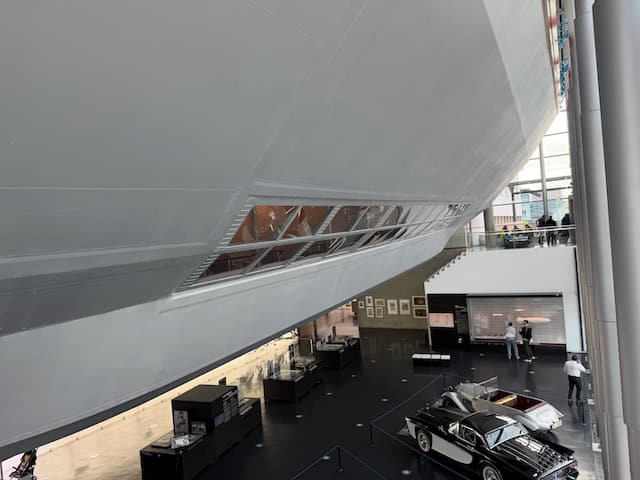
reconstructed zeppelin hull
The Hindenburg was the fastest way to cross the Atlantic for passengers and goods in 1936. The museum has a partial reconstruction of the airship and some of the wreckage from its crash.

Zeppelins were first flown to destinations within Germany and then across Europe. The fast, economical airships became the first aircraft to carry passengers across the Atlantic Ocean.

By 1936, the Hindenburg carried passengers and up to eight tons of perishable goods like flowers, food, and medicine in its cargo hold for the relatively speedy two-day transAtlantic journey. Zeppelins were also used for polar expeditions including Roald Amundsen’s last fateful trip to rescue Italian explorers at the North Pole. 

During Wartime

museum exhibits explain the zeppelin's history
Zeppelins changed military strategy in WWI but barely played a role in WWII.

The museum has fascinating exhibitions about the zeppelin’s role in WWI and the subsequent shut down of production demanded by the Allies after Germany’s loss in the conflict. Two of the already-built zeppelins were given as reparations to Italy and France. A third was sent to the USA. German engineers also came to the United States to work with the military to develop an American dirigible program. 

Let Your Imagination Soar Aboard the Hindenburg

One of the highlights at the Zeppelin Museum is exploring a partial reconstruction of the Hindenburg. It was one of the largest passenger-carrying zeppelins ever built. The reconstruction was faithfully built adhering to the airship’s original plans.

Enjoy the 1930s Bauhaus design of the surprisingly spacious lounges and public spaces and relax where passengers would have. Peek into the restrooms and down the halls where the passenger cabins are located aboard the luxury airship. It’s clear that traveling by zeppelin was for strictly for those with means.

During the zeppelin’s heyday, 50 to 70 passengers could comfortably travel across the Atlantic to Lakehurst, New Jersey just outside of New York City, or to Brazil’s then capital, Rio de Janeiro. In 1928, the journey to New Jersey aboard the LZ 127 Graf Zeppelin took more than four days, while less than a decade later the Hindenburg could make the crossing in about 50 hours.

The Hindenburg Disaster

The Hindenburg crash signaled the end of transatlantic passenger flights aboard zeppelins.

After a transatlantic journey on May 6, 1937, the Hindenburg crashed and burned while landing in Lakehurst, New Jersey. The zeppelin was carrying half its normal passenger load on that flight. Incredibly, of the 97 people aboard, which included 61 crewmen and 36 passengers; 65 lived through the catastrophe while 32 souls perished. The museum contains photos, newsreels and news clips of one of the world’s most infamous air disasters.

An aviation failure of epic proportions, the fiery Hindenburg crash has been studied in minute detail since then. Spoiler alert: While a number of factors (highly combustible hydrogen gas, weather conditions, the flammable coating of the rigid aircraft) may all have played a role, the exact cause of the crash is still a mystery. Many of the most sensational photographs of the burning Hindenburg in the exhibition were taken by Richard Fleischhut, who became known for his photographic portraits of stars like Marlene Dietrich.

An older man and young boy look at an exhibit together
The Zeppelin Museum is fascinating for visitors of all ages.

With the development of faster aircraft and public confidence dwindling after the Hindenburg disaster, the era of passenger travel aboard zeppelins came to a close. This was not the end of the zeppelin, however. The museum explores how Hitler’s National Socialist Party leveraged the airships for propaganda purposes and used slave and forced labor brought to Friedrichshafen from across Europe to build zeppelins before and during WWII, even though they knew the airships had limited military usefulness.

A Family Connection

We have a family connection to that dark period of history. We spotted signage in the museum that noted after Allied bombers attacked Friedrichshafen on March 18, 1944, Hitler ordered all military production, including the Zeppelin factory, to move to hastily constructed underground bunkers. It was on that March 18th bombing run that my father-in-law and his B-24 crew mates, who had taken off from Wendling Air Base in the UK, were shot down over Friedrichshafen. They managed to fly their crippled aircraft across Lake Constance and landed in Switzerland, barely avoiding Nazi capture.

photograph and handwriting in an open book
My father-in-law kept a journal during his internment in Switzerland in 1944. He is in the back row, second from the right, in the crew photo.

The men were interned in Adelboden, Switzerland for the remainder of the war. The 392nd bombing group had one of its deadliest days of the war on that mission. Only 10 of the 24 planes that flew to Friedrichshafen that day returned to England.

Models, Statistics, and A Flight Simulator

inside museum sign points to Hindenburg Hall
Hindenburg Hall is the first stop for many visitors to the Zeppelin Museum.

The museum has an entire gallery dedicated to the Hindenburg. In addition to models, photographs, and plenty of fascinating facts, the largest surviving pieces of Hindenburg wreckage are on display here; the rudder bearing arm and part of the tail unit.

In Zeppelin Hall, aviation fans can geek out over routes, statistics, comparisons, and models of various aircraft. There is a lot to see here. In addition to aircraft models, visitors can admire the luxurious Mercedes-Maybach custom-built for Herr Zeppelin, as well as other classic cars on exhibit. 

The museum explores the science, technology, and social impact of zeppelins. Be sure to see the advertisements for passenger travel.

Ever wonder what makes a gas balloon rise or how airship gears and engines work? Visitors can learn the basics of flight technology and the science behind airships, and use the museum’s NT Zeppelin flight simulator to embark on a scientific research mission. The interactive stations bring the technology of zeppelins to life and are a hit with visitors of all ages.

The Wunderkammer: A Cabinet of Wonders

The zeppelin’s soaring popularity in the 1930s created a huge market for all things airship-related including clocks, coins, toys, and tableware. Based on 16th century collector’s cabinets, the Wunderkammer is a treasure trove of 350 zeppelin-inspired items that can be further explored using the tablets near the displays. I could have spent hours in the Wunderkammer admiring everything from the carousel to miniature zeppelins.

Image and Power

After viewing the extensive exhibitions on the zeppelin’s history, development, role in two world wars, and the merchandise the zeppelin craze spawned; head upstairs to see the photography gallery. Image and Power: Photography in Focus contains fascinating photographs from the museum’s archives and explores the role photographs of the zeppelin played in promoting political agendas and national identity, among other things. The photographs will be on view until April 12, 2026.

Art and Restitution

Obligation of Ownership focuses on the provenance of the 40 works of art displayed here from the Bodensee Museum and the ongoing difficulties of reuniting art confiscated or stolen from victims of the Third Reich. The museum scrutinizes its own collection regarding Nazi looting and relocation of cultural treasures, along with a look at art dealers who played a role. Even 80 years after the end of the war, restitution work continues.

painting of a woman on a wall
The challenge of reuniting art with its rightful owners continues 80 years after WWII ended.

Take a Walk

After your visit to the Zeppelin Museum, take some time to explore Friedrichshafen. More than half of the city was destroyed by bombing during WWII, but today there are beautiful public gardens to stroll in, lovely churches to visit, and plenty of coffee shops, bars, and restaurants to relax in while you take in the views across Lake Constance to Switzerland’s magnificent mountains.

As you stroll along the Lake Constance shoreline take a moment to enjoy the public art including Helmut Lutz’s Sound Ship (above left), a carved wooden toad who appears to be watching the sunset over Switzerland (center), and a memorial to Herr von Zeppelin (right) in the park across from the water. There’s also a pedestrian shopping zone nearby if you’re looking for some retail therapy.

Practicalities: Plan Your Trip

We stayed at the charming Hotel Villino, a Relais & Chateau property in Bodolz, a 30-minute drive from Friedrichshafen. The Villino is a delightful, family-owned property with 21 beautifully decorated, comfortable rooms and suites. It is surrounded by gardens in a peaceful countryside setting and has a spa on the property. The hotel was the ideal base for exploring the Bodensee region and a pleasure to return to after day trips throughout the area.

The Villino boasts a Michelin-starred dining room with two elegant multi-course pre-fix menus with an Italian-Asian flair. We enjoyed the restaurant very much, both at breakfast and dinner. Reservations are essential for dinner.

Eat Like a Local

We also enjoyed dining in nearby Lindau at Hotel Restaurant Alte Post, known for traditional Styrian and Swabian cuisine like schnitzel, roasts, spaetzle, and fish dishes. It was the perfect place for dinner before catching a performance of Swan Lake at the Lindau Marionettenoper a few streets away. (Get tickets to see a show if you can; it’s a delightful experience.) In the warmer weather Alte Post’s beer garden is open, serving beverages and hearty fare. Be sure to reserve as the restaurant is very popular with residents and visitors.

For a very local experience, head to Bodolzer Dorfstubel in Bodolz.  This casual eatery offers German dishes like schnitzel, spaetzle, wurstsalat, steaks, and stews. Our waiter, who didn’t speak English comfortably (I relied on Google translate) pulled up the restaurant’s Instagram account and showed us photos of the food to help us choose. It was a tasty meal that left us too full for dessert.

The Bodensee

The Bodensee region encompasses Germany, Austria, Switzerland, and Lichtenstein, and offers travelers a world of cultural activities and culinary opportunities, along with boating, hiking, and other outdoor pursuits. The Zeppelin Museum is just one of the highlights in area filled with them. Be sure to get a Bodensee PLUS card for free admission to the Zeppelin Museum and 160 other attractions in the Lake Constance region. Visit traveltawk.com again soon for more stories on the fascinating cross-cultural Bodensee.

Written and photographed by Jeanne Neylon Decker

This article, photographs, and all materials published by TravelTawk.com are protected by US Copyright Laws and may not be reproduced without permission from the publisher.

This post may contain affiliate links. If you click and book, I may earn a commission at no cost to you. Thank you for your support. I promise not to spend it all on ice cream!

Berlin’s Little Istanbul and the Turkish Market

Berlin is home to the largest Turkish community outside of that country. In fact, approximately 200,000 Berlin residents claim Turkish heritage making them the city’s largest ethnic minority.  The Kreuzberg neighborhood in central Berlin, known as Little Istanbul, is home to many of them, including our server at the Ritz Carlton. It was she who suggested we visit the popular Turkish market on Maybachuferstrasse.

IMG_0393

Berlin’s Turkish Market is held Tuesdays and Fridays from 11 a.m. until 6:30 p.m.

Tuesday morning we jumped on the Number 2 Ubahn line at Potsdamerplatz, changed at Alexanderplatz (a major transit hub) to the Number 8 line and took it to Schonleinstrasse. We walked a few short blocks on Schinkestrasse heading East towards the Landwehrkanal and Maybachuferstrasse—home of Berlin’s largest outdoor Turkish market.

IMG_0386

Kreuzberg in central Berlin is known as Little Istanbul for its large number of Turkish residents, the largest community outside of Turkey.

IMG_0378

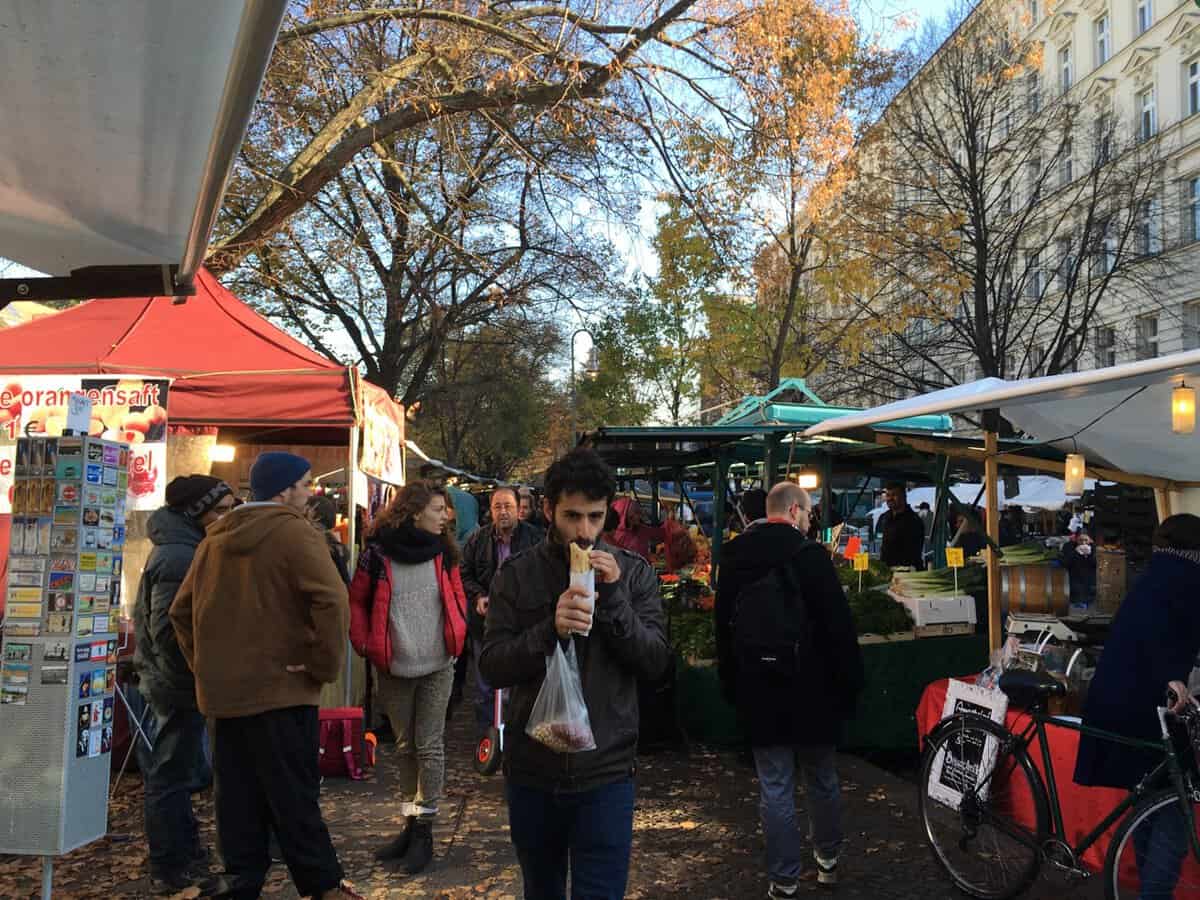
Fresh produce, spices and herbs are in abundance at the Turkish Market on Maybachuferstrasse.

IMG_0394

Shoppers line up to take home these kabobs.

Vendors set up shop from 11 a.m. until 6:30 p.m. on Tuesdays and Fridays and draw quite a diverse crowd from young mothers pushing their strollers to older residents in traditional garb to tourists looking for a quick bite from one of the many food stalls.

IMG_0408

The Turkish Market draws a diverse crowd.

IMG_0400

Fresh baked breads are one reason people flock to the market.

IMG_0416

Fish doesn’t get much fresher than this.

Merchants hawking fresh produce, baked goods, fresh fish, cheese, spices, flowers, clothing, toys, electronics, leather goods, table linens and a surprising quantity of fabric and sewing notions line the approximate half-mile on Maybachuferstrasse.

IMG_0410

Thread, buttons, ribbons, trim, and other sewing needs are all available at Berlin’s Turkish Market.

IMG_0385

Stalls with brightly colored bolts of fabric for clothing and household needs line Maybachuferstrasse.

Young people lounge along the canal enjoying impromptu musical performances by buskers while neighbors shop and chat. It’s a very lively scene.

IMG_0418

A cup of subtly spiced saklep, a hot beverage akin to a milky tea, is just the thing on a chilly autumn day.

IMG_0422

It was hard to resist these delicious looking, aromatic Anatolian delights.

We were very tempted by the delicious looking food on offer at the market but had reservations for lunch at Hasir, so we continued on.

IMG_0436

Hasir is a popular Turkish restaurant with authentic cooking and a casual vibe.

Though we probably could have walked, we were really hungry so we got back on the Ubahn and took the Number 8 one stop to Kottbusser Tor. A quick walk northeast on Adalbertstrasse brought us to the heart of Kreuzberg’s Turkish neighborhood and Hasir, located at Adalbertstrasse 10.

The casual restaurant features traditional Turkish dishes with lamb and kabobs playing a major role on the menu. The service was efficient but friendly, and the meals were well priced.  They get quite a crowd here and even after the typical lunch period, the restaurant was full.

IMG_0433

Lamb, salad and roasted pepper with traditional bread made a delicious lunch at Hasir.

IMG_0434

Entree portions are large enough to share.

After a delicious lunch we walked past several other eateries that were also part of the Hasir group, including a Hasir Express.

IMG_0441

We stopped into a local bakery and treated ourselves to some just baked baklava—delicious!

IMG_0440

We weren’t really hungry but the pastry looked so good we had to stop in.

On our way back to the Ubahn, we took a detour at the Istanbul Supermarket—an enormous Turkish grocery fronted by fresh produce stands.

IMG_0445

From the fresh produce outside, to the bounty within, this supermarket has everything a well-stocked kitchen needs.

IMG_0446

Tea time!

The market had everything from meats, cheeses, canned and packaged goods, to walls of teas and spices. I would have happily filled my shopping bag had we not been staying in a hotel on this trip.  Next time!

Note: This post has been updated from one I published earlier and contains affiliate links.  If you book through TravelTawk.com, I will earn a small commission at no cost to you.  Thank you for your support!


Written and photographed by Jeanne Neylon Decker

This article and all materials published by TravelTawk.com are protected by US Copyright Laws.

Treasures of Berlin’s Museum Island

Take a stroll through the Brandenburg Gate, down Unter den Linden, to the banks of the River Spree. There you’ll find some of the world’s most intriguing and important cultural treasures—the Ishtar Gate, the bust of Nefertiti and so many extraordinary antiquities, classical sculpture and masterworks, it is impossible to imagine they could all be in one place—but they are—Berlin’s Museum Island.

IMG_0852

Museumsinsel http://www.smb.museum is home to five separate historical museum buildings, each designed by a well-regarded architect of the time and now part of a UNESCO world heritage site. Here you will find the Pergamonmuseum, Altes (Old) Museum, Alte Nationalgalerie, the Bode-Museum, and the Neues (New) Museum.

IMG_0626

The museums on Berlin’s Museumsinsel are a treasure trove of important paintings, sculpture, and antiquities from around the globe.

According to Visit Berlin, more than 3 million people come each year to view the collections that range from prehistory to 20th century art. Savvy travelers will want to purchase a Museum Pass, which provides entry to 50 major and lesser-known museums, including the five on Museum Island, over three consecutive days for one low fee. The price was 24 Euro when we visited in November. Passes are available at Berlin Tourist Info points, in the museums, and online at Shop.visitberlin.com.

IMG_0859

The magnificent Ishtar Gate, believed to date from 170 AD, was dedicated to Zeus and Athena. It was brought to Berlin from Western Turkey in 1903.

The long lines and crowded galleries attest to the fact that the Pergamon Museum is on nearly every visitor’s short list of places to visit in Germany’s capitol city.   It should be. The magnificent Pergamon Altar, Ishtar Gate, and marvelous sculpture and other works from ancient Sumeria, Babylon, Assyria, and modern day Iraq, Turkey and Syria are all on display here.  Restoration is underway on the Ishtar Gate, but it remains open for viewing. The Pergamon Altar was closed for restoration during our recent visit and will reopen in 2019. We were fortunate to see it several years ago.

IMG_0866

Detail from the Processional Way, which leads to the Ishtar Gate, at the Pergamon.

IMG_0869

Stunning Roman mosaics cover the floor in the gallery that contains the Market Gate of Miletus, built in the 2nd century AD in Turkey and excavated and brought to Berlin in the early 1900s.

IMG_0901

The stunning Aleppo Room at the Pergamon, seen through protective glass walls.

IMG_0907

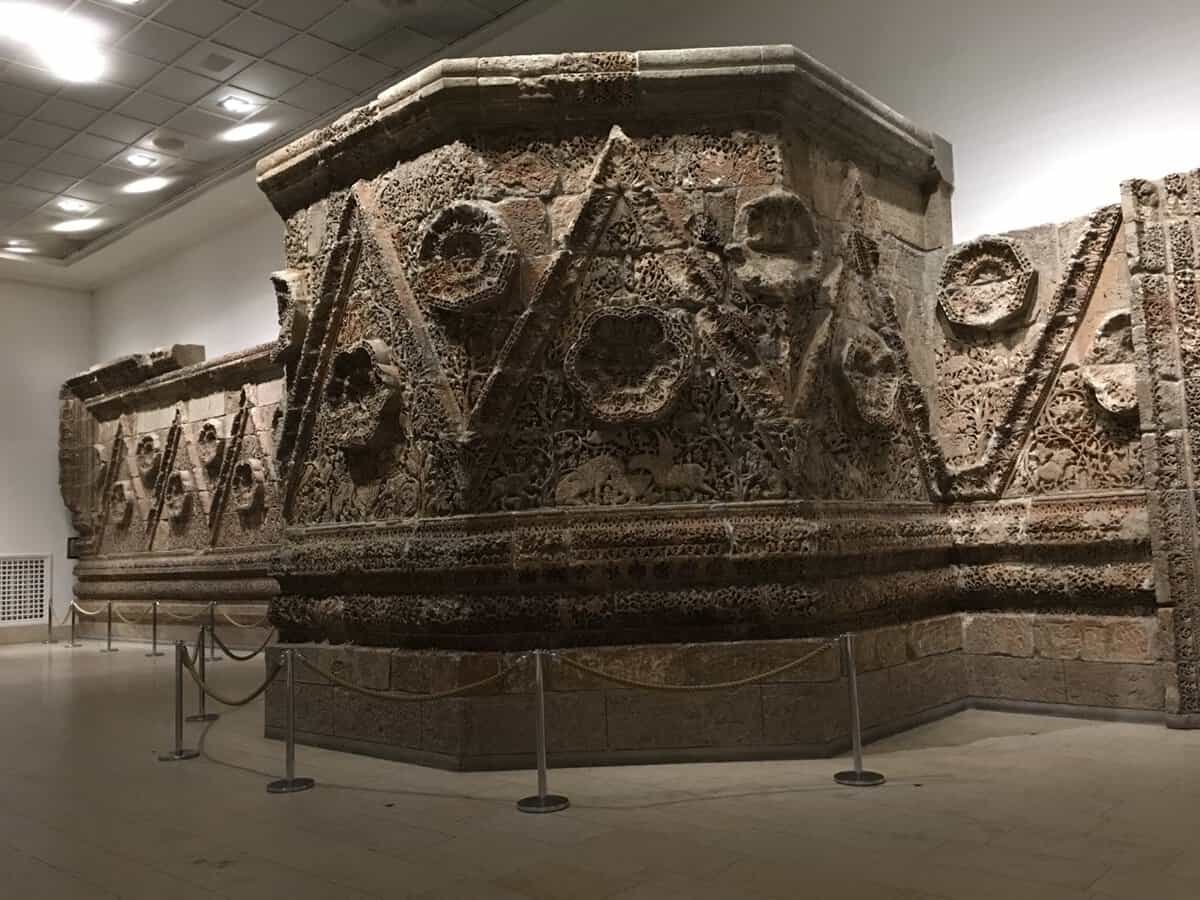
Facade of the Caliph Palace Mshatta from Amman/Jordan from the 8th century. The 33 meter long, 5 meter high facade was brought to Berlin in 1903 to the Bode Museum. In 1932 it was reconstructed in the Pergamon.

We practically had the galleries to ourselves when we visited the Bode-Museum in November. This beautiful museum boasts art from the Byzantine and Roman Empires, a spectacular sculpture collection spanning from the early Middle Ages to the late 18th century, and one of the most extensive numismatic collections in the world. We could not understand why the Bode wasn’t full of people enjoying these art treasures.

IMG_0842

Pedro Roldan’s Our Lady of Sorrows (Mater Delorosa) at the Bode-Museum.

IMG_0784

The Bode-Museum is known for it’s sculpture collection. Friezes, sacred art and other cultural treasures are also on display.

IMG_0838

Don’t miss the extensive numismatic collection at the Bode. It’s one of the most comprehensive in the world.

The Bode also has a lovely café where we enjoyed a delicious and very reasonably priced lunch along with views over the Spree. The cafe balcony overlooks the museum’s grand entrance below.

IMG_0815

IMG_0814

The comfortable cafe at the Bode was perfect for a light lunch.

IMG_0817

Save room for dessert!

If Impressionist works are more to your liking, visit the Alte Nationalgalerie, home to 19th century works by Renoir, Manet, Monet, and Cezanne, Adolph von Menzel and other well regarded artists of that time period. The Alte Nationalgalerie was the third museum to open on Museum Island.

IMG_0617

The Alte Nationalgalerie is home to a fine collection of 19th century paintings– part of Berlin’s State Art Collection.

Housed in one of Berlin’s most impressive neoclassical buildings, the Altes Museum was dedicated in 1828 by Friedrich Wilhelm III for “the study all antiquities and the free arts”. The museum’s permanent collection centers on classic antiquities covering Etruscan, Roman and Greek art and includes urns, vases, sarcophagi, friezes, pottery and sculpture.

IMG_0769

The Altes Museum is a popular destination for student and tour groups.

The 3300 year-old bust of Nefertiti is among the highlights at the Neues Museum, or New Museum. After sustaining significant damage during World War II, the building, which was designed by Friedrich August Stuler and constructed between 1843 and 1855, was abandoned. In 2003, extensive restoration began and the museum opened in 2009 with three main collections—Egyptian art from the Egyptian Museum and Papyrus Collection, prehistoric objects from the Museum for Prehistory and Early History, and classical antiquities. Visitors will find works from around the globe including the Middle East, North Africa, and Northern Europe at the Neues Museum.

For updated information on each of the museums on Berlin’s Museum Island and details on permanent collections, temporary exhibitions, admission, hours and directions, please visit http://www.smb.museum.

Note: The banner image is the Cathedral of Berlin known also as Berlin Dom, located on Museum Island.  In addition to church services, the Berlin Dom is open for tours. Numerous concerts and other events are also held there throughout the year. To the right is the Berlin TV Tower, constructed by the Soviets during the Cold War and now a popular tourist destination.

36 Years After the Fall of the Berlin Wall–Take a Peek Behind the Iron Curtain

IMG_0606

A Look at Life in the DDR (German Democratic Republic)

Much of the world rejoiced when the Berlin Wall came down on Nov 9, 1989. Now 36 years later, two of Berlin’s museums give visitors a frighteningly clear view of what life was like for those caught behind the Wall when it was erected in 1961. Berlin’s DDR Museum ddr-museum.de on Museum Island, is a good starting point to witness life behind the Iron Curtain.

IMG_0468

Interactive displays show career paths available to East German residents.

The museum has an actual Trabant which was the only car manufactured in East Germany. Though costly, constructed partially from cardboard, and with a waiting list that could take 6 years or more– these small sedans were in high demand. It’s not surprising that Communist Party officials preferred Volvos. Visitors line up to sit in the driver’s seat and take a video- simulated drive through the countryside and city streets of the former East Berlin.

IMG_0466

Visitors can take a simulated spin in a Trabant at the DDR Museum.

A typical East Berlin apartment has been recreated inside the museum giving visitors a very clear idea what home life was like, right down to to what usual furnishings would have looked like.

IMG_0474

Books, magazines, television and decor give visitors a glimpse into home life in East Berlin during the Cold War.

IMG_0472

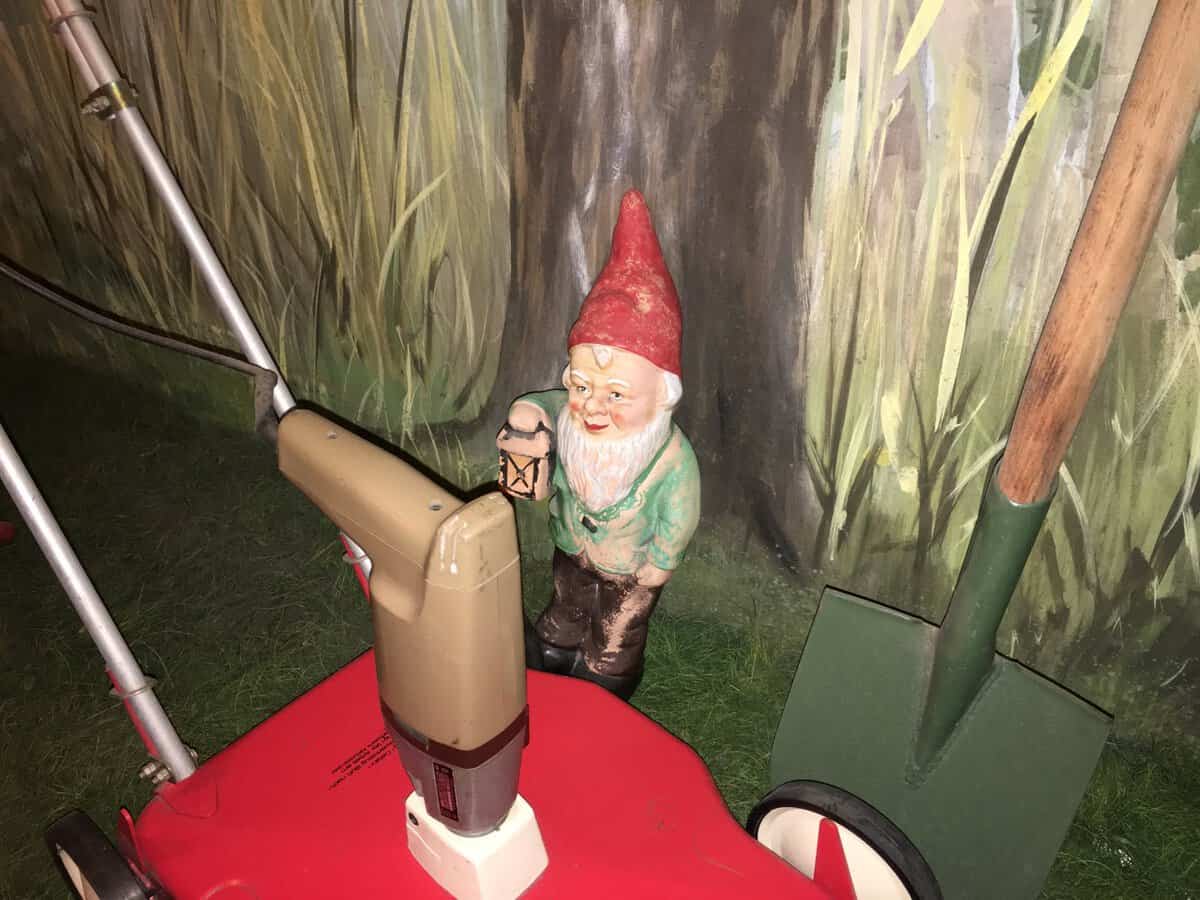
Garden gnomes were a popular addition to patios and lawns.

Even an outdoor patio area has been included– complete with a lawn chair and the ever-popular garden gnome that apparently graced a good many gardens.

IMG_0476

See what’s cooking in a typical East German kitchen.

Food supplies were limited for most East German residents, as a glimpse inside a typical kitchen cupboard shows. Selections were extremely restricted and canned goods played a major role in menu planning.

IMG_0479

Kitchen cupboard contents show a heavy reliance on canned and packaged foods.

Party higher ups had access to all the best the West had to offer and more, of course.

IMG_0485

There was no shortage of Western goods for those at the top echelons of the Communist Party.

The DDR Museum has wardrobes full of clothing and advertisements of the “fashions” at the time– 10 to 15 years behind the styles those in the West were sporting.  The fabrics used were ugly and uncomfortable and because fasteners were expensive, most garments had neither zippers nor metal closures of any kind. Levi’s and designer wear were reserved for those at the top, as the exhibits show.

IMG_0470

Fashionista frauleins in frumpy evening fashions.

Leisure activities are also featured, particularly the East German penchant for nude bathing and sun bathing which was in direct opposition to Communist Party policies. The Museum portrays these activities as subversive acts undertaken by far more than half the population. Photos show happy naked families enjoying outings in the great outdoors.

IMG_0491

Life in the former GDR is captured in photos, films and video displays at the DDR Museum.

The museum also has news clips, videos and more that tell stories of daring escapes made to the West, including one failed attempt made inside the belly of a stuffed cow.  Sadly, many failed attempts are heartbreakingly documented, as are some spectacular success stories.

IMG_0484

A bleak, solitary cell is on display at the museum. Would-be escapees could well have landed in a cell like this one.

Propaganda videos of East Berlin residents discussing their life experience are included and some of those filmed even complain that their housing is inadequate, though they are optimistic that their next family lodging will be more expansive.

IMG_0480

Military recruitment posters, Communist Party propaganda, social protocols– State sanctioned of course, are all part of the displays at the DDR Museum. It’s definitely worth a few hours to tour and explore this fascinating look at how people in the Eastern Sector really lived.

The DDR Museum is on the Berlin Welcome Card.

I Spy: The Stasi Museum

IMG_0528

The Stasi Museum is located in the secret police service’s former headquarters.

As we saw at the DDR Museum, life was not easy for most people trapped by the Berlin Wall in the East. Operating under the auspices of the Ministry of State Security, the Stasi, East Germany’s secret police, made sure that any dissent, real, or imagined, was immediately quashed. Known for their horrific methods of dealing with dissidents or provocateurs, they were indeed a force to be reckoned with and the Stasi Museum stasimuseum.de shows in great detail exactly how this secret organization carried out their reign of terror against ordinary citizens and perceived “enemies of the State.”

IMG_0538

Residents watch construction of the “Wall” that divided Berlin from 1961-1989.

The Stasi’s responsibilities included recruiting spies to inform not only on those behind the Iron Curtain, but also on Western residents and businesses. It was not unheard of for the Stasi to grab people off the streets on both sides of the Wall, using vans disguised as delivery vehicles.  The museum has an example of one of these and visitors can see how the inside of the van has been completely retrofitted into small individual prison cells.  Many who were picked up in these vehicles were never seen again.

IMG_0530

These ordinary looking vans were fitted out inside with individual cells for those unfortunate enough to be picked up by Stasi.

Neighbors were encouraged to report on one another as were family members, and as the records show, when the Berlin Wall crumbled, many relationships did too. It was not unusual for husband and wife to report on the other’s activities and when this came to light after Stasi records became public, divorces, already high in the East, increased dramatically.

IMG_0531

Informants were everywhere as the museum displays depict.

People were not paranoid to think that their activities were being monitored.  The Stasi photographed people at such mundane tasks as grocery shopping with cameras built into shopping bags.  The museum has examples of ties with cameras, belt cameras, cigarette packages that are actually cameras and more. Those old spy movies were not far from the truth.

IMG_0553

Cameras were built into everything from cigarette packets to watering cans during the Stasi’s reign.

IMG_0549

The tape on this radio indicates the only “approved” stations Stasi office workers were permitted to listen to.

A training film on view shows how agents would enter a home, photograph anything they found of interest, steal items and in some cases, deliberately move items around to make the person “under investigation” feel like they were losing their mind.  One case documented at the museum involved a psychologist who suffered from depression.  The Stasi regularly entered her apartment, moved things around, even substituted her tea bags with another brand, and did other strange things that eventually led to her suicide.

Another former DDR resident learned that the Stasi let the air out of her tires daily making her late to work—something that had puzzled her for a very long time. This was another kind of psychological sabotage in their large arsenal of such trickery—all documented at the Stasi Museum. The videos of the subjects of such subterfuge were fascinating.

IMG_0560

A “subversive” in custody measured, photographed and his “aroma” captured in the jar to the right.

The museum has plenty of exhibits that document those who were responsible for the devastation this corrupt government organization wreaked upon those on both sides of the Iron Curtain. In fact, visitors can see the office of Erich Mielke, the last Minister of State Security, which is presented almost exactly as he left it.

IMG_0545

This diagram shows exactly how Minister of Security Erich Mielke liked his breakfast presented.

Interestingly, many of the faces on displayed documents are blacked out likely because these individuals, who have never been prosecuted, are alive and well today.

For a chilling look at the Stasi’s operations, add this museum to your Berlin itinerary.

Note: This is an updated version of an article I wrote previously and contains affiliate links.  If you book through traveltawk.com, I may earn a small commission at no cost to you.  Thank you for your support!

Written and photographed by Jeanne Neylon Decker

This and all materials published by TravelTawk.com  are protected by US Copyright Laws.

Cordobar and Pauly Saal: Two of Berlin’s Creative Kitchens

UPDATE: BOTH OF THESE RESTAURANTS HAVE CLOSED SINCE THIS I WROTE THIS ARTICLE.

Berlin’s dining scene is eclectic and exciting. It’s certainly far beyond schnitzel and the ubiquitous currywurst—though there are plenty of opportunities to indulge in these traditional dishes. From Katz Orange http://www.katzorange.com to the food hall at KaDeWe http://www.kadewe.de, Berlin has something for everyone’s palate. Two of our most memorable dining experiences were at Cordobar and Pauly Saal.

IMG_0984

Try Cordobar for a fun night out.

We arrived at Cordobar just as the dining room was beginning to fill and the bar wasn’t yet three deep. Cordobar  www.cordobar.net is a wine bar for the cool kids, for sure, though there were plenty of folks in their prime enjoying the wine and food, too.

IMG_0965

The small dining room fills up fast, as does the bar area.

The small and lively space has an extensive wine list, a short list of small dishes for sharing and features one large plate each evening, also for sharing. The menu changes constantly but the website gives an indication of the sorts of dishes the kitchen prepares. While some things may sound strange—take a chance and order them anyway—you’ll be glad you did.

IMG_0926

A peek at Cordobar’s extensive wine list.

When I see a glass of Salmon Billecart for less than 10 Euro a glass, I order it— a little bubbly is the perfect start to any evening. While I sipped my champagne, our knowledgeable and friendly waitress guided us through the extensive wine list, which focused on German and Austrian offerings, though it is not limited to producers from these countries.  The list also included many natural/biodynamic wines that are so much in vogue in Europe right now. We chose to order by the glass so we could sample more wines and we were delighted with all of our selections—from Hirsch Gruner Veltliner to Zantho Muskat to Shelter Spatburgunder (pinot noir) to the Joschuari 2012 (gamay)—all new to us and perfect with the food we picked. Guests may also select from the bottles that line the walls.

IMG_0919

We started with the fresh baked bread and butter—we spend a lot of time in Portland,  so paying for bread and butter was not a new concept for us. Served in a paper bag, the warm bread was perfect.

IMG_0927

The eggplant exceeded expectations.

Some of the dishes we chose sounded like odd combinations but were all absolutely wonderful and unexpected. We shared the eggplant with pineapple, pepper and saffron, and the grilled zucchini prepared with almond milk and miso to start.

IMG_0928

The grilled zucchini had an Asian flair.

Next up was the main event—the featured large plate of the evening—lamb neck tacos. The lamb was perfectly prepared with Middle Eastern seasonings and presented as a large chunk of meat on a separate plate.

IMG_0942

The Middle Eastern spices were a perfect foil for the rich and succulent lamb.

The “tacos” were cabbage leaves topped with a creamy sauce to which we added the tasty lamb. Different and delicious!

IMG_0941

Cabbage leaves stood in for the more traditional tortillas.

IMG_0949

The assembled lamb tacos– delightfully different.

Cordobar is extremely popular so if you’d like to be assured of a table in the small dining room, make a reservation. The bar area was packed all night and tables in the dining room were empty only long enough for staff to clean them. http://www.cordobar.net

IMG_0697

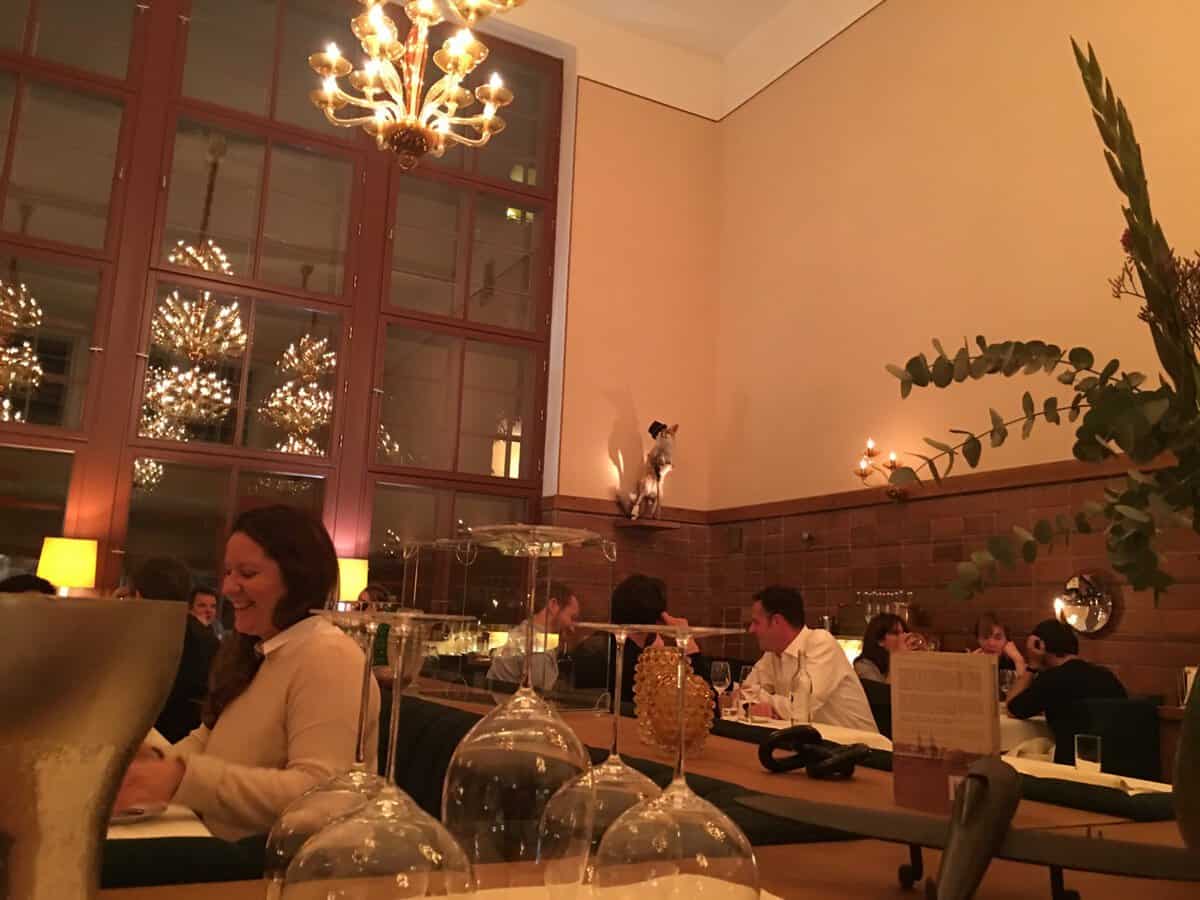
The inviting dining room at Berlin’s Pauly Saal, abuzz with happy guests.

We were really excited to try the Michelin starred Pauly Saal http://www.paulysaal.com, another highly recommended Berlin restaurant on our list. Pauly Saal features a beautiful dining room, a terrace (closed during our November visit), a lovely bar area and an open kitchen with the very talented Chef Arne Anker at the helm. We had a chance to ask chef about the significance of the rocket above the open kitchen (in banner photo) but it turns out no political statement was intended, just a touch of whimsy that adds a fun focal point to the room.

IMG_0726

The restaurant is open for lunch, cocktails and dinner daily. Three menus are offered at lunch—two, three or four courses. Dinner guests choose from two multi -course prix fix menus, either a four- course “little menu” or a six-course meal. An additional cheese course is also available for a surcharge with both options.

IMG_0736

Pauly Saal’s extremely talented chef, Arne Anker.

We chose the four-course meal, which sounded deceptively modest: pike prepared with elderflower, oyster and radish; kale salad with mustard, squash and wheat; lamb loin with parsley root, eggplant and zucchini, and for dessert—blueberries with yogurt, white chocolate and rose. While each of these dishes may sound simple, they most assuredly were not. Each dish was truly a culinary creation designed to delight every one of the senses.

IMG_0691

Perfect perch.

IMG_0698

We’d eat our kale every day if it was prepared like this.

IMG_0704

Gorgeous lamb with innovative accompaniments including the faux marrow bone.

IMG_0708

Desert was almost too pretty to eat… almost.

IMG_0711

Chocolate “stones” artfully mixed with the real thing.

The finale came after dessert — a small dish of chocolate “stone” truffles—presented with real stones.

IMG_0690

There are more than 600 bottles on Pauly Saal’s wine list.

Pauly Saal’s wine list is quite extensive with more than 600 bottles on offer. We toured Europe in our by- the- glass selections, choosing two different wines for each course. A German Sauvignon Blanc from Weedenborn, Spanish Albarino by Picarana, a Klingenberg 2012 Spatburgunder and Chateau des Tours Cotes- du- Rhone were among the perfect pairings our extremely knowledgeable sommelier suggested.

Reservations are a must at Pauly Saal but if you aren’t able to secure a table, do stop in to the bar for a drink and a snack—the bar food looked pretty incredible, too. http://www.paulysaal.com

A walk to the restrooms was a reminder that Pauly Saal is located in a historic building constructed as a school for Jewish girls in 1930.

IMG_0720

Placards in the hallway tell the story of 11 Auguststrasse.

IMG_0721

Originally built as a Jewish girls’ school, these historic photos depict the students at play and at work in the 1930s.

The building was designed by prominent Jewish architect Alexander Beer. He later perished in the Theresienstadt Concentration Camp. On the walls one finds numerous photos depicting laughing children at play and studiously attending to their lessons. Placards detail the story of the building and students who once walked these halls.

IMG_0714

The building was officially returned to the Jewish community in 2009 and is meant to honor the past and be a part of Berlin’s “creative future,” as the sign above indicates. In addition to Pauly Saal, Camera Work Contemporary Gallery, The Kennedys Museum, Michael Fuchs Gallery, and Mogg & Melzer Delicatessen have found a home at 11-13 Auguststrasse.