
Browsing Category

Family Fun

MoMA’s Must See Picasso Sculpture Closes Soon

Note: This exhibition is now closed!

In just over a month’s time, one of the most extensive and engaging exhibitions of Pablo Picasso’s sculpture ever presented in the United States will close. If you haven’t already visited the Museum of Modern Art’s marvelous retrospective of the painter’s rarely seen works, get your tickets and go see it before it closes on Feb. 7, 2016. http://www.moma.org

IMG_0797

A visitor examines Picasso’s Man With A Lamb (1943).

For the first time since 1967, New York’s MoMA presents one of the largest exhibitions of the painter’s three-dimensional work. The exhibit includes more than 100 sculptures plus photographs and works on paper, many never before displayed in North America. I was fortunate to see the exhibition during the Member Preview before it opened to the public in September.

IMG_0746

Left foreground, Woman with Child (1961), center rear, Head of a Woman (1957), right, Chair (1961). All three of these sculptures are painted sheet metal.

While Picasso was a formally trained painter, he was a self-taught sculptor and his work reflects the exuberance and personal relationship he had with the art form. He kept most of his sculptures in his personal possession rarely allowing these works to be displayed. One of the first and only times some of these pieces were presented publicly was in 1966 at a major retrospective at the Petit Palais in Paris when the artist was 85 years old. The following year, the MoMA staged Sculpture of Picasso in New York featuring many of the same works. Picasso’s sculptures have not been on public view on such a grand scale since.
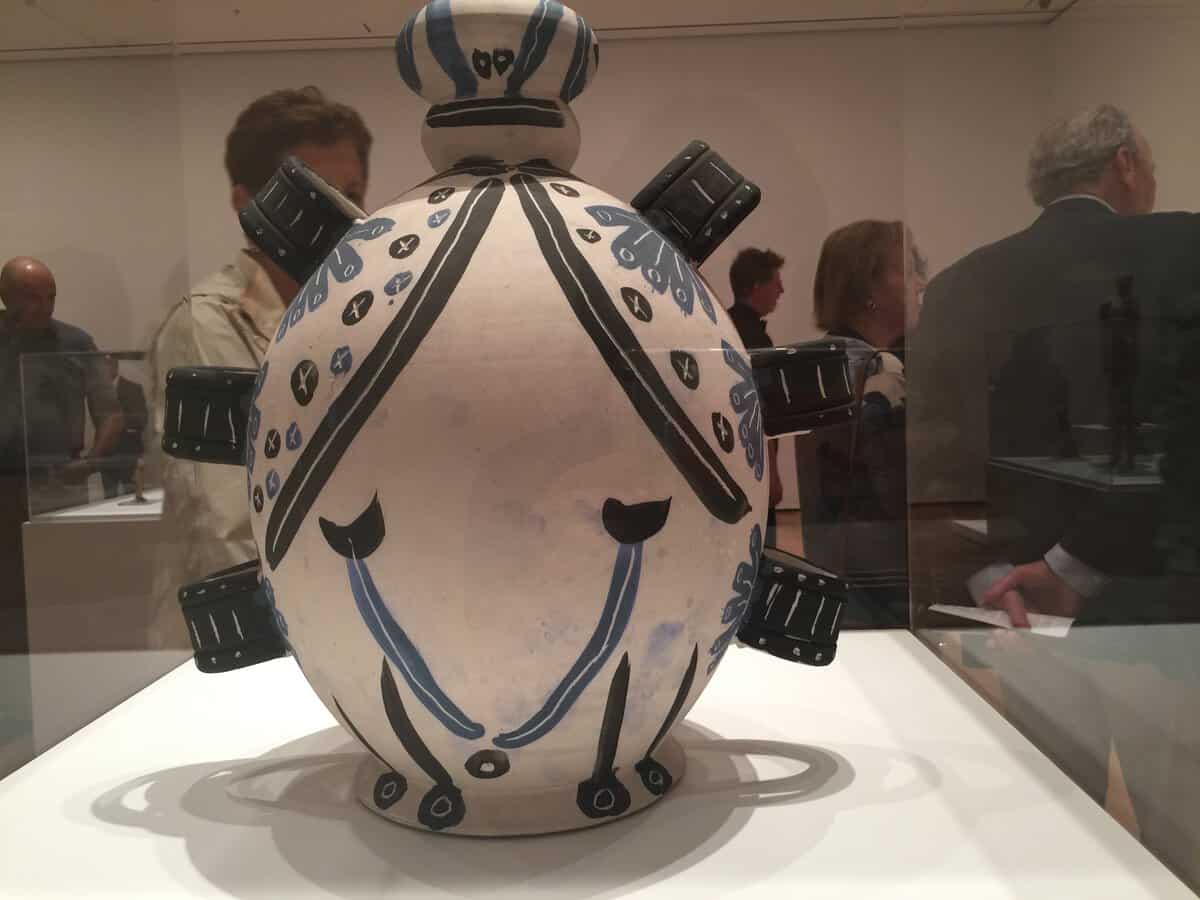
IMG_0775

Insect (1951) was created from fired white clay and painted.

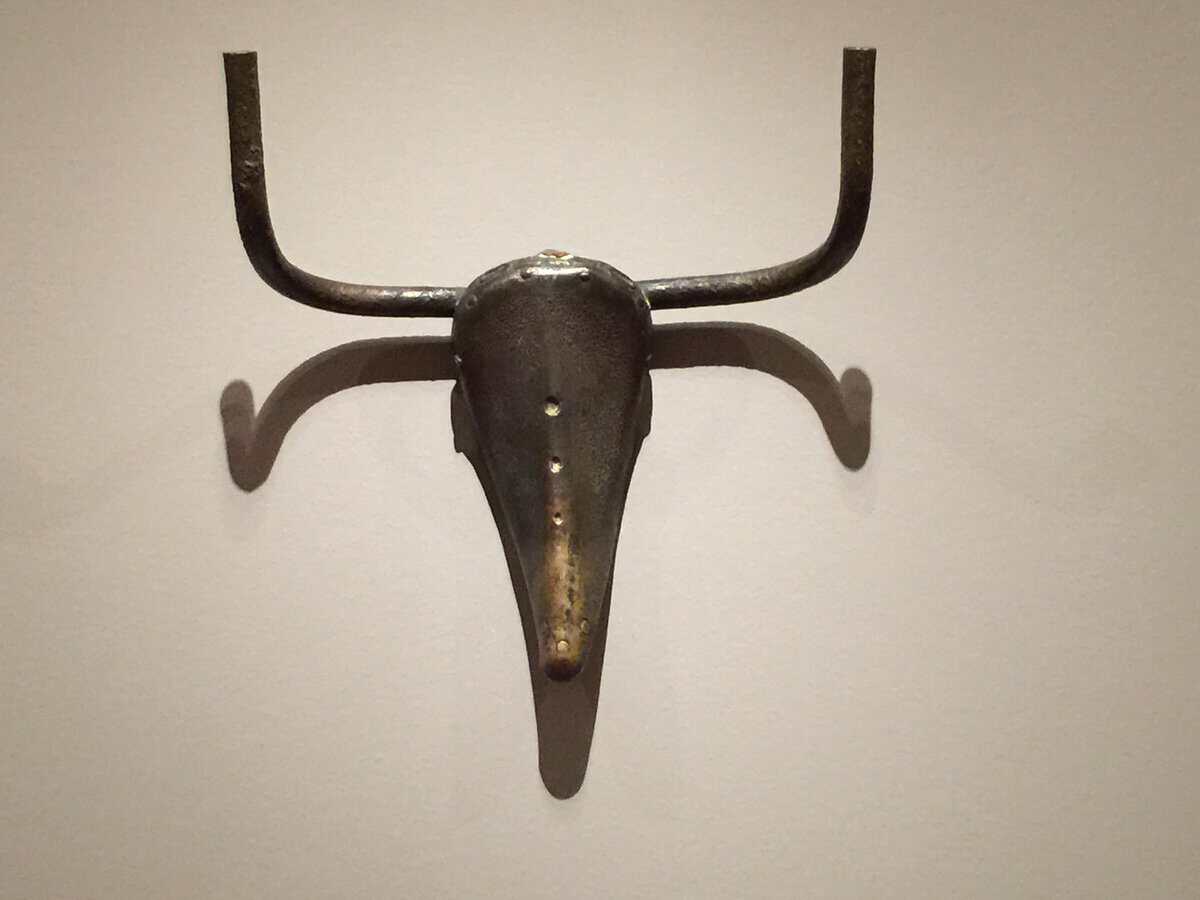
Picasso was fond of unconventional techniques and materials and frequently used found objects and materials including scrap wood, wire, metal and cardboard in his sculpture. Wicker baskets, pie tins, palm fronds, toy cars and many other scavenged items found their way into Picasso’s work. He used a bicycle seat and handlebars to create Bull’s Head, which was on loan from a private collection, for example.
IMG_0799

Bull’s Head, (Spring 1942) is a repurposed bicycle seat and handlebars.

IMG_0811

Left, bronze Pregnant Woman (1949). Right, Flowery Watering Can (1951-52) incorporates a watering can, plaster, nails and wood.

Museumgoers will learn that Picasso’s forays into sculpture were influenced by many sources including ceramics and woodcarvings by Paul Gaugin and Edgar Degas as well as by Oceanic and African sculpture. His themes run the gamut from political expression to family life. Just as in his paintings, women are frequent subjects in Picasso’s sculpture.

IMG_0768

Left, Bather (1931) bronze. Right, Head of a Woman (1932) plaster.


IMG_0771

Left, Woman with Vase (1933) bronze. Center, Head of a Warrior (1933) plaster, metal and wood.

He enjoyed reinventing and reimagining many of the same themes as the exhibition demonstrates. His Glass of Absinthe – six different polychromed bronze pieces each including an actual absinthe spoon, is a good example of this.

IMG_0807

Seated Woman (1947), Standing Woman (1945), Seated Musician (1950), and Seated Faun (1950) are among the small earthenware, terracotta and clay pieces in this display case.

Visitors to Museum of Modern Art http://www.moma.org will need timed tickets to see the Picasso Sculpture exhibition. Only members, corporate members and guests accompanied by members are exempt from this. Each day a limited number of tickets will be available for same day viewing but we strongly suggest that you get your tickets in advance to ensure you don’t miss this wonderful exhibition.

IMG_0783

Woman with Outstretched Arms (1961) painted iron and sheet metal.

Published in conjunction with the exhibition and available in the MoMA’s book and gift shops, the Picasso Sculpture catalog makes a beautiful souvenir that will allow you to revisit your favorite works again and again.


Motorcycle Mania—Moto Talbott Collection

Note: The Moto Talbott Collection closed permanently on September 30, 2024.

I’m not much of a motorcycle aficionado myself, but I have been married to one for enough years to recognize the distinctive sound of a Ducati from a distance. On our recent trip to California’s Monterey Peninsula, we drove up to Carmel Valley to indulge in some wine tasting and discovered the Moto Talbott Collection. My husband’s delight quickly faded when he saw the motorcycle museum was closed, but fate smiled once again when founder Robb Talbott appeared in the courtyard.

Moto Talbott is a “must see” for motorcycle aficionados.

We had a nice chat, but Mr. Talbott was off to an appointment so no chance for a sneak peek behind the gates that day. We left with the promise to return later that week; my husband clutching the newly printed brochure Robb had kindly given him.

Rare, vintage, award- winning and beautifully restored motorcycles, all with stories to tell, await visitors to Moto Talbott.

Bright and early that Friday morning, we returned to Moto Talbott. In the courtyard were the museum’s newest acquisitions—two BMW Isetta 300s. Originally produced in Italy in the 1950s, Issetas are known as micro cars or “cabin scooters.” These two had been languishing in a hayloft in a Northern California barn for more than 40 years. Robb had picked them up just the night before.

These Isseta micro cars had just arrived after languishing in a hayloft for 40 years.

The Moto Talbott Collection opened in November 2016 and has been  attracting motorcycle fans from all over the world ever since. The collection is mostly motorcycles (more than 170 of them) but also features scooters, vintage transportation- themed toys, motorcycle memorabilia and more. The bikes are artfully displayed in a 6,000 square foot building with walls of snow barrier board trucked in from Wyoming and constructed by hand. Every detail has been carefully thought through.

This BMW is handsomely displayed against a handcrafted wall of Wyoming snow barrier board.

There are some real gems in the collection, including the Ducati Marianna that won the very last Motogira D’Italia in 1956 and is credited with saving the Ducati Company from possible closure. There’s a terrific photo of the wining rider, Guiliano Maoggi, with a cigarette clenched in his teeth on the wall above the bike, along with the fascinating story of his victory.

Visitors can learn about the last Motogiro d’Italia and the winning Ducati’s intriguing victory tale.

Steve McQueen’s 1931 VL Harley is there, as is a demonstration bike from WWII with the gas tank and engine covering cut away so soldiers training on it could learn what went where. This particular bike, which is quite a rare find, came to the collection complete with troop movement maps, gloves and a fully- functioning Thompson sub-machine gun, which has since been rendered inoperable.

Every bike has a fascinating story and a great deal of history behind it, including this rare WWII demo bike.

There’s a Vespa specially designed to promote Coach’s leather goods, a motorcycle that was buried in the backyard to protect it from certain destruction in a fire, race and award winners, beautiful restorations, trial bikes, rare and vintage motorcycles—they’re all here.

Each Coach logo was carefully hand painted on this promotional Vespa.

What really makes a trip to Moto Talbott special is the opportunity to learn the history and stories behind these bikes from the engaging and knowledgeable docents. We were fortunate to spend the morning with Rich Watson, former Economics professor at UC Santa Barbara and a lifelong lover of motorcycles. Rich could not have been more informative and entertaining. We were captivated by the intriguing tales he told, from his description of riders being impaled by enormous splinters during the American board racing days of the early 1900s to stories of unbeatable BSAs.

Engaging docents like Rich Watson enrich the visitor’s experience by sharing the stories and history behind the bikes.

These Indians from the early 1900s were used for American board racing– an extremely dangerous form of motorcycle racing not permitted for decades.

The impressive collection currently features road bikes and dirt bikes from 16 countries, from the Czech Republic to Mexico. MV Agusta, BSA, Bultaco, BMW, Indian, Harley Davidson, Kawaski, Maico, Gilera, Triumph, Honda—nearly every notable motorcycle company is represented here.

Road bikes and dirt bikes from around the globe are part of the collection at Moto Talbott.

The “Riders for Health” motorcycle under the orange vest traveled more than 80,000 kms bringing health care and aid to those in need in Zimbabwe.

The former proprietor of the highly regarded Talbott Vineyards and chairman of the board of the eponymous clothing company his family founded, Robb Talbott’s commitment to excellence and quality is as apparent in the Moto Talbott Collection as it was in his previous endeavors. The museum was at least three years in the making and was created so that he could “…share his passion for bikes and beauty… And mostly to share the stories of these bikes and their history.” The museum’s mission statement rings especially true after talking with Robb—”preservation, restoration and education…all driven by passion.”

Some of founder Robb Talbott’s vintage toys are displayed here.

We also had the chance to meet Bobby Weindorf, the museum’s curator and chief restorer.   Motorcycles have been part of Bobby’s life since he was 12 years old. His career was built on his passion: five years with American Honda’s factory road race and Supercross/Motocross teams; a dealership in Santa Barbara for 10 years, and several years in Italy working with motorcycle race teams. When asked about his three favorite bikes in the collection, he chose the 1977 MV Agusta 850SS because, “It’s big, powerful and makes a bold Italian statement,” a 1977 Hodaka Super Combat Wombat, “…cute dirt bike with an awesome name,” and a 1965 BMW R 69S in Granada Red, for it’s “pure elegance in a rare color…”

Moto Talbott is dedicated to preservation, restoration and education–and doing a spectacular job in all three area.

Bobby noted that Moto Talbott will continue to evolve: expanding and changing the collection, offering events, and continuing to educate visitors, preserve the “survivors,” and restore the classic motorcycles that he and the others involved in this marvelous museum have worked so tirelessly to make accessible to motorcycle lovers from around the world.

Update–The museum has been temporarily closed due to Covid-19.  For more information click here.