Browsing Category

Art

Everything You Need to Know About Florence’s Famous Duomo: Il Grande Museo del’Opera del Duomo

Florence’s Il Grande Museo del’Opera del Duomo has nothing at all to do with opera. Instead, it is all about the work, or opera, involved in building, preserving and maintaining one of the most recognizable Renaissance buildings in the world—Florence’s Duomo, also known as the Cathedral of Santa Maria del Fiore.

img_2754

A spectacular view of Brunelleschi’s dome from Caffe La Terrazza.

If you’ve ever wanted to see how Brunelleschi’s magnificent dome was constructed, learn what the other options were for the Duomo’s facade, or see the remarkable art treasures once housed in the cathedral, this is the place to come.

img_2161

Welcome to the recently reopened and reimagined Museo del’Opera del Duomo.

img_2111

Soaring galleries give visitors a new perspective on the superb sculpture on display at the museum.

Re-opened in October 2015 after years of restoration and reconstruction, the Museo dell’ Opera del Duomo has an exquisite collection of sculpture, paintings and other masterworks displayed on three floors in 6,000 square meters of exhibit space, all designed to showcase the art to its best visual and historical advantage.

img_2104

A visitor gets an up close look at a statue in the museum.

Most of the works were at one time in, or outside the Duomo.

img_2128

These sculptures once graced niches in Giotto’s bell tower.

Some of the treasures to be found include the original North Doors created by Lorenzo Ghiberti for the Baptistry of San Giovanni along with the Doors of Paradise by Lorenzo and Vittorio Ghiberti. Replicas now hang on the Baptistry.

img_2181

Ghiberti’s stunning Doors of Paradise and North Door once graced the Baptistry of San Giovanni but can now be found inside the museum.

img_2178

Detail of door.

In all, the museum boasts 750 works of art covering 720 years of history.

img_2209

Arnolfo di Cambio’s stunning Christ with the Soul of Mary
img_2152

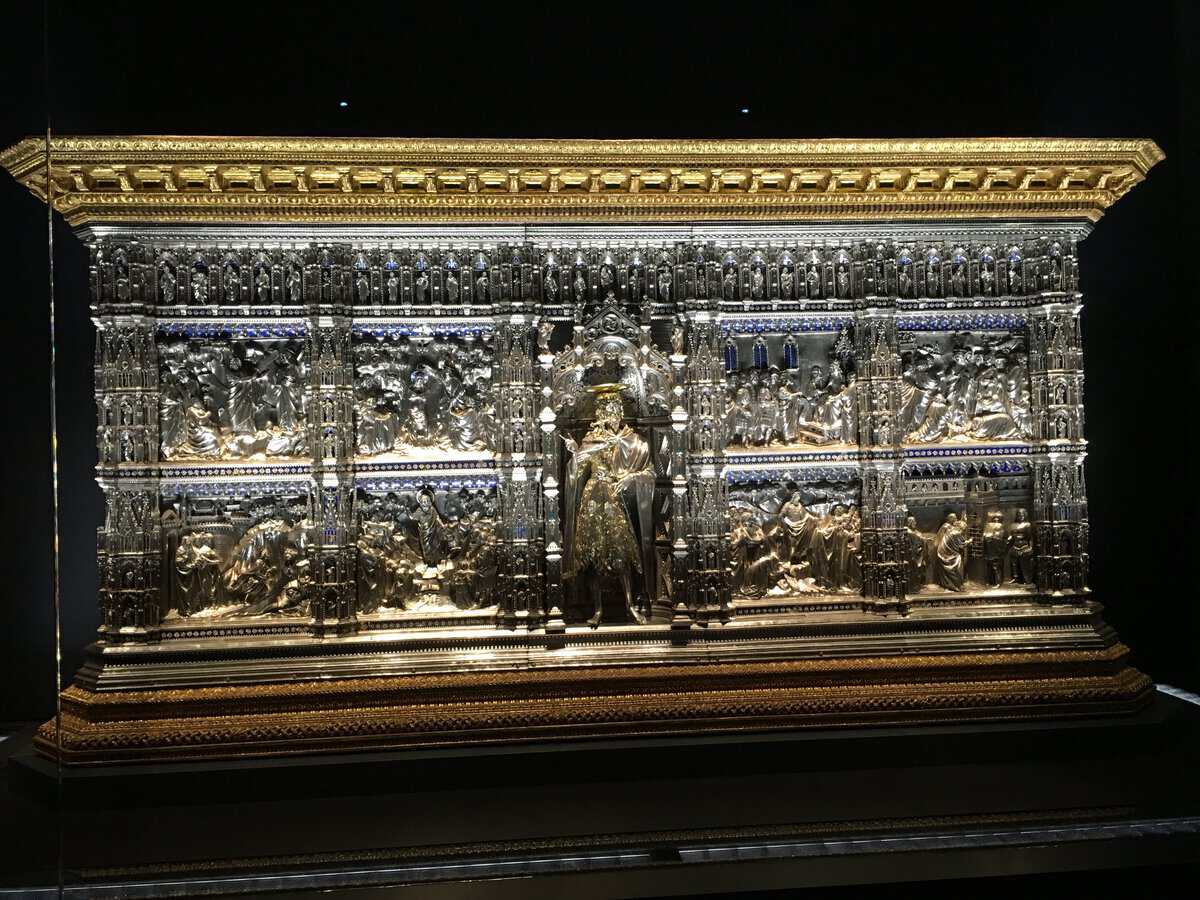
This exquisite silver alter features scenes from the life of John the Baptist and was created by Lorenzo Ghiberti, Betto di Geri, Bernardo Cennini, Antonio di Salvi, Francesco and Leonardo di Giovanni, Antonio del Pollaiolo and Andrea del Verrocchio.

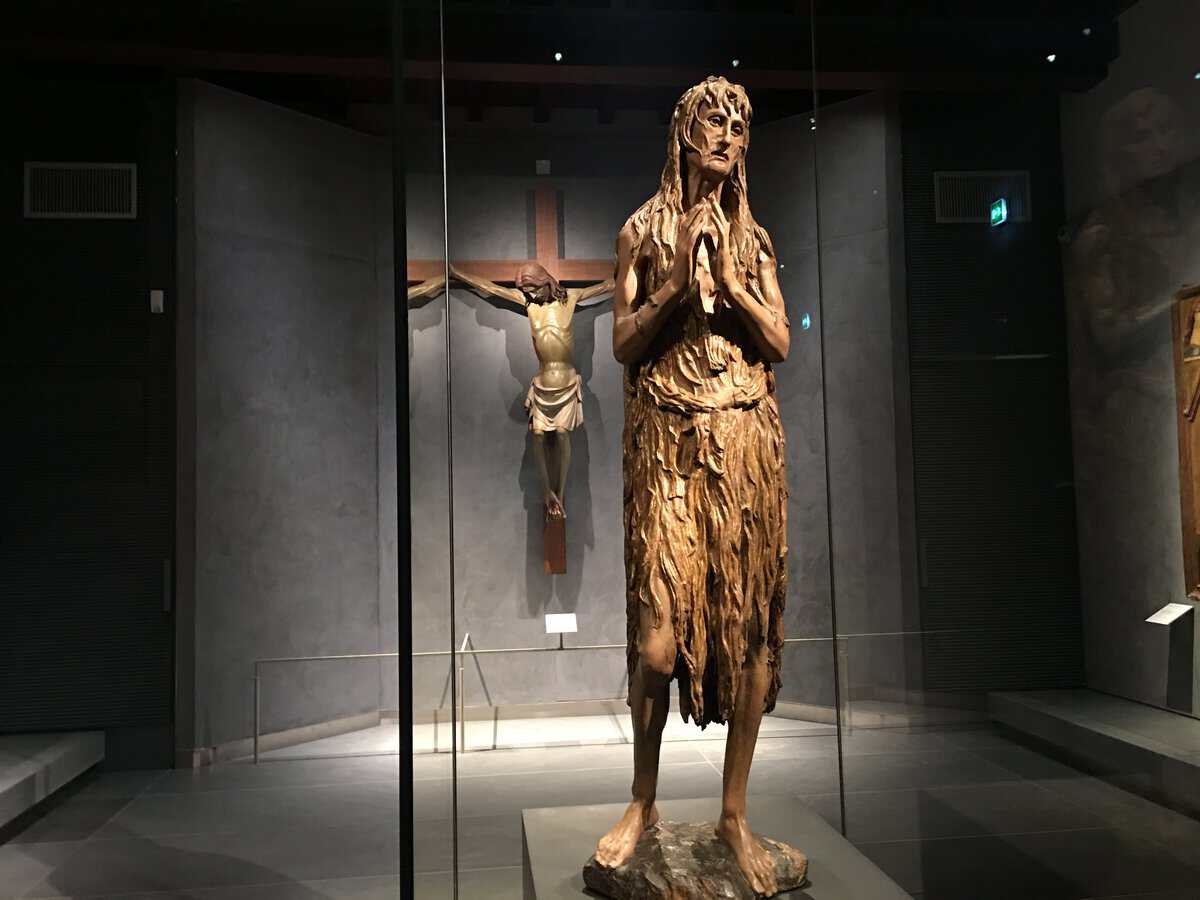
Michelangelo’s poignant pieta, sculpture by Donatello including his magnificent Mary Magdalene as Penitent, and works by Andrea Pisano, Antonio Pollaiolo, Arnolfo di Cambio and other highly regarded Medieval and Renaissance artists are on display.

img_2580

Michelangelo sculpted this pieta for his own tomb. He later destroyed it. It was reconstructed and acquired by Cosimo de Medici In 1671 and placed in the Duomo in 1722. It was the next to last sculpture Michelangelo ever created.
img_2176

Donatello’s Mary Magdalene as Penitent draws many visitors.

img_2579

Sacred items and iconography are part of the museum’s extensive collection.

img_2108In the Cappella Musicale, or music gallery, you will hear enchanting sacred music, and find works by Luca della Robbia and others, as well as rare illuminated music books.

img_2143

Beautiful music fills this gallery where rare illustrated books, sacred objects and art treasures are displayed.

img_2164Brunelleschi’s dome, still considered a marvel of engineering, remains one of Florence’s most iconic monuments.

img_2249

Models of Brunelleschi’s dome show how it was built and why it remains an engineering marvel.

In addition to the art treasures, the museum contains original building materials, equipment and tools, dating back to the Duomo’s 15th century construction.

img_2137

Wooden pulleys, ropes and other original construction equipment used to build the Duomo can be seen at the museum.

img_2140

Original 15th century tools and equipment used to build the Duomo are displayed near a continuously running film that explores the design and construction.

Also featured are drawings and models of the dome and Giotto’s bell tower, which was begun in 1334, after Giotto’s death. An outdoor terrace offers splendid views of the dome.

img_2133

Brunelleschi’s wooden model of the dome fascinates visitors.

img_2124

A detailed model of the bell tower designed by Giotto is on display near beautiful stained glass windows created by notables including Ghiberti, Donatello, Paolo Uccelli and Andrea del Castagno.

Visitors to the museum will learn about the history of this spectacular cathedral, designed by Arnolfo di Cambio and dedicated in 1412. The name Santa Maria del Fiore means St. Mary of the Flowers or Virgin of the Flowers. Once the largest church in all of Europe, today it is third in size, after St. Peter’s Basilica in Rome and London’s St. Paul’s Cathedral.

img_2134A film called Courage to Dare about Florence during the Renaissance and the creation and construction of the Duomo runs continuously in the museum.

img_2103

A number of possibilities considered for the Duomo’s facade are on display, including this one.

Combination tickets can be purchased for the Duomo Museum, the Baptistery, the bell tower and the Crypt of Santa Reparta, named for the 7th century church that once stood on the site of the Duomo. There is no charge to enter the Duomo, but paid tickets are required for visitors who wish to climb the more than 400 steps to the top of the bell tower.

img_2213

The Baptistry of San Giovanni always draws crowds. Tickets are required to enter.

Appropriate clothing is essential for entry. In other words, no shorts, short skirts or skimpy, shoulder baring tops on women or men. Bulky bags and backpacks must be checked. Visit www.ilgrandemuseodelduomo.it for information on ticket prices, hours and tours.

img_2215

Admission to the Duomo is free but take care to dress appropriately or you will be denied entry.

On our visit, we also had free access to a photographic exhibition called Opera di Viva by Michele Pecchioli, which paid tribute to the hundreds of men and women who have worked to preserve the artistic integrity and cultural heritage of the building and the art works within for more than 700 years.

img_2565

Michele Pecchioli’s photographs pay tribute to the men and women who restore and preserve the art and cultural heritage of Florence’s iconic Duomo.

img_2560The photos feature the restorers, artists, employees and security guards who play a role in safeguarding these treasurers and ensuring public access to the works for years to come. Note: This was a temporary exhibition and may now longer be available for viewing.

img_2561

A close up of a security guard charged with safeguarding the priceless treasures at the Duomo and its museum.

When the sun begins to set in Florence, head over to Piazzale Michelangelo for another perspective on the Duomo —and enjoy the gorgeous vista across the Arno over the city.

img_7935

Some of the most spectacular views of Florence can be had from the Piazzale Michelangelo. Don’t miss a visit to the beautiful San Miniato al Monte across the street. It’s the oldest church in Florence, after the Baptistry.

img_7939

Florence’s Duomo viewed from Piazzale Michelangelo.

img_2764

The department store La Rinescente has a terrace restaurant with fine views of the Duomo, as well as drinks and light fare.

If you crave an aperitivo with your sunset and Duomo views, go to La Rinascente, the department store on Piazza Repubblica. Go directly up to La Terrazza on the top floor and you’ll find a little rooftop café/bar with great views of the city and the iconic dome. It gets crowded so get there early or be prepared to wait.

img_2766

img_2771

Sensational sunset view over the Piazza della Repubblica from Caffe La Terrazza.

Cin Cin!

Written and photographed by Jeanne Neylon Decker

Protected by US Copyright Laws.

A Visit to Florence’s Salvatore Ferragamo Museum: Scarpe Diem

IMG_2791Descend the staircase in the stunning Palazzo Spini Feroni, which houses the flagship Ferragamo store and serves as company headquarters, and you’ll be greeted by walls of Salvatore Ferragamo’s strikingly beautiful shoes, artfully displayed, of course. Though they play a major role in the Museo Salvatore Ferragamo, a marvelous small museum on Florence’s posh Via Tornabuono, there’s much more to see than fabulous footwear.

IMG_2794

Ferragamo’s shoes may themselves be considered works of art.

The Museum tells the story of the man, who grew up outside of Naples, the eleventh of 14 children and became “shoemaker to the stars”; the company, which became synonymous with beautiful and comfortable shoes that were widely imitated; and the city of Florence itself.

IMG_2816

Visitors can learn about Florence’s fascinating history at the museum.

Stunning masterworks of 17th and 18th century Florentine art, a look at the palazzo’s chapel with frescoes by Bernardino Poccetti, artful fashion, and company’s history are all part of the museum experience www.ferragamo.com/museo.

IMG_2822

There is much more to see than shoes at the Museo Salvatore Ferragamo.

IMG_2800In addition to the innovatively designed shoes for which the company is known, the signed lasts created for Marilyn Monroe, Rita Hayworth, Sophia Loren and so many other movie stars and well-known names, past and present, are on view along with Ferragamo’s leather working tools.

IMG_2830

Wooden lasts created for movie stars, royalty and other recognizable names hang on the museum’s walls.

The company’s history is cleverly presented in photographs displayed on racks like tourist post cards.

IMG_2803

These “picture postcards” give visitors a glimpse of the company’s past.

IMG_2802

Video and still photos tell the story of Salvatore Ferragamo and the company he created.

Beautiful sculpture, noteworthy paintings, historic books, documents, and more from the family’s extensive collection compete for visitors’ attention. Classical music such as Corelli’s Le Sonata per Violino, Violone e Cimbalo plays in various gallery spaces, adding to the ambiance.IMG_2824

IMG_2819

IMG_2807Along with the permanent collection, the museum hosts rotating exhibitions. 

The famous building, constructed in 1289, is itself part of the museum. Among other things, the Palazzo Spini Feroni was once home to the City Council when Florence was the capital of Italy. Salvatore Ferragamo purchased the Palazzo in 1938, after returning from America, and it has served as Ferragamo’s headquarters since that time.

IMG_2792

During it’s long and colorful history, the Palazzo Spini Feroni was home to Florence’s City Council, a hotel and art galleries before becoming Ferragamo’s headquarters.

IMG_2836

Salvatore Ferragamo’s widow, Wanda, was instrumental in creating the museum.

Through the efforts of Ferragamo’s widow and family members, Museo Salvatore Ferragamo was founded in 1995 after an exhibition at Florence’s Palazzo Strozzi went on tour, hosted by New York’s Guggenheim Museum, the County Museum of Los Angeles, London’s Victoria & Albert Museum, and Sogetsu Kai Foundation in Tokyo among others. The traveling exhibition became the basis of the permanent collection at the museum.

IMG_2833

Private guided tours can be arranged via email.

Private guided tours can be arranged by emailing [email protected].The museum also hosts special events. Check the website for ticket information and additional details.

Written and photographed by Jeanne Neylon Decker

This and all materials published by TravelTawk.com are protected by US Copyright Laws.

This article contains affiliate links.  If you click and book, I may earn a small commission at no cost to you. Thank you for your support. I promise not to spend it all on gelato!

Pitstop in Pisa

If you’ve never been and you’re in the area, it’s worth a stop to see Pisa’s famous Leaning Tower and the Campo dei Miracoli or Square of Miracles.  The Tower, or Torre, which was begun in 1173 and not completed until 1399 almost 200 years later, is one of the most recognizable and visited sites in Italy.

IMG_7895

Go ahead– it’s why you’re here!

It’s easy to reach Pisa from Florence by car or train. We stopped on our way back to Panzano from Lucca. Park in one of the signed lots close to the piazza. There is a bit of an “element” looking to take advantage of tourists near the Campo dei Miracoli so it’s worth putting your car in an attended, paid lot. If you’ve arrived by train, take the LAM Rossa bus from the station in the direction of San Jacapo and get off at Torre.

IMG_7881

Site map of the Campo dei Miracoli shows where everything is located.

If you’re feeling energetic, you can climb the 251 steps to the top of the Tower, for a fee. Children under the age of 8 are not allowed up into the Tower for safety reasons and children between the ages of 8 and 18 must have an adult accompany them. Opening hours and ticket prices are available at here, the official tourism website for Pisa.

IMG_7884

Part of the fun is watching everyone else take their photos.

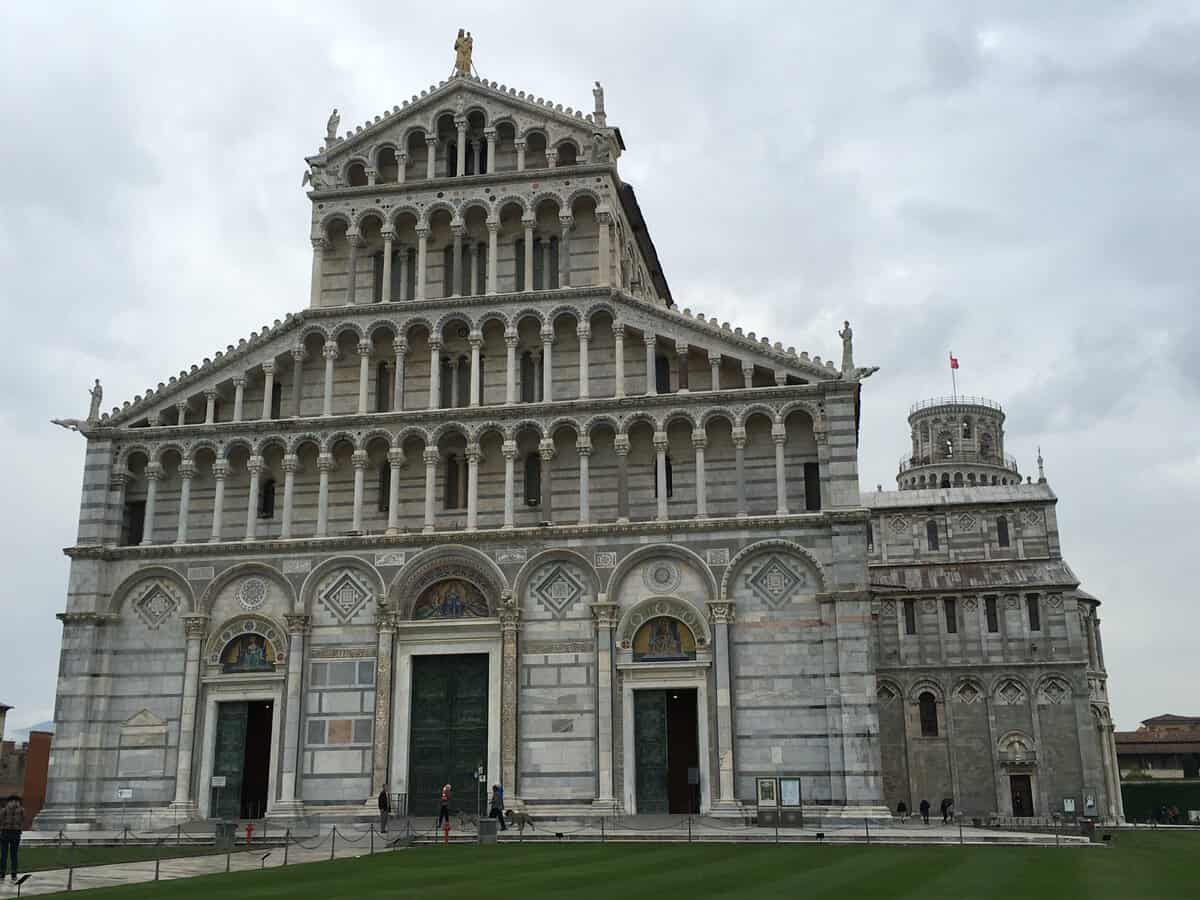
Take the requisite photos, enjoy watching others take theirs, and then visit Il Duomo, Pisa’s cathedral. It is really beautiful and has the holy doors or porta santa open for the Catholic Church’s Jubilee Year of Mercy. Inside, in addition to the spectacular architecture, you’ll find art treasures like 700-year-old depictions from the bible, works by Ghirlandaio, the tomb of the Holy Roman Emperor Henry VII, a beautiful mosaic by Cimabue, and a carved pulpit by Giovanni Pisano. Photos are not allowed inside.

IMG_7919

Take the time to come inside. There is no charge to enter Pisa’s magnificent Il Duomo.

The Baptistery, though not as spectacular inside as the duomo, is also worth seeing if time allows. The Museo dell’Opera del Duomo, which contains many of the artworks formerly housed in Il Duomo, the Baptistery and the Camposanto (cemetery) is also located on the Square of Miracles.

IMG_7883

Construction on the Baptistry began in 1152 and is the best known work of Pisan architect Diotisalvi.

Entrance to the Cathedral is free but you must collect an entry coupon at the ticket office on the square. For tickets and admission information for the Baptistry, Museum and Camposanto click here.

Day Tripping– Lovely Lucca

The lively and lovely small city of Lucca is the birthplace of Giacomo Puccini and a wonderful place to spend one day or several. We’ve had a few day trips from our home base in Panzano in Chianti (www.stayitalia.com more on that in another post) and keep promising ourselves to spend more time here.

IMG_7826

Lucca is a popular destination for visitors to Tuscany and easy to reach by car or train from Florence.

You cannot drive inside the walled city. You must park in one of the lots outside. Be sure to look for the pay station if you park in any area with blue lines. White lines mean free parking, but blue lines require payment. We were so excited to get a spot near the Porta Santa Maria that we didn’t even notice we were in a pay zone and came back to find a parking ticket on our windshield. Note—if you get a parking ticket, pay it while you are still in Italy at any Post Office. You can do so with cash or credit card and you’ll avoid paying your car rental company the fee they charge to provide the Italian government with your information plus you’ll avoid the hassle of paying via wire transfer/foreign currency once you return home.

IMG_7836

Bicycling is a popular means of getting around in Lucca– inside the city walls and on top of them.

Once you get inside the walls, Porte San Pietro is the main gate–find an Info Point—Porta Santa Maria or Porta San Donato both have them. Pick up a tourism map which has several itineraries for exploring the town. Itineraries are in Italian, English and German and include opening times, closing days, and other important information for the major sites such as museums and churches.

IMG_7875

Visitors and locals alike stroll or bicycle around Lucca’s famous medieval walls. Bicycle rentals are readily available.

Lots of people go to Lucca to “walk the wall” or ride bicycles around the city on the top of its ancient fortifications—Passaggiata delle Mura. The medieval walls built in 1544 replaced earlier Roman ones and extend 4,195 meters around the perimeter of Lucca. There are plenty of bicycle rental places just inside the walls, particularly near the Porta Santa Maria. It was a blustery, rainy day when we were there a few weeks ago, so we put this on our list for next time.

IMG_7878

Now a place for picnics and soccer practice, the grassy area around the walls was once a moat.

IMG_7788

If you have time for a delicious and leisurely lunch (or dinner), go to la Buca di Sant’Antonio, Via della Cervia 3, 55100 Lucca +39058355881 www.bucadisantantonio.com. The restaurant specializes in traditional cuisine of the area and the food is delicious.We’ve had several memorable meals here.You must reserve a table because the restaurant is quite popular.

IMG_7776

Put Buca di Sant’ Antonio on your list of delightful restaurants in Lucca.

IMG_7779

Maccheroni lucchesi al sugo di coniglio– housemade pasta with rabbit sauce– as delicious as it looks.

IMG_7782

Puntarella alla Romana– a crisp, bitter salad topped with anchovies widely regarded as a Roman specialty.

IMG_7781

Petto di faraona all’ uva moscato– guinea fowl in a wonderful moscato wine sauce with crispy pancetta. Yum!

The Church of St. Michele in Foro is one of Lucca’s “must visit” sites. It was built on the site of the Roman forum in the 11th and 12th centuries and is still the center of city life. The church has works by Luca della Robbia and Fillipino Lippi, among others.

IMG_7792

This beautiful church is worth seeing both for its architecture and the wonderful art inside.

IMG_7811

San Michele in Forno.

Piazza San Martino is home to Lucca’s duomo of the same name. Built in the Gothic Romanesque style, this beautiful church contains some important artworks by Ghirlandaio, Tintoretto and Fra Bartolomeo as well as the Holy Face of Lucca, a wooden Christ on a crucifix attributed to Nicodemus, as legend has it.

IMG_7808

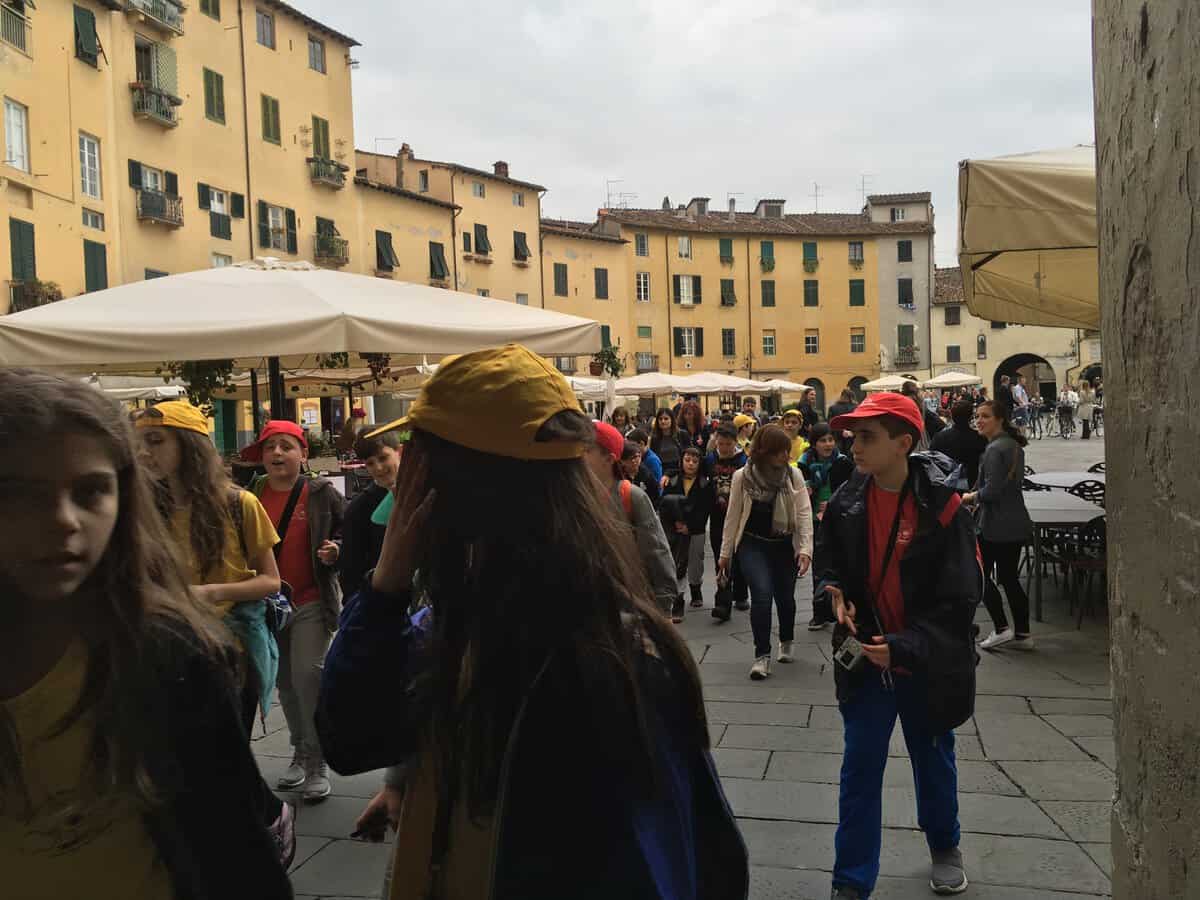
The anfiteatro is another of Lucca’s attractions. Built in the second century AD, the amphitheater’s former arena is now home to many shops and restaurants built into the ancient Roman walls, which are interesting to see from both inside and outside.

IMG_7828

IMG_7832

This Roman amphitheater once hosted games and gladiators. Now it’s a popular dining and shopping destination.

The Torre delle Ore, or clock tower, dates back to 1390. It is the tallest tower in town and has 207 wooden steps that ambitious visitors are welcome to climb.  In its early days, the time was announced by bells alone but a clock face was added in 1752.

IMG_7818

Hardy souls who climb the tower can see the hand-wound clock mechanism from the 18th century. It’s still working!

Lucca has a Puccini Museum, of course, which is at Corte San Lorenzo 9 (near the Piazza Citadella)– the composer’s birthplace. The museum features furnishings, artworks, pianos, musical scores and other personal belongings including letters and notes from and to Puccini.

Shopping seems to be a popular past time in Lucca and there is no shortage of brand names from which to choose.

IMG_7821

Lucca has plenty of stores to keep shoppers happy.

IMG_7822

This giant sewing machine is a clever advertisement for the Milanese menswear maker.

Lucca is perfectly suited to those who like to wander, and we do, but after awhile we needed a break and stopped in for a gelato at De’Coltelli, 10 Via San Paolina, www.decoltelli.it . Definitely seek this one out for their terrific artisanal gelato offered with complimentary panna (thick, sweetened whipped cream), which just adds to the deliciousness!

IMG_7815

Panna is offered free as a thank you to gelato lovers here.

If it’s a drink or coffee you crave, pop in to The Dark Side—a cool little bar at 24 Via San Frediano at the corner of Via Angillara near the Church of San Frediano.

IMG_7870

Come over to the Dark Side. You’ll be glad you did.

IMG_7839

Step inside San Frediano for the beautiful baptismal font and works by Sienese sculptor Jacapo della Quercia, Matteo Civitali, and Amico Aspertini. The stunning facade features a golden mosiac depicting the Ascension.

Although we had come in for a quick coffee, we stayed for more than a half hour. The bartender was really friendly and he gave us tastes of some popular aperitivos along with descriptions of everything we sampled.

IMG_7868

Our knowledgable and friendly bartender at the Dark Side.

The Dark Side’s complementary snacks, served with drinks, looked abundant and delicious, but we were off to Pisa.


Carneros: Art, Bubbles and Fine Dining

IMG_8382

This lovely path leads to the di Rosa Collection– one of the most extensive contemporary art collections in Northern California.

If you’re ready for a break from wine tasting and need to get off the well-trodden and always busy wine road that is Route 29, head over to the tranquil Carneros District and stop in at the di Rosa Collection. This lovely property has been open to the public since 2000, when it was incorporated as a nonprofit public trust.

IMG_8353

The Gatehouse Gallery features rotating exhibitions of contemporary art.

Rene and Veronica di Rosa’s extensive contemporary art collection includes some 2,000 works by 800 artists including Richard Shaw, Bruce Nauman, Larry Sultan, John Buck, Allan Rath, Paul Kos, Viola Frey and many others and is considered to be one of the most important collections in Northern California.

IMG_8354

Book a tour to see the entire collection both inside the buildings and around the gorgeous grounds.

The works are displayed in three buildings and throughout the property. The modern Gatehouse Gallery is home to rotating exhibitions of modern paintings, sculpture, multi-media and interactive pieces.

IMG_8373

A recent exhibition in the Gatehouse Gallery.

IMG_8377

An interactive piece lets visitors…

IMG_8355

…blow giant smoke rings!

IMG_8370

Tongue-In-Cheek, a recent exhibition at Gatehouse.

Gallery admission allows access only to the current exhibition on view in the Gatehouse and is self-guided. To experience the entire collection, set aside 1-1/2 to two hours for the superb guided tour of the outbuildings, including the chapel, and the exquisite grounds. It is best to book the guided tour in advance to avoid disappointment.

IMG_8360

Take a tour and experience the art outdoors.

You’ll likely see peacocks racing through the tall grass around many of the outdoor sculptures including, “Field Hands.” The catalog of the permanent collection, Local Color, makes a great souvenir or a gift for an art-loving friend. Click here for updated information.

IMG_8363

Outside art.

IMG_2536

Domaine Carneros is right across the road from di Rosa.

After your tour of the di Rosa Collection, go across the street to the elegant Domaine Carneros—it’s home to Tattinger’s California sparkling wines. Reservations are required.

Domaine Carneros-- Taittinger's California Sparkling Wine.

Domaine Carneros– Taittinger’s California Sparkling Wine.

There are numerous options for tasting from flights to single glasses. Take your glass out onto the beautiful terrace and enjoy the spectacular view across the vineyards of the Carneros District.

IMG_8411

Enjoy a drink in this pleasant lounge area at Farm.

One of my favorite dining destinations is in the Carneros, just a short distance away—Farm at the Carneros Inn. We have celebrated many memorable meals here and the last, which happened to be an anniversary, was no exception. Start with your libation of choice and relax outside on the comfy couches that surround the open fire. Depending on the hour, you’re likely to see children running happily around the lawn—much better here than in the dining room!

IMG_8417

The dining room is casual but elegant.

The menu at Farm changes often to reflect the restaurant’s commitment to local, seasonal and sustainable produce, fish and meat. The cuisine is contemporary Californian and the wine list draws almost entirely from California producers.

IMG_8423

The wine list focuses on Californian bottlings. Our somm gave us terrific recommendations like this Philip Staley 2012 Viognier.

Service is impeccable and the room is spare yet elegant. The restaurant is open daily for dinner only and reservations are a must.

IMG_8422

A complimentary amuse bouche began our dining adventure.

IMG_8430

Even a chicken breast is elevated to new culinary heights at Farm.

IMG_8427

The halibut was sublime.

IMG_8433

A chocolate lover’s dream dessert.

IMG_8436

A lovely finish to a beautiful meal.

The hotel also has a casual option called Boon Fly, which is open for breakfast, lunch and dinner. Reservations are only available at dinner. This is great place to stop if you want a quick and tasty lunch and are in the mood for a burger, salad or sandwich.

Mix it up a bit and add Carneros to your itinerary. You’ll be glad you did!

Note– I have updated this post to reflect the need for reservations during the current coronavirus crisis, though other elements of your visit may also  change.  Please check with individual wineries, restaurants and galleries for details and requirements.

Art and Wine in Napa Valley—A Visit to Mumm Napa and Hall Wines

A surprising number of Napa wineries also have art galleries on their premises. The Hess Collection, Clos Pegase, and Hall Wines –more on that winery later—are among our personal favorites.

IMG_8216

Mumm Napa is a great place to stop for a glass of sparkling wine and a visit to their photo gallery.

We frequently stop by Mumm Napa to see what’s new in their gallery, which features fine art photography. This time, we grabbed a glass of their California sparkling—always choosing one that is not readily available outside the winery, like the Santana or a DVX Cuvee – and headed off to see the Graham Nash photos then on view.   The primarily black and white photos focused mostly on Nash’s days as part of the band Crosby, Stills, Nash and Young.

IMG_8206

Mumm Napa’s gallery features fine art photography and exhibitions changes frequently.

IMG_8209

A color photo by singer/songwriter Graham Nash on view at Mumm Napa’s photography gallery.

Mumm’s permanent collection includes a sizable collection of Ansel Adam’s black and white photos of Yosemite and other beautiful California locations.

Mumm’s photo exhibits change frequently and you may be lucky enough to visit while they’re hosting an artist’s reception.There is no charge for admission to the Mumm gallery nor are you required to purchase wine, but why wouldn’t you? After viewing the photos, relax on their expansive verandah with another glass and enjoy the pleasant views out over the vineyards.

IMG_8210

Hall Wines has a truly marvelous contemporary art collection and they make delicious wines, too, which were two reasons we chose to stop in. Located on Route 29 in St. Helena, visitors can’t help but notice the huge metal rabbit that appears to be leaping over the vineyards (shown above).   Lawrence Argent created the sculpture. He is also the artist responsible for the gigantic red rabbit titled, “Leap,” in the Sacramento, CA airport. Hall’s owners, Kathryn and Craig Hall, were quite taken by the airport piece and had a similar one commissioned for the winery.

IMG_8476

Baldessari’s camel greets visitors to Hall Wines in St. Helena.

IMG_8477

Please don’t ride the sheep!

Guests at Hall are greeted by a whimsical flock of sheep by Francois- Xavier Lalanne and a camel sculpture by John Baldessari, both positioned close to the main entrance. Other contemporary pieces on view include a an enormous piece constructed of “temperamental” index cards by Peter Wegner and a huge wall hanging fashioned from embroidered and bedazzled textiles (read repurposed sweaters) by Nick Cave. You’ll find fiber optic art, a crazy kaleidoscope by Alyson Shotz that looks out over the vineyards behind the modern tasting facility, and many more edgy pieces to capture your imagination by highly regarded artists like Russell Crotty, Joel Shapiro, Anya Gallaccio, Jaume Plensa, Jesus Moroles, Ivan Navarro, Spencer Finch and others.

IMG_8481

Wenger’s “temperamental” index cards are prominently displayed in the visitor’s center.

IMG_8480

This piece by Nick Cave was fashioned from repurposed textiles like embellished sweaters.

Outside, you’ll find more art including a number of structures by Patrick Dougherty reminiscent of the “Big Bamboo” installation that was on display, and available for climbing, at Rome’s Macro Museum in the Testaccio during one visit. Please do not climb any of the art at Hall. There are plenty of benches to rest on to contemplate life and watch the grapes grow. There is also a barn on the property available for private functions.

IMG_8515

It’s fun to explore these “structures” on the grounds at Hall Wines.

IMG_8519

Hall hosts private events in this barn.

After touring the collection outside, head back in to the LEED® Gold certified building for what the Halls tout as #crazygoodcabernet—and it is. The attentive and very knowledgeable wine hosts will tell you everything you want and need to know about the provenance of the grapes, the processes used and the excellent wines you will taste here. There is a fee for tasting and several options are offered. Reservations are requested.

IMG_8487

Step inside the beautiful tasting room for some #crazygoodcabernet.

Hall also has a well-stocked gift shop with just about anything the wine aficionado could want, including a suitcase designed to carry those precious bottles back home on the plane.

IMG_8483

The gift shop has something for every wine fan.

Wineries cannot compete with their own distributors by discounting prices so sometimes it’s wise to wait until you get home to buy—this applies to all wineries in California. If you fall in love with a wine that’s only available at the winery, buy it! California wineries ship to most states.

Looking for more art? Click here.

Note– I have updated this post to reflect the need for reservations during the current coronavirus crisis, though other elements of a visit may also have changed.  Please check with individual wineries for details and requirements.

Art and More at Seattle’s Free Frye Museum

IMG_8920

Welcome to the Charles and Emma Frye Art Museum.

Charles and Emma Frye began collecting art in 1893 focusing primarily on French and German artists from the 19th and early 20th centuries. The couple built an impressive Founding Collection of 230 paintings, now on permanent display at their namesake museum in Seattle’s Capitol Hill area. The museum is open to the public at no charge, as the Fryes intended when they established the Charles and Emma Frye Free Public Art Museum in 1952.

IMG_8925

The museum has expanded and been updated since it opened at its current location in 1952.

The Fryes had a particular interest in German painters of the mid-19th Century Munich School including Wilhelm Leibl, Franz von Lenbach and Max Slevogt whose works, along with other prominent painters of the period, are part of the Founding Collection.

IMG_8897

Henry Raschen’s 1913 portraits of Emma and Charles Frye hang in the Frye Salon.

The Frye’s Permanent Collection includes not only those works collected by Charles and Emma, but also later acquisitions made by the Frye Foundation. These later aquisitions expanded the collection to include American artists as well as European painters other than the French and German artists the couple built their original collection upon.

IMG_8896

Acquisitions by the Frye Foundation expanded the collection to include American artists.

Gilbert Stuart and John Singleton Copley’s Colonial Period paintings hang alongside the American Realism works of Winslow Homer and Thomas Eakins. Mary Cassatt, James McNeil Whistler, and John Singer Sargent are among the ex-pat painters whose Impressionist works are displayed.

IMG_8888

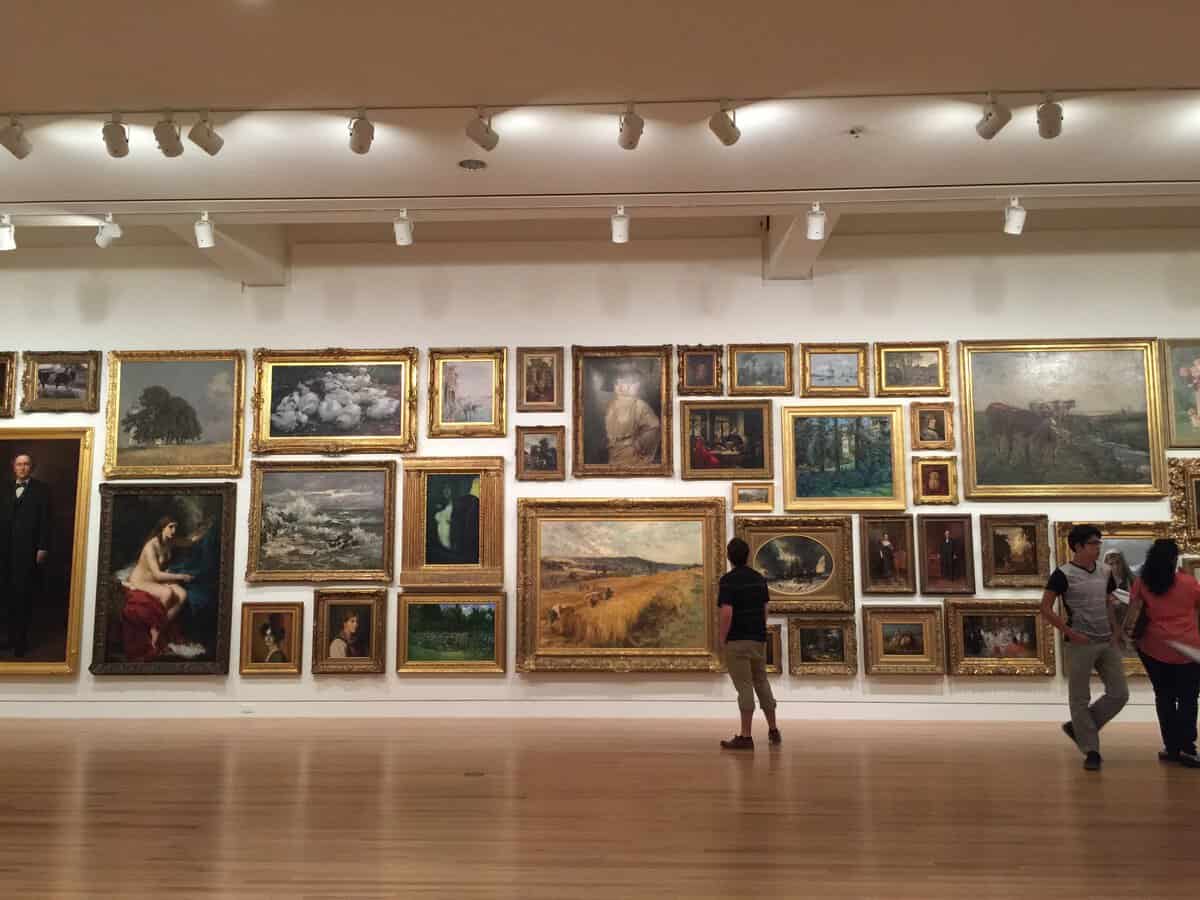
Paintings are hung as they once were in the Frye home gallery.

IMG_8891

Portrait of Chief Seattle by Henry Raschen, 1916.

The vast collection of paintings covers every wall in the Frye Salon with the works hung as they once were in the Frye’s home gallery. The Frye Salon is reminiscent of Boston’s Isabella Gardener Stewart Museum. In other words, there is not much space between the works and they are not hung in any apparent order— historical, religious and allegorical paintings hang beside portraits, landscapes and seascapes. There are several copies of a hardcover guide available to visitors in the gallery that identifies and describes each work and artist.

IMG_8902

Visitors reference gallery guide to identify paintings and artists.

IMG_8903

The helpful guide is available only in the gallery. There are several other books about the museum and its collection for sale in the shop, but not the gallery guide.

In addition to the Permanent Collection, there are several changing contemporary exhibitions.

IMG_8877

The Frye features contemporary art as well as European and American paintings from the 19th and 20th centuries.

We enjoyed the two Andy Warhol exhibitions on view during our visit. During the 1970s, Warhol recorded a reported 40,000 Polaroids documenting his personal and professional endeavors. Warhol’s Little Red Book #178 is a collection of 19 Polaroid pictures of his friends and other celebrities taken in 1970 while he made his film L’Amour.

IMG_8883

Little Red Book #178 has 19 of the reported 40,000 Polaroid photos Warhol took in the 1970s.

From 1964-1966, Warhol recorded hundreds of visitors to his studio, called The Factory, using a Bolex camera. Warhol’s 12 Screen Tests features artists and celebrities who were instructed to sit still for the length of a 16 mm film—about three minutes. Subjects featured in 12 Screen Tests include Dennis Hopper, Edie Sedgwick, Susan Sontag, Lou Reed, Bob Dylan, Marcel Duchamp and Brooke Hayward. Not everyone was capable of the task assigned. Bob Dylan’s Screen Test shows him smoking a cigarette and fidgeting throughout.

IMG_8906

Hundreds of Warhol’s Factory visitors were filmed for his series of “Screen Tests.”

IMG_8905

Subjects were meant to be still for the three minute films, but Bob Dylan fidgeted and smoked throughout his “Screen Test.”

Also on view was Structure and Ornament, a multi media exhibition of Leo Saul Berk’s work based on the iconic Chicago-area Ford House, his childhood home.

IMG_8868

Berk’s dream about sleeping on the floor at Ford House was the inspiration for “Heat Signature.”

The artist refers to his work as “a riff on the house,” which has historical significance and was designed by architect Bruce Goff. The exhibition includes the history of the home, photographs and films, along with Berk’s sculptures and other works, based upon the unique structure and the artist’s memories of living there.

IMG_8861

Leo Saul Berk’s childhood residence, the iconic Ford House, was the basis for the “Structure and Ornament” exhibition.

IMG_8876

“Cone Twelve,” Berk’s aluminum composite and stainless steel sculpture.

IMG_8865

“Mortar and Marbles” is a to-scale representation of a section of the Ford House’s curved coal walls.

We also saw American Portraits: 1880-1915– a selection of portraiture by artists whose works are included in the Founding Collection.

IMG_8907

Museum visitors relax and enjoy the “American Portraits: 1880-1915” exhibition.

The Museum has a nice little café with an outdoor garden. Sandwiches, soups, sweets and other simple but satisfying offerings are available at very reasonable prices.

IMG_8927

The Frye’s cafe has a lovely garden area and is a nice option for lunch or coffee.

On our first visit to the Frye Museum, we were told that one of the galleries was closed for yoga, but would soon reopen. While yoga is no longer offered at the museum, the Museum hosts art classes for everyone from pre-schoolers to life-long learners, Mindful Mediation on the first and third Wednesday of the month, art history lectures, jazz concerts, activities for those with memory loss and their families, film presentations and more.  Find the complete schedule here.

Charles and Emma Frye would no doubt be pleased to see their wish– that the public enjoy free access to art, that ‘perfection of good-nature,’ continues to be a reality today, thanks to their free art museum.

Written and photographed by Jeanne Neylon Decker

Protected by US Copyright Laws.

Outdoor Art at Seattle’s Olympic Sculpture Park

After a beautiful morning at Chihuly Garden and Glass and lunch at Seattle Central Armory’s Skillet Counter, we headed down to the Olympic Sculpture Park, part of the Seattle Art Museum.  On the way we passed a Duckload of friendly tourists.

Seattle's Duck Tour.

Seattle’s Duck Tour is one way to see the sights in the Emerald City.

We enjoyed the view of snowcapped Mt. Ranier in the distance and the cruise ships docked nearby.

Seattle is a popular jumping off point for Alaskan cruises.

Seattle is a popular jumping off point for Alaskan cruises.

And finally reached our destination– the Olympic Sculpture Park.

IMG_8829

All are welcome at Seattle’s Olympic Sculpture Park. Admission is free.

IMG_8821

Jaume Plensa’s 46- foot Echo, towers over visitors with her eyes closed to the sea beyond.

This beautiful urban art park was once an industrial site. Now, less than 10 years later, the nine acres on Elliott Bay is Seattle’s largest downtown green space and home to spectacular sculpture by some of the most influential and respected artists in the world including Richard Serra, Ellsworth Kelly, Alexander Calder, and Louise Nevelson.

IMG_8788

A view of Richard Serra’s Wake.

IMG_8799

It’s an entirely different visual experience to wander among the panels of Wake.

IMG_8804

Alexander Calder’s The Eagle provides a brilliant pop of color and a shady place to rest.

IMG_8810

Typewriter Eraser by Claes Oldenburg and Coosje van Bruggen must add a touch of whimsy to the daily commute.

With views toward the Olympic Mountains and Puget Sound, thought provoking and attention getting art, and its beautiful waterfront location, the award-winning Olympic Sculpture Park ought to be on your list of “must sees” in Seattle.

IMG_8802

Cargo ships glide by Bunyon’s Chess by Mark di Suvero.

Puget Sound makes a beautiful backdrop for these sculptures.

IMG_8814

di Suvero’s Schubert Sonata has a prime location.

IMG_8811

The nine-acre sculpture park has lovely wooded paths to explore.

The Olympic Sculpture Park is pedestrian and bicycle friendly, handicapped accessible, and admission is free.

IMG_8816

Roy McMakin’s Love and Loss was commissioned for the Olympic Sculpture Park.

IMG_8796

Beverly Pepper’s Perre’s Ventaglio III is right at home among the vegetation.

What a fantastic place to spend a beautiful day in Seattle! Next, dinner decisions, The Frye and we take flight to Boeing Field–a visit to the Museum of Flight.

Note: Banner image is Louise Bourgeois’s Father and Son. Each figure is in turn concealed and revealed by the water in which they stand, separated, arms outstretched.

Seattle: Whirlwind Weekend in the Emerald City

Art, food and fun highlighted our three-day weekend in the Emerald City. We started off our Saturday morning with a monorail ride from the central shopping area to the Center City area, home of the iconic Space Needle. The monorail, which was built for the 1962 World’s Fair, costs just $4.00 and is only $2.00 for seniors, children under 12, disabled, and active duty military.

IMG_8615

It’s a quick but fun ride on Seattle’s monorail.

The trip takes only minutes between Westlake Center Station at 5th and Pine Streets and The Seattle Center Station. Purchase your ticket at the kiosk or from the cashier as you enter the train. The monorail runs every 10 minutes or so from 8:30 a.m. on weekends (7:30 a.m. during the week) and closes between 9 p.m. and midnight, depending on the date and what’s happening downtown. Be sure to check the schedule.

IMG_8777

Sonic Bloom greets visitors walking to EMP or Chihuly Garden and Glass. The “sunflowers” move and emit sound.

The monorail drops you off steps from at the Space Needle, Chihuly Garden and Glass and MoPOP Museum (Museum of Pop Culture).

Seattle's iconic Space Needle was built for the 1962 World's Fair.

Seattle’s iconic Space Needle was built for the 1962 World’s Fair.

We’d been to the Space Needle on previous visits so headed right to the Chihuly Garden and Glass.

IMG_8698

There’s a reason Chihuly Garden and Glass is on everyone’s Top 10 list. Don’t miss it!

We should have bought our tickets online—the lines were long for the cashiers inside and at the outdoor kiosks, and cost more than the online price. Plan ahead! Once you have your ticket and have reached the admission area, ask to have your arm stamped so that you can return in the evening to view these magnificent glass works illuminated. The sun sets quite late in Seattle during the summer months so keep that in mind when planning your return visit.

IMG_8643

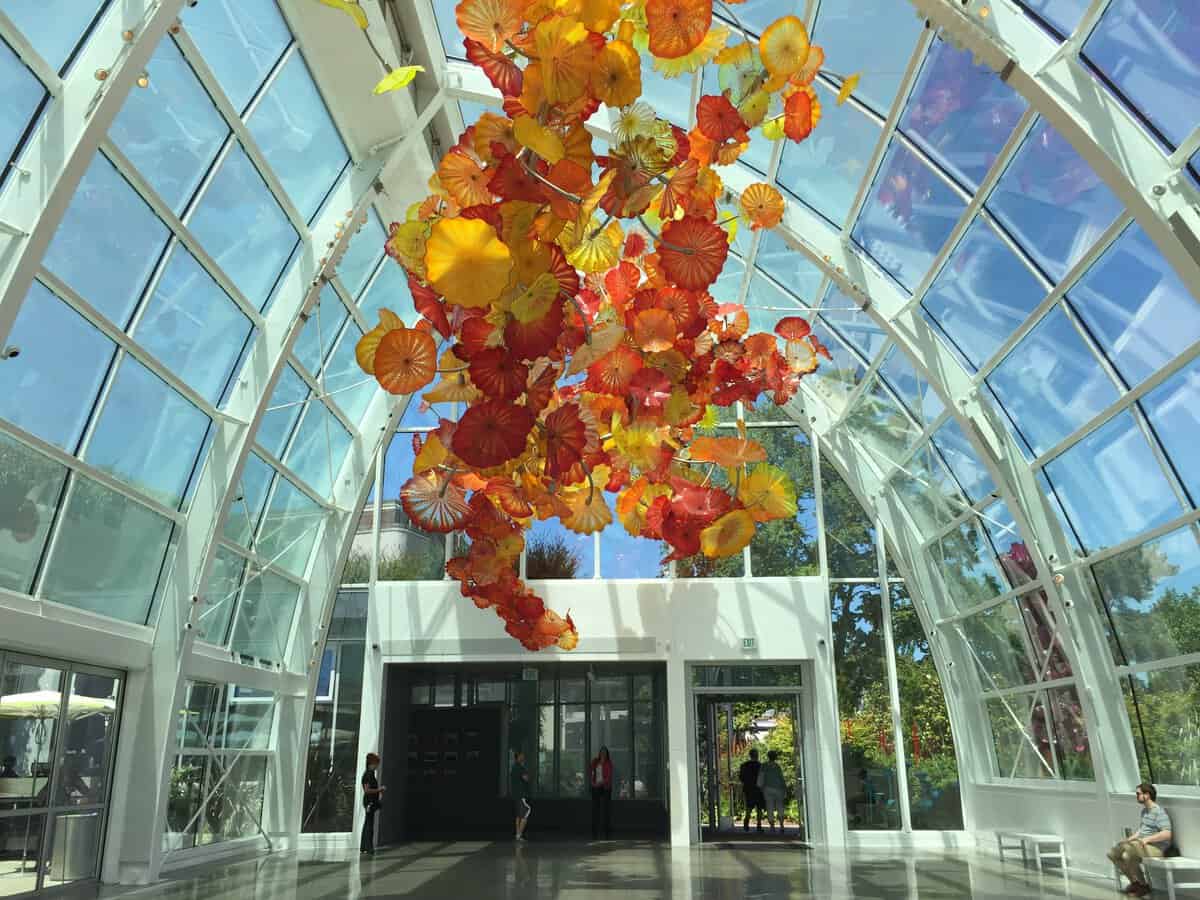
Prepare to be amazed.  Detail of Chihuly’s Sealife Tower.

The Chihuly Garden and Glass is included in Seattle’s City Pass so if you plan to visit more than one of the included attractions—yes, the Space Needle is one of them—you may want to opt for the City Pass. You’ll save money and time since you won’t wait on line.

IMG_8636

Tabac Basket in the Northwest Room.

Once inside, be prepared to be awed. There is a reason Chihuly Garden and Glass is on everyone’s “must see” list. We heard more than a few “wows” as soon as we stepped into the first gallery. Dale Chihuly’s glass art works are artistic, whimsical and beyond stunning.

IMG_8675

Mille Fiori– A thousand flowers- delight the senses.

These photos cannot capture the splendid forms, movement, intricacy and vibrant colors in Chihuly’s work but they do give an hint of what you’ll experience at Chihuly Garden and Glass.  It is a magical place.

IMG_8656

Persian Ceiling floods the room with color from above.

It seems as you move from gallery to gallery the works get progressively more beautiful and intricate.   The lighting, staging and even the music in the galleries combine to create a magnificent experience.

IMG_8754

Ikebana and Float Boats capture the viewer’s imagination.

A stroll through the gorgeous gardens is another delight. The art is so beautifully integrated in the various plantings that you’ll want to linger.

IMG_8722

A view in the garden.

IMG_8723

IMG_8727

Northwest timber is integrated in the glass garden.

IMG_8731

We had the added benefit of a spectacular day—clear, blue skies and temperatures in the mid-70s.  The soothing background music being performed by a gentleman playing the Eyhu on the street just outside the garden added to our enjoyment.

IMG_8765

Soothing music further enhanced our enjoyment of the gardens.

The works on display are included in a fairly comprehensive catalog titled, Chihuly Garden and Glass, available in the gift shop in the lobby.  It is one of many available volumes featuring Mr. Chihuly’s art. In addition to the usual museum gift shop items like books and calendars featuring the artist’s work, original pieces of Chihuly’s glass art are also on offer.

IMG_8779

This is no ordinary gift shop.

IMG_8781

A spectacular souvenir.

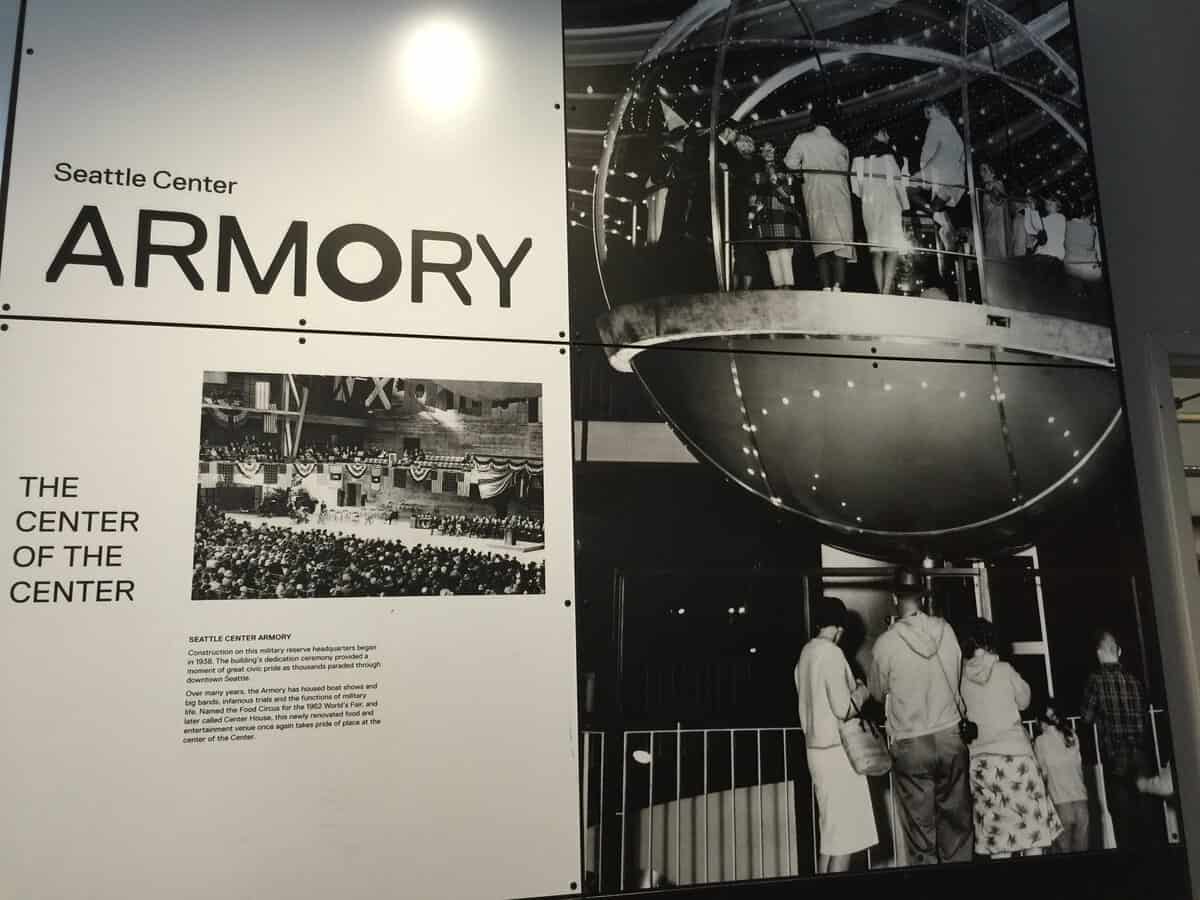
If you’ve worked up an appetite after your stroll through the garden, head over to the Seattle Center Armory a few steps away. Originally built in 1939 to house the 146th artillery and its half-ton tanks, it was repurposed for the 1962 World’s Fair and became the city’s first vertical shopping mall, called the Food Circus.

IMG_8775

Once home to an artillery unit and half-ton tanks, the Armory now features food and family fun.

Today, in addition to a public space that hosts more than 3,000 free family entertainment and cultural events each year, you’ll find a food court that’s got something for everyone. Though Starbuck’s and Subway do have a presence here, they share the main floor with more interesting offerings from the likes of Eltana’s Wood- Fired Bagel Café, Seattle Fudge, MOD Pizza, Kabab, Cool Guys Fry Bar, Ceres Roasting Company, Bigfood BBQ, Quincy’s (burgers and seafood) , Blue Water Taco, Plum Pantry (vegan and organic selections), The Confectional and Skillet Counter.

IMG_8770

The Seattle Center Armory is a busy place at lunchtime.

Mediterranean street food, beef baracoa, fish tacos, Belgian style fries, individual cheesecakes, pizza, vegan fare, and a terrific fried chicken sandwich are among the tantalizing possibilities we deliberated for lunch.

IMG_8769

So many choices…

We chose Skillet Counter where the Fried Chicken Sammy with a fennel seed crust, kale, and jalapeno aioli on a potato roll called out to my traveling companions. I had a delicious curried carrot soup and a salad. We met Chef Mike “Mookie” who kindly shared his recipe for the soup and the aioli. Looking forward to whipping up some of that at home!

IMG_8773

Skillet Counter’s Chef Mike aka “Mookie”

If you’ve got little ones in tow—you’re in luck—Seattle’s Children’s Museum is just downstairs. Here you’ll find interactive exhibitions, hands on, and age appropriate activities for children ages 10 months to 10 years.

IMG_8776

Seattle Children’s Museum is lots of fun for the little ones.

IMG_8784

After our satisfying lunch at Skillet Counter, we headed down towards Elliott Bay to the Olympic Sculpture Park, part of the Seattle Art Museum.  So much to see and do in the Emerald City!

Written and photographed by Jeanne Neylon Decker

Protected by US Copyright Laws.

Note: Things change.  Please be sure to verify opening times and pricing for any and all places and activities mentioned.

Hats Off to Degas–Lucas Shakes Things Up at SF’s Legion of Honor

Note: This exhibition has closed!

San Francisco’s venerable Palace of Legion of Honor, part of the city’s Fine Arts Museums, is currently hosting the very popular Degas, Impressionism and the Paris Millinery Trade.

The extensive exhibition focuses on the impact of the millinery trade in Paris during the Belle Epoch era on the work of Degas and his contemporaries.  Paintings and pastels by Degas, Renoir, Edouard Manet, Mary Cassatt, Toulouse- Lautrec and others, some never before shown in the U.S., are featured. In addition to the splendid impressionist paintings, included in the exhibition are 40 marvelous examples of millinery from that time period—in other words—hats!

Hats featuring flowers were popular in the 19th and 20th centuries. Silk, cotton, velvet and paper were all used to construct artificial flowers like those shown here.
Some patrons were definitely in the spirit of things.

These hats range in size and complexity from the sublime to over the top. One chapeau is topped with an entire owl, which had been preserved specifically for that purpose. There are plumes, beads, metallic wire, ribbons and flowers adorning these mostly enchanting toppers.

Plumage from domestic and exotic birds, including ostrich and owls, often were used to embellish luxury ladies’ hats.

These hats all sport fashionable feathers. The hat on the left features a complete owl while the one on the right has an African starling above its brim.

A visitor admires Manet’s “At the Milliner’s”–one of about 40 paintings and pastels in the exhibition.

Men’s hats are included in the exhibit too. There are fine examples including boater and bowler hats, along with a sketch of Degas himself in a top hat.

Bowlers and top hats, along with carrying cases, are part of the exhibit.

The 42 year-old Edgar Degas is shown here wearing a top hat.

The exhibition was quite crowded, mostly with ladies of a certain age, oohing and ahhing over the millinery creations. There were a few patrons sporting hats and we spotted several of the museum’s docents in the spirit of things– wearing lovely fascinators.

Feathered finery got a lot of attention from visitors.

We didn’t take a docent-guided tour but shared our table at lunch with a group of ladies from the San Jose area who had and raved about it. It is necessary to reserve a spot for a guided tour in connection with this exhibit.

This docent wears a fine fascinator for her presentation. Reservations for the free tours are essential for this exhibition.

Some of the Impressionist paintings in this exhibition have not been shown in the U.S. before.

Special exhibition tickets are required for the Degas exhibit, in addition to the general admission fee for the museum. This doesn’t seem to be keeping the crowds away at all downstairs. There were numerous tour groups vying to get close to the works during our midweek trip to the Legion of Honor.

Special exhibition tickets are required, in addition to general admission. The galleries became quite crowded at times.

Upstairs in the galleries featuring Rodin’s classic sculpture, visitors can enjoy near solitude—at least during our visit. Displayed with the August Rodin: The Centenary Installation, which honors the 100th anniversary of the artist’s death, you’ll find the provocative work of Sarah Lucas. Sarah Lucas:Good Muse is the first major exhibition of the UK artist’s work in the U.S.

The museum is best known for its ancient and classical European collections which includes paintings, sculpture, furnishings and porcelain.

Sarah Lucas’ work brings contemporary art and controversy to the Legion of Honor.

Sarah Lucas:Good Muse would probably be much more comfortable at the SFMOMA (SF Museum of Modern Art) than at the classically- focused Legion of Honor. The docent who provided a tour of the exhibition shared that many patrons and members of the museum were more than a little unhappy with Lucas’ work.

Giant plaster cast boots, soft sculptures and a series of Lucas’ yellow urinal sculptures are on display among the 50 bronze, plaster and marble works by Rodin.

Lucas’ sculptures, made from plaster, panty hose, florescent lights, a bedspring and mattress, cigarettes and other materials, allude to sexual interactions, availability, empowerment, and domestic responsibilities, according to the docent. She also pointed out examples where Rodin’s work related to the themes of Lucas’ pieces.

“Washing Machine Fried Eggs” invites discussion of women’s sexual and domestic roles.

Apparently the artist wanted to “bring color” to the galleries and chose to include a series of yellow urinal sculptures displayed atop small refrigerators, placed among Rodin’s classic sculpture. We found the juxtaposition interesting but could easily understand the contretemps. At the entrance to the galleries where Lucas’ work is displayed, there are signs warning that the art may not be appropriate for all viewers. We have chosen not to include photos of the most controversial work for that reason.

Electricity in this piece “keeps the energy up” according to the artist.

Degas, Impressionism and the Paris Millinery Trade closes September 24 and Sarah Lucas: Good Muse closes September 17. Go see these very different exhibitions for yourself and let us know what you think. A day at the Palace of Legion of Honor is always a day well spent.